Latest Post
Showing posts with label PARTICLE PHYSICS. Show all posts

Searching for dark energy with neutrons: With neutrons, scientists can now look for dark energy in the lab

Written By Unknown on Thursday, January 15, 2015 | 1:55 AM

Neutrons between parallel plates can test hypothetical forces in the universe. Credit: TU Vienna
It does not always take a huge accelerator to do particle physics: First results from a low energy, table top alternative takes validity of Newtonian gravity down by five orders of magnitude and narrows the potential properties of the forces and particles that may exist beyond it by more than one hundred thousand times. Gravity resonance spectroscopy, a method developed at the Vienna University of Technology, is so sensitive that it can now be used to search for Dark Matter and Dark Energy.

All the particles we know to exist make up only about five per cent of the mass and energy of the universe. The rest -- "Dark Matter" and "Dark Energy" -- remains mysterious. A European collaboration led by researchers from the Vienna University of Technology has now carried out extremely sensitive measurements of gravitational effects at very small distances at the Institut Laue-Langevin (ILL) in Grenoble. These experiments provide limits for possible new particles or fundamental forces, which are a hundred thousand times more restrictive than previous estimations.

Undiscovered Particles?

Dark matter is invisible, but it acts on matter by its gravitational pull, influencing the rotation of galaxies. Dark energy, on the other hand, is responsible for the accelerated expansion of the universe. It can be described by introducing a new physical quantity -- Albert Einstein's Cosmological Constant. Alternatively, so-called quintessence theories have been put forward: "Perhaps empty space is not completely empty after all, but permeated by an unknown field, similar to the Higgs-field," says Professor Hartmut Abele (TU Vienna), director of the Atominstitut and group leader of the research group. These theories are named after Aristotle's "quintessence" -- a hypothetical fifth element, in addition to the four classical elements of ancient Greek philosophy.

If new kinds of particles or additional forces of nature exist, it should be possible to observe them here on earth. Tobias Jenke and Hartmut Abele from the Vienna University of Technology developed an extremely sensitive instrument, which they used together with their colleagues to study gravitational forces. Neutrons are perfectly suited for this kind of research. They do not carry electric charge and they are hardly polarizable. They are only influenced by gravity -- and possibly by additional, yet unknown forces. Theoretical calculations analysing the behaviour of the neutrons were done by Larisa Chizhova, Professor Stefan Rotter and Professor Joachim Burgdörfer (TU Vienna). U. Schmidt from Heidelberg University and T. Lauer from TU Munich contributed with an analytic tool.

Forces at Small Distances

The technique they developed takes very slow neutrons from the strongest continuous ultracold neutron source in the world, at the ILL in Grenoble and funnels them between two parallel plates. According to quantum theory, the neutrons can only occupy discrete quantum states with energies which depend on the force that gravity exerts on the particle. By mechanically oscillating the two plates, the quantum state of the neutron can be switched. That way, the difference between the energy levels can be measured.

"This work is an important step towards modelling gravitational interactions at very short distances. The ultracold neutrons produced at ILL together with the measurement devices from Vienna are the best tool in the world for studying the predicted tiny deviations from pure Newtonian gravity," says Peter Geltenbort (ILL Grenoble).

Different parameters determine the level of precision required to find such tiny deviations -- for instance the coupling strength between hypothetical new fields and the matter we know. Certain parameter ranges for the coupling strength of quintessence particles or forces have already been excluded following other high-precision measurements. But all previous experiments still left a large parameter space in which new physical non-Newtonian 
phenomena could be hidden.

A Hundred Thousand Times Better than Other Methods

The new neutron method can test theories in this parameter range: "We have not yet detected any deviations from the well-established Newtonian law of gravity," says Hartmut Abele. "Therefore, we can exclude a broad range of parameters." The measurements determine a new limit for the coupling strength, which is lower than the limits established by other methods by a factor of a hundred thousand.

Even if the existence of certain hypothetical quintessence particles is disproved by these measurements, the search will continue as it is possible that new physics can still be found below this improved level of accuracy. Therefore, Gravity Resonance Spectroscopy will need to be improved further -- and increasing the accuracy by another few orders of magnitude seems feasible to the Abele's team. However, if even that does not yield any evidence of deviations from known forces, Albert Einstein would win yet another victory: his cosmological constant would then appear more and more plausible.

Strange materials cropping up in condensed matter laboratories

Written By Unknown on Wednesday, January 14, 2015 | 9:12 PM

A conformal field theory in condensed matter (labelled CFT) gets a hand from string theory – the string theory hand has an extra dimension and a black hole in it. Credit: Image courtesy of Perimeter Institute for Theoretical Physics
Subir Sachdev, William Witczak-Krempa, and Erik Sørensen are condensed matter physicists. They study exotic but tangible systems, such as superfluids. And their latest paper about one such system has a black hole in it.

How did a black hole get into a condensed matter paper? "Well, it's a long story," says Sachdev, who is a professor at Harvard and a Distinguished Visiting Research Chair at Perimeter Institute.

It's a long story, he might add, that in a way starts with him: he was one of the first condensed matter physicists to venture into the strange land of string theory, where the black holes live. But that is getting ahead of the tale.

"Let's start here," Sachdev says. "Condensed matter physicists study the behaviour of electrons in many materials -- semiconductors, metals, and exotic materials like superconductors."

Normally, these physicists can model the behaviour of a material as if electrons were moving freely around inside it. Even if that's not what's actually happening, because of complex interactions, it makes the model easy to understand and the calculations easier to do. Electrons (and occasionally other particles) used in this kind of short-hand model are called quasi-particles.

However, there are a handful of systems that cannot be described by considering electrons (or any other kind of quasi-particle) moving around.

"What we try to do is understand a quantum system where you have electricity without electrons," says Sachdev. "Of course, the system does have electrons in it, but the behaviour of the system doesn't look like electrons moving at all. What you see is not even particles, but some lumps of quantum excitations that are doing strange quantum things."

"Without quasi-particles, it's a mess," says William Witczak-Krempa. Witczak-Krempa, a Perimeter postdoctoral fellow, is also a condensed matter theorist who collaborated with Sachdev on the paper. "It's this quantum fuzzball of stuff."

Describing such a fuzzball system is a challenge -- but it's crucial to understanding many modern materials, including superfluids and high-temperature superconductors. The broad problem of how to model systems without quasi-particles has been stumping condensed matter theorists for decades.

"What we decided to do was look at a simple case of such an electricity-without-electrons system," says Witczak-Krempa. "That turns out to be a quantum phase transition between a superfluid and an insulator."

A fair amount of work had been done on such systems, such that the team was able to make progress modelling the system using the traditional mathematical tools of condensed matter. Sachdev and Witczak-Krempa worked with Erik Sørensen of McMaster University on this aspect of their paper. Sørensen used a computer simulation -- specifically, a quantum Monte Carlo simulation -- to predict how conductivity should change with temperature and frequency as a superfluid turns into an insulator.

"This frequency dependence tells us how the quantum fluid behaves in time. This dynamic behaviour is notoriously hard to study using standard methods, including quantum Monte Carlo simulations," says Witczak-Krempa. "Erik's work was a huge computational achievement. It took months of processing time. And, in the end, the results still needed to be converted into a form that can be compared with experiments. This is where we tried something new."

To perform this conversion, Sachdev and Witczak-Krempa tackled the same system from a different angle: string theory. (Here, they build on Sachdev's previous work with Perimeter Faculty member Robert Myers and one of his graduate students, Ajay Singh.) One of the pillars of string theory is that certain quantum field theories (technically known as conformal field theories) can be translated into a theory of gravity with one extra dimension.
Sachdev explains where the extra dimension comes in. Wiggling his fingers above the tabletop, he conjures strings moving through the air.

"In certain configurations, the strings all end on a kind of membrane," he says, tapping his fingertips on the table's surface. "You might ask yourself: if you were living on the membrane [the table surface] -- and you didn't know about the extra dimensions where the strings were, what would you see?"

He answers himself: "Only the ends of the strings. They would look like particles. What's amazing is that string theorists found that the theories that you'd use to define the ends of the strings on the membrane are remarkably like the theory we want to use to describe our system."

The quantum field theory describing Sachdev and Witczak-Krempa's "fuzzball" system shares many fundamental properties with the conformal field theories associated with string theory -- so many that the researchers were able to map the two-dimensional field theory into a three-dimensional theory of gravity.

"We ended up studying the physics of this alternate reality," says Witczak-Krempa. "Using this technique, we were able to translate a very hard problem into a fairly easy one." Albeit a fairly easy problem involving a black hole.

"We wanted to look at the physics of the boundary -- the physics at the table top," says Witczak-Krempa. "But we wanted to heat it up a bit -- give it a finite temperature. It turns out that the natural way of doing this is to invoke a black hole." Really?

"There are various ways of developing an intuition about that," he says. "For instance, you can remember that the black hole will release Hawking radiation. The Hawking radiation escapes and eventually hits the boundary where the system lives, and heats it up."

Witczak-Krempa admits it's unorthodox: "Most condensed matter people would go: 'Why is there a black hole in this paper?' It's crazy. But what's even crazier is that this mathematical machinery works quite well. It gives you answers that make a lot of sense. You can compare them directly with Erik's Monte Carlo results, and they check out."

It's the first time results from a traditional large-scale condensed matter simulation have been compared to results from the new string theory approach.

Sachdev is cautiously thrilled: "There are a couple of issues we don't fully understand and one discrepancy we wish we understood better, but in general it's worked extremely well. It's progress on something I've been thinking about for more than 20 years. And now we finally have a theory that is perhaps not complete, but is encouragingly successful."

What's more, string theory has finally produced a set of physical predictions that experimentalists can go check. Sachdev and Witczak-Krempa are hoping that an experimental team will try soon.

"Let's see what happens," says Sachdev. "We're pushing string theory to a new regime. Whatever happens, we will learn more."

Turning the Moon into a cosmic ray detector

Written By Unknown on Sunday, January 4, 2015 | 4:46 AM

Artists rendition of the SKA. Credit: SKA Organisation
Scientists from the University of Southampton are to turn the Moon into a giant particle detector to help understand the origin of Ultra-High-Energy (UHE) cosmic rays -- the most energetic particles in the Universe.

The origin of UHE cosmic rays is one of the great mysteries in astrophysics. Nobody knows where these extremely rare cosmic rays come from or how they get their enormous energies. Physicists detect them on Earth at a rate of less than one particle per square kilometre per century.

Dr Justin Bray, a Research Fellow in Cosmic Magnetism at the University of Southampton, is lead author of a proposal to use the Square Kilometre Array (SKA), set to become the largest and most sensitive radio telescope in the world, to detect vastly more UHE cosmic rays by using the Moon as a giant cosmic ray detector.

On Earth, physicists detect these high-energy particles when they hit the upper atmosphere triggering a cascade of secondary particles that generate a short and faint burst of radio waves only a few nanoseconds long.

It is this signal that astronomers hope to pick up from the Moon, but as these signals are so short and faint no radio telescope on Earth is currently capable of picking them up.
With its large collecting area and high sensitivity, the SKA will be able to detect these signals using the visible lunar surface -- millions of square kilometres -- giving the researchers access to more data about UHE cosmic rays than they have ever had before.

The current largest detector on Earth is the Pierre Auger Observatory in Argentina that covers an area of 3,000 square kilometres, about the size Luxembourg. The SKA will be more than 10 times larger (33,0000 square kilometres) and researchers hope to detect around 165 UHE cosmic rays a year from the Moon compared to the 15-a-year currently observed.

Dr Bray announced details of the project at a major SKA conference in Italy.. He says: "Cosmic rays at these energies are so rare that you need an enormous detector to collect a significant number of them -- but the moon dwarfs any particle detector that has been built so far. If we can make this work, it should give us our best chance yet to figure out where they're coming from."

Dr Bray is working with Professor Anna Scaife, also from Physics and Astronomy at the University of Southampton, who leads the development of the SKA's Imaging Pipeline as part of the Science Data Processor (SDP) work package consortium.

Professor Scaife says: "Defining science goals for the telescope is crucial for ensuring that the appropriate technical capabilities are considered during the design phase."

Using a network of radio antennas in the Southern hemisphere, the SKA will advance our understanding of how the Universe evolved and challenge Einstein's theory of relativity. With receivers across Australia and Africa, its dishes and antennas will provide detailed information on the large scale 3D structure of the Universe.

When operational in the early 2020's, the SKA radio telescope will produce more than 10 times the current global traffic of the Internet in its internal telecommunications system. To play back a single day's worth of SKA data on an MP3 player would take about two million years.

Source: University of Southampton

Hunt for Big Bang particles offering clues to the origin of the universe

Written By Unknown on Monday, December 29, 2014 | 5:50 AM

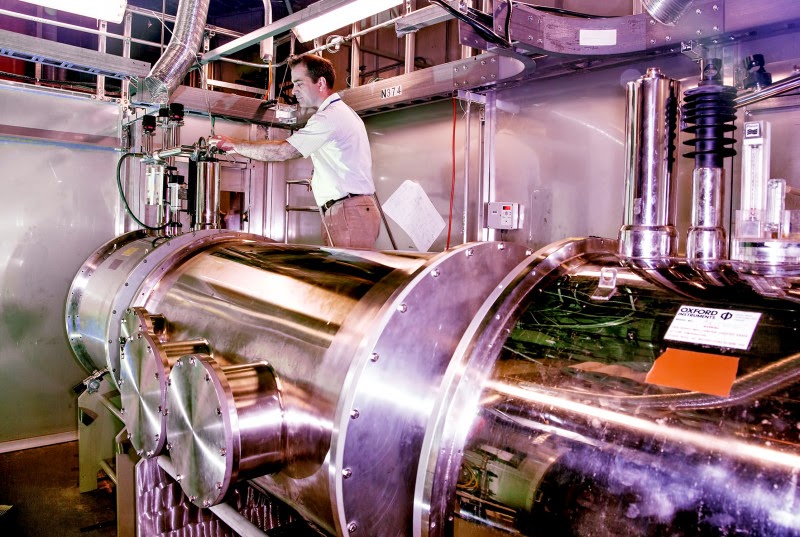
Chris Tully makes an adjustment to the PTOLEMY prototype.
Credit: Elle Starkman/PPPL Office of Communications
Billions upon billions of neutrinos speed harmlessly through everyone's body every moment of the day, according to cosmologists. The bulk of these subatomic particles are believed to come straight from the Big Bang, rather than from the sun or other sources. Experimental confirmation of this belief could yield seminal insights into the early universe and the physics of neutrinos. But how do you interrogate something so elusive that it could zip through a barrier of iron a light-year thick as if it were empty space?

At the U.S. Department of Energy's Princeton Plasma Physics Laboratory (PPPL), researchers led by Princeton University physicist Chris Tully are set to hunt for these nearly massless Big Bang relics by exploiting a curious fact: Neutrinos can be captured by tritium, a radioactive isotope of hydrogen, and provide a tiny boost of energy to the electrons -- or beta particles -- that are emitted in tritium decay.

Tully has created a prototype lab at PPPL to detect Big Bang neutrinos by measuring the extra energy they impart to the electrons -- and to achieve this with greater precision than has ever been done before. Spotting these neutrinos is akin to "detecting a faint heartbeat in a sports arena filled to the brim" said Charles Gentile, who heads engineering for the project, which Tully has dubbed PTOLEMY for "Princeton Tritium Observatory for Light, Early Universe Massive Neutrino Yield." Ptolemy was an ancient Greek astronomer who lived in Egypt during the first century.

Darkest, coldest conditions achievable

The task calls for measuring the energy of an electron with a precision comparable to detecting the mass of a neutrino, which until recently was thought to have no mass at all. Such measurements require the darkest, coldest conditions achievable in a laboratory and the use of quantum electronics -- a discipline that deals with the effect of quantum mechanics on the behavior of electrons in matter -- to detect the minute extra energy that a Big Bang neutrino would impart. Quantum mechanics describes the motion and direction of subatomic particles.

Why is the energy that a Big Bang neutrino provides so extraordinarily small? What's unique about these relics is that their wavelength has been stretched and cooled as the space-time we live in has expanded over approximately 13.7 billion years. This expansion has cooled a tremendous number of neutrinos to temperatures that are billions of times colder, and therefore less energetic, than those of neutrinos originating from the sun. When tritium captures these cold neutrinos, they create a narrow peak in energy that is just above the maximum energy of an electron from tritium decay.

The difficulty in identifying a Big Bang relic doesn't end there. Since neutrinos can take different forms, the height of the peak could be higher or lower by a factor of two, depending on whether the neutrino is like normal matter with a corresponding particle of antimatter -- an antineutrino -- or whether the neutrino is different and is in fact its own antiparticle. The extra height might not appear at all if neutrinos decay over billions of years into yet unknown, lighter particles.

Cutting-edge technology

Tully aims to show that the prototype for PTOLEMY, which is housed in a basement site at PPPL, can indeed achieve the precision needed to detect Big Bang neutrinos. The cutting-edge technology could then become the basis for a major experiment at PPPL to test long-held assumptions about the density of Big Bang neutrinos throughout the universe.

Confirming the assumptions could validate the standard model of the origin of the universe, Tully says, while refuting them could overturn the model and prompt new ideas about the Big Bang and its aftermath. Finding the neutrinos could also show if they could be a source of the invisible dark matter that scientists say makes up 20 percent of the total mass of the universe.

Such discoveries could be epochal. Could the project "make long-term contributions to the understanding of the universe?" Tully asks in presentations about PTOLEMY. "Absolutely!" he says. "We believe that we live in a sea of 14 billion-year-old neutrinos all around us. But is it true?"

The prototype at PPPL may hold the key to finding out. The device consists of a pair of superconducting magnets connected to opposite ends of a five-foot cylindrical vacuum chamber. A source containing a tiny bit of tritium sits inside one end of the chamber, with a calorimeter that Argonne National Laboratory is providing to measure electron energy set at the other end. The experiment will bind electrons from the tritium decay to magnetic field lines and pass them through filters in the vacuum chamber that will remove all but the highest-energy electrons, which the calorimeter will then measure.

Preventing "noise"

Great care will be taken to keep random thermal "noise" from disrupting the finely tuned equipment at each end of the experiment. Researchers will deposit the tritium on the nanomaterial graphene -- a layer of carbon just one atom thick -- to ensure that the electrons come off cleanly into the vacuum.

The calorimeter at the other end of the chamber will be connected to a dilution refrigerator set at between 70 and 100 millikelvins, a temperature 20 times colder than deep space and less than one-tenth of a degree above absolute zero. This deep-freeze will keep the calorimeter poised between a superconducting state -- one in which electrons can flow with virtually no resistance -- and a non-superconducting state with resistance to the flow of electrons. The delicate balance between these two states, combined with extremely low noise conditions achievable only with quantum electronics, will provide the sensitivity needed to precisely measure the energy of an electron that impinges upon the calorimeter. The setup will produce "the most precise electron-energy measurements ever made using calorimeter techniques," Tully said.

This experiment is "a perfect match for the competencies and capabilities that exist at PPPL," said Adam Cohen, deputy director for operations at PPPL and supervisor of the PTOLEMY project. Such qualities include know-how in handling tritium, a laboratory for synthesizing nanomaterial, decades of experience operating magnets and vacuum vessels, and space for an expanded experiment. "Chris and I talked about collaboration between PPPL and the University about three years ago," Cohen recalled. "Every time we pursue an activity with the campus it strengthens the bridge that exists between us."

Cross-fertilization

Looking ahead, Cohen sees PTOLEMY attracting new students, researchers and visitors, along with experts in high-energy physics, to PPPL. This could produce cross-fertilization with the Laboratory's core mission of advancing fusion and plasma science, he said.

 
Support : Creating Website | Johny Template | Mas Template
Copyright © 2011. The planet wall - All Rights Reserved
Template Created by Easy Blogging Published by Mas Template
Proudly powered by Blogger