Latest Post
Showing posts with label DARK MATTER. Show all posts

Astronomers discover a replica solar system

Written By Unknown on Thursday, January 29, 2015 | 1:00 AM

This image shows Kepler-444 and its five orbiting planets. (Courtesy of Peter Devine and Tiago Campante/University of Birmingham)
Scientists have located an ancient solar system, dating back to the dawn of the galaxy, which appears to be a miniature version of the inner planets in our own solar system.

An international research group, including Yale University professors of astronomy Sarbani Basu and Debra Fischer, announced the discovery Jan. 27 in The Astrophysical Journal. The findings are the result of observations made by the NASA Kepler spacecraft over a period of four years.

The old, Sun-like star, named Kepler-444, has five orbiting planets with sizes between those of Mercury and Venus. Kepler-444 formed 11.2 billion years ago, when the universe was less than 20% of its current age. This makes Kepler-444 the oldest known system of terrestrial-sized planets. The Kepler-444 system was already older than our own solar system is today when our Sun and planets were born.

“This system shows that planet formation could take place under very different conditions from the ones in which our solar system was formed and has implications for estimating the total number of planets in our galaxy, and other galaxies,” Basu said.

The five planets in the Kepler-444 system have orbits that are equivalent to less than one-tenth of Earth’s distance from the Sun. The Kepler-444 planets are rocky and Earth-like, but their exact compositions are uncertain.

The scientists carried out their research using asteroseismology — listening to the host star’s natural resonances, which are caused by sound trapped within it. These oscillations lead to miniscule changes or pulses in the star’s brightness, allowing researchers to measure the star’s diameter, mass, and age. The planets were then detected from the dimming that occurs when the planets transited, or passed across, the stellar disc. This fractional fading in the intensity of starlight enabled scientists to measure accurately the sizes of the planets relative to the size of the star.

“There are far-reaching implications for this discovery,” said lead author Tiago Campante of the University of Birmingham (U.K.). “We now know that Earth-sized planets have formed throughout most of the universe’s 13.8-billion-year history, which could provide scope for the existence of ancient life in the galaxy.”

The research collaboration involved nearly two-dozen institutions in the United States, England, Denmark, Portugal, Australia, Germany, and Italy.

Source: Yale university

Tail discovered on long-known asteroids

Written By Unknown on Monday, January 26, 2015 | 7:48 PM

The faint tail can be seen in active asteroid 62412. Image courtesy of Scott Sheppard
Washington, D.C.--A two-person team of Carnegie's Scott Sheppard and Chadwick Trujillo of the Gemini Observatory has discovered a new active asteroid, called 62412, in the Solar System's main asteroid belt between Mars and Jupiter. It is the first comet-like object seen in the Hygiea family of asteroids. Sheppard will present his team's findings at the American Astronomical Society's Division of Planetary Sciences meeting and participate today in a press conference organized by the society.

Active asteroids are a newly recognized phenomenon. 62412 is only the 13th known active asteroid in the main asteroid belt. Sheppard and Trujillo estimate that there are likely about 100 of them in the main asteroid belt, based on their discovery.

Active asteroids have stable orbits between Mars and Jupiter like other asteroids. However, unlike other asteroids, they sometimes have the appearance of comets, when dust or gas is ejected from their surfaces to create a sporadic tail effect. Sheppard and Trujillo discovered an unexpected tail on 62412, an object which had been known as a typical asteroid for over a decade. Their findings reclassify it as an active asteroid. The reasons for this loss of material and subsequent tail in active asteroids are unknown, although there are several theories such as recent impacts or sublimation from solid to gas of exposed ices.

"Until about ten years ago, it was pretty obvious what a comet was and what a comet wasn't, but that is all changing as we realize that not all of these objects show activity all of the time," Sheppard said.

In the past, asteroids were thought to be mostly unchanging objects, but an improved ability to observe them has allowed scientists to discover tails and comas, which are the thin envelope of an atmosphere that surrounds a comet's nucleus.

"We're actually looking anew through our deep survey at a population of objects that other people cannot easily observe, because we're going much deeper," Sheppard said, explaining why they were able to see that 62412 was active when it had been considered a typical main belt asteroid for 15 years.;

Discoveries such as this one can help researchers determine the processes that cause some asteroids to become active. Sheppard will discuss his and Trujillo's theories about the genesis of 62412's activity. They found that 62412 has a very fast rotation that likely shifts material around its surface, some of which may be emitted to form the comet-like appearance. The tail may be created directly from ejected material off the fast rotating nucleus, or from ice within the asteroid subliming into water vapor after being freshly exposed on the surface. They also find a density for 62412 typical of primitive asteroids and not consistent with the much lower-density comets. Further monitoring of this unusual object will help confirm the activity's source.

Sheppard and Trujillo have a paper about this work in press at The Astronomical Journal.


Source: NASA

Physicists suggest new way to detect dark matter

Written By Unknown on Tuesday, December 30, 2014 | 2:37 PM

This is associate professor Chris Kouvaris from the University of Southern Denmark. Credit: University of Southern Denmark
For years physicists have been looking for the universe's elusive dark matter, but so far no one has seen any trace of it. Maybe we are looking in the wrong place? Now physicists from University of Southern Denmark propose a new technique to detect dark matter.

The universe consists of atoms and particles -- and a whole lot more that still needs to be detected. We can only speculate about the existence of this unknown matter and energy.

"We know that app. 5 pct. of the universe consists of the known matter we are all made of. 

The rest is unknown. This unknown matter is called dark matter, and we believe that it is all around us, including here on Earth," explains Chris Kouvaris, associate professor at the Centre for Cosmology and Particle Physics Phenomenology (CP3-Origins), Department of Physics, Chemistry and Pharmacy, University of Southern Denmark.

He and his colleague from CP3-Origins, postdoc Ian Shoemaker, now suggest a new way to detect the existence of the elusive dark matter.

Cosmic noise is a problem

Over the last years, physicists have placed detectors in underground sites app. a kilometer or more deep in order to detect dark matter. The idea is that dark matter is easier to detect in deep sites because there is less noise from cosmic or Earth-produced radiation that can potentially cover the dark matter signal. This approach of detecting dark matter makes sense provided that dark matter interacts only a bit with atoms as it goes underground. The scientific term for this is that dark matter is weakly interacting with its surroundings.

"But we don't know if dark matter is that weakly interacting. In principle dark matter particles can lose energy as they travel underground before they hit the detector due to interactions with regular atoms. And in that case they might not have enough energy left to trigger the detector once they arrive there," says Chris Kouvaris.

Signals are good 12 hours a day

In a new research paper, he and Shoemaker study the possibility that dark matter can indeed interact substantially with atoms. They claim that depending on the properties of the dark matter particles, deep placed detectors can be blind because particles might have lost most of their energy before reaching the detector.

"In such a case, it would make more sense to look for dark matter signals on the surface of the Earth or in shallow sites," Kouvaris argues.

Placing a detector in shallow sites or on the surface ensures small energy loss for the dark matter particles but it also means a big increase in the background noise. This was after all the reason why detectors were placed in deep sites in the first place. To overcome this problem Kouvaris and Shoemaker propose -- instead of trying to detect a single collision of a dark matter particle with the detector -- to look for a signal that varies periodically during the day.

Because dark matter particles approach the detector from various directions, as the Earth rotates, the flux of the particles reaching the detector can vary. This causes a signal that will go from maximum to minimum in 12 hours and back to maximum again after another 12 hours.

Such a pattern will make the signals from dark matter stand out clear even though the detectors also pick up cosmic noise.

"The best locations for the observation of such a modulation signal are places in the south hemisphere with latitude around 40 degrees, such as Argentina, Chile and New Zealand" says Chris Kouvaris.

What is dark matter and dark energy?

27 pct. of the universe is believed to consist of dark matter. Dark matter is believed to be the "glue" that holds galaxies together. Nobody knows what dark matter really is.

5 pct. of the universe consists of known matter such as atoms and subatomic particles.
The rest of the universe is believed to consist of dark energy. Dark energy is believed to make the universe expand.

Source: University of Southern Denmark

New revelations on dark matter and relic neutrinos

Written By Unknown on Monday, December 29, 2014 | 7:07 PM

Temperature map of the relic radiation (bottom left), and close-ups showing, in relief, the polarisation of light in the 353 GHz channel (the colors correspond to the intensity of the thermal emission from galactic dust. Credit: © ESA - Planck collaboration
The Planck collaboration, which notably includes the CNRS, CEA, CNES and several French universities, has disclosed, at a conference in Ferrara, Italy, the results of four years of observations from the ESA's Planck satellite. The satellite aims to study relic radiation (the most ancient light in the Universe). This light has been measured precisely across the entire sky for the first time, in both intensity and polarisation1, thereby producing the oldest image of the Universe. This primordial light lets us "see" some of the most elusive particles in the Universe: dark matter and relic neutrinos.

Between 2009 and 2013, the Planck satellite observed relic radiation, sometimes called cosmic microwave background (CMB) radiation. Today, with a full analysis of the data, the quality of the map is now such that the imprints left by dark matter and relic neutrinos are clearly visible.

Already in 2013, the map for variations in light intensity was released, showing where matter was in the sky 380,000 years after the Big Bang. Thanks to the measurement of the polarisation of this light (in four of seven frequencies2, for the moment), Planck can now see how this material used to move. Our vision of the primordial Universe has thus become dynamic. This new dimension, and the quality of the data, allows us to test numerous aspects of the standard model of cosmology. In particular, they illuminate the most elusive of particles: dark matter and neutrinos.

New constraints on dark matter The Planck collaboration results now make it possible to rule out an entire class of models of dark matter, in which dark matter-antimatter annihilation3 is important. Annihilation is the process whereby a particle and its antiparticle jointly disappear, followed by a release in energy.

The basic existence of dark matter is becoming firmly established, but the nature of dark matter particles remains unknown. There are numerous hypotheses concerning the physical nature of this matter, and one of today's goals is to whittle down the possibilities, for instance by searching for the effects of this mysterious matter on ordinary matter and light. Observations made by Planck show that it is not necessary to appeal to the existence of strong dark matter-antimatter annihilation to explain the dynamics of the early universe. 

Such events would have produced enough energy to exert an influence on the evolution of the light-matter fluid in the early universe, especially around the time relic radiation was emitted. However, the most recent observations show no hints that this actually took place.

These new results are even more interesting when compared with measurements made by other instruments. The satellites Fermi and Pamela, as well as the AMS-02 experiment aboard the International Space Station, have all observed an excess of cosmic rays, which might be interpreted as a consequence of dark matter annihilation. Given the Planck observations, however, an alternative explanation for these AMS-02 or Fermi measurements-such as radiation from undetected pulsars-has to be considered, if one is to make the reasonable hypothesis that the properties of dark matter particles are stable over time.

Additionally, the Planck collaboration has confirmed that dark matter comprises a bit more than 26% of the Universe today (figure deriving from its 2013 analysis), and has made more accurate maps of the density of matter a few billion years after the Big Bang, thanks to measurements of temperature and B-mode polarisation.

Neutrinos from the earliest instants detected

The new results from the Planck collaboration also inform us about another type of very elusive particle, the neutrino. These "ghost" particles, abundantly produced in our Sun for example, can pass through our planet with almost no interaction, which makes them very difficult to detect. It is therefore not realistic to directly detect the first neutrinos, which were created within the first second after the Big Bang, and which have very little energy. However, for the first time, Planck has unambiguously detected the effect these relic neutrinos have on relic radiation maps.

The relic neutrinos detected by Planck were released about one second after the Big Bang, when the Universe was still opaque to light but already transparent to these particles, which can freely escape from environments that are opaque to photons, such as the Sun's core. 380,000 years later, when relic radiation was released, it bore the imprint of neutrinos because photons had gravitational4 interaction with these particles. Observing the oldest photons thus made it possible to confirm the properties of neutrinos.

Planck observations are consistent with the standard model of particle physics. They essentially exclude the existence of a fourth species of neutrinos5, previously considered a possibility based on the final data from the WMAP satellite, the US predecessor of Planck. Finally, Planck makes it possible to set an upper limit to the sum of the mass of neutrinos, currently established at 0.23 eV (electron-volt)6.

The full data set for the mission, along with associated articles that will be submitted to the journal Astronomy & Astrophysics (A&A), will be available December 22 on the ESA web site. These results are notably derived from measurements made with the High Frequency Instrument (HFI), which was conceived and assembled under the direction of the Institut d'astrophysique spatiale (CNRS/Université Paris-Sud), and utilized, under the direction of the Institut d'astrophysique de Paris (CNRS/UPMC), by different laboratories including those from the CEA, the CNRS and French universities, with funding from CNES and the CNRS.

Notes
1. Polarisation is a property of light on the same level as color or direction of travel. This property is invisible to the human eye, but remains familiar (sunglasses with polarised lenses and cinema 3D glasses, for instance).. A travelling photon is associated with an electrical field (E) and a magnetic field (B), at right angles to each other and to their direction of travel. If the electrical field remains in the same plane, the photon is said to be linearly polarised, as is the case for relic radiation.
2. In all three frequencies of the Low Frequency Instrument (LFI) and in the 353 GHz channel of the High Frequency Instrument (HFI).
3. In some models, dark matter particles are their own anti-particles.
4. According to general relativity, even if photons have no mass, they are sensitive to the gravitational force that bends space-time.
5. According to the standard model of particle physics, there are three species of neutrinos.
6. The electron volt (symbol: eV) is a unit of energy used in particle physics to express mass, since mass-energy equivalence links energy and mass (E=mc2, where c represents the speed of light). The lightest known particle after photons and neutrinos weighs 511 keV, more than 2 million times the sum of the mass of all three neutrinos.

Source: CNRS

Researchers detect possible signal from dark matter

Could there finally be tangible evidence for the existence of dark matter in the Universe? After sifting through reams of X-ray data, scientists in EPFL's Laboratory of Particle Physics and Cosmology (LPPC) and Leiden University believe they could have identified the signal of a particle of dark matter. Credit: Image courtesy of Ecole Polytechnique Fédérale de Lausanne (screen shot from video)
Could there finally be tangible evidence for the existence of dark matter in the Universe? After sifting through reams of X-ray data, scientists in EPFL's Laboratory of Particle Physics and Cosmology (LPPC) and Leiden University believe they could have identified the signal of a particle of dark matter. This substance, which up to now has been purely hypothetical, is run by none of the standard models of physics other than through the gravitational force. Their research will be published next week in Physical Review Letters.

When physicists study the dynamics of galaxies and the movement of stars, they are confronted with a mystery. If they only take visible matter into account, their equations simply don't add up: the elements that can be observed are not sufficient to explain the rotation of objects and the existing gravitational forces. There is something missing. From this they deduced that there must be an invisible kind of matter that does not interact with light, but does, as a whole, interact by means of the gravitational force. Called "dark matter," this substance appears to make up at least 80% of the Universe.
Andromeda and Perseus revisited

Two groups have recently announced that they have detected the much sought after signal. One of them, led by EPFL scientists Oleg Ruchayskiy and Alexey Boyarsky, also a professor at Leiden University in the Netherlands, found it by analyzing X-rays emitted by two celestial objects -- the Perseus galaxy cluster and the Andromeda galaxy. After having collected thousands of signals from the ESA's XMM-Newton telescope and eliminated all those coming from known particles and atoms, they detected an anomaly that, even considering the possibility of instrument or measurement error, caught their attention.

The signal appears in the X-ray spectrum as a weak, atypical photon emission that could not be attributed to any known form of matter. Above all, "the signal's distribution within the galaxy corresponds exactly to what we were expecting with dark matter, that is, concentrated and intense in the center of objects and weaker and diffuse on the edges," explains Ruchayskiy. "With the goal of verifying our findings, we then looked at data from our own galaxy, the Milky Way, and made the same observations," says Boyarsky.

A new era

The signal comes from a very rare event in the Universe: a photon emitted due to the destruction of a hypothetical particle, possibly a "sterile neutrino." If the discovery is confirmed, it will open up new avenues of research in particle physics. Apart from that, "It could usher in a new era in astronomy," says Ruchayskiy. "Confirmation of this discovery may lead to construction of new telescopes specially designed for studying the signals from dark matter particles," adds Boyarsky. "We will know where to look in order to trace dark structures in space and will be able to reconstruct how the Universe has formed."

WATCH VIDEO


Source: Ecole Polytechnique Fédérale de Lausanne

Hunt for Big Bang particles offering clues to the origin of the universe

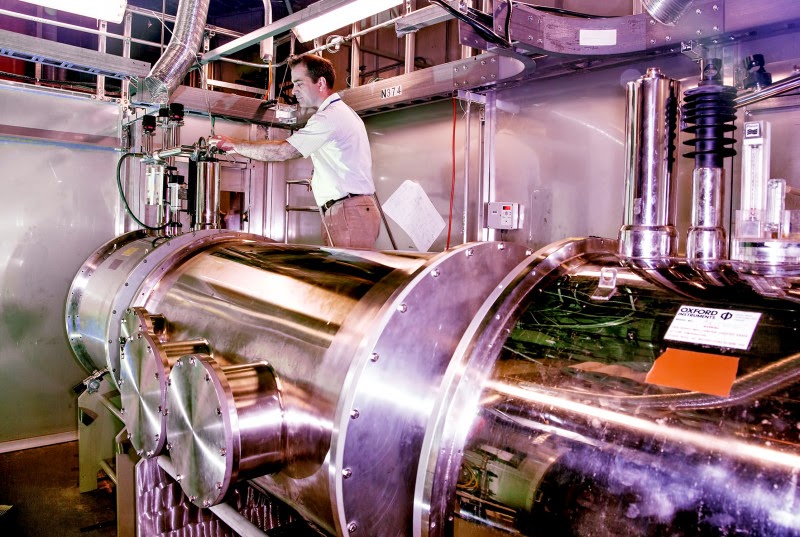
Chris Tully makes an adjustment to the PTOLEMY prototype.
Credit: Elle Starkman/PPPL Office of Communications
Billions upon billions of neutrinos speed harmlessly through everyone's body every moment of the day, according to cosmologists. The bulk of these subatomic particles are believed to come straight from the Big Bang, rather than from the sun or other sources. Experimental confirmation of this belief could yield seminal insights into the early universe and the physics of neutrinos. But how do you interrogate something so elusive that it could zip through a barrier of iron a light-year thick as if it were empty space?

At the U.S. Department of Energy's Princeton Plasma Physics Laboratory (PPPL), researchers led by Princeton University physicist Chris Tully are set to hunt for these nearly massless Big Bang relics by exploiting a curious fact: Neutrinos can be captured by tritium, a radioactive isotope of hydrogen, and provide a tiny boost of energy to the electrons -- or beta particles -- that are emitted in tritium decay.

Tully has created a prototype lab at PPPL to detect Big Bang neutrinos by measuring the extra energy they impart to the electrons -- and to achieve this with greater precision than has ever been done before. Spotting these neutrinos is akin to "detecting a faint heartbeat in a sports arena filled to the brim" said Charles Gentile, who heads engineering for the project, which Tully has dubbed PTOLEMY for "Princeton Tritium Observatory for Light, Early Universe Massive Neutrino Yield." Ptolemy was an ancient Greek astronomer who lived in Egypt during the first century.

Darkest, coldest conditions achievable

The task calls for measuring the energy of an electron with a precision comparable to detecting the mass of a neutrino, which until recently was thought to have no mass at all. Such measurements require the darkest, coldest conditions achievable in a laboratory and the use of quantum electronics -- a discipline that deals with the effect of quantum mechanics on the behavior of electrons in matter -- to detect the minute extra energy that a Big Bang neutrino would impart. Quantum mechanics describes the motion and direction of subatomic particles.

Why is the energy that a Big Bang neutrino provides so extraordinarily small? What's unique about these relics is that their wavelength has been stretched and cooled as the space-time we live in has expanded over approximately 13.7 billion years. This expansion has cooled a tremendous number of neutrinos to temperatures that are billions of times colder, and therefore less energetic, than those of neutrinos originating from the sun. When tritium captures these cold neutrinos, they create a narrow peak in energy that is just above the maximum energy of an electron from tritium decay.

The difficulty in identifying a Big Bang relic doesn't end there. Since neutrinos can take different forms, the height of the peak could be higher or lower by a factor of two, depending on whether the neutrino is like normal matter with a corresponding particle of antimatter -- an antineutrino -- or whether the neutrino is different and is in fact its own antiparticle. The extra height might not appear at all if neutrinos decay over billions of years into yet unknown, lighter particles.

Cutting-edge technology

Tully aims to show that the prototype for PTOLEMY, which is housed in a basement site at PPPL, can indeed achieve the precision needed to detect Big Bang neutrinos. The cutting-edge technology could then become the basis for a major experiment at PPPL to test long-held assumptions about the density of Big Bang neutrinos throughout the universe.

Confirming the assumptions could validate the standard model of the origin of the universe, Tully says, while refuting them could overturn the model and prompt new ideas about the Big Bang and its aftermath. Finding the neutrinos could also show if they could be a source of the invisible dark matter that scientists say makes up 20 percent of the total mass of the universe.

Such discoveries could be epochal. Could the project "make long-term contributions to the understanding of the universe?" Tully asks in presentations about PTOLEMY. "Absolutely!" he says. "We believe that we live in a sea of 14 billion-year-old neutrinos all around us. But is it true?"

The prototype at PPPL may hold the key to finding out. The device consists of a pair of superconducting magnets connected to opposite ends of a five-foot cylindrical vacuum chamber. A source containing a tiny bit of tritium sits inside one end of the chamber, with a calorimeter that Argonne National Laboratory is providing to measure electron energy set at the other end. The experiment will bind electrons from the tritium decay to magnetic field lines and pass them through filters in the vacuum chamber that will remove all but the highest-energy electrons, which the calorimeter will then measure.

Preventing "noise"

Great care will be taken to keep random thermal "noise" from disrupting the finely tuned equipment at each end of the experiment. Researchers will deposit the tritium on the nanomaterial graphene -- a layer of carbon just one atom thick -- to ensure that the electrons come off cleanly into the vacuum.

The calorimeter at the other end of the chamber will be connected to a dilution refrigerator set at between 70 and 100 millikelvins, a temperature 20 times colder than deep space and less than one-tenth of a degree above absolute zero. This deep-freeze will keep the calorimeter poised between a superconducting state -- one in which electrons can flow with virtually no resistance -- and a non-superconducting state with resistance to the flow of electrons. The delicate balance between these two states, combined with extremely low noise conditions achievable only with quantum electronics, will provide the sensitivity needed to precisely measure the energy of an electron that impinges upon the calorimeter. The setup will produce "the most precise electron-energy measurements ever made using calorimeter techniques," Tully said.

This experiment is "a perfect match for the competencies and capabilities that exist at PPPL," said Adam Cohen, deputy director for operations at PPPL and supervisor of the PTOLEMY project. Such qualities include know-how in handling tritium, a laboratory for synthesizing nanomaterial, decades of experience operating magnets and vacuum vessels, and space for an expanded experiment. "Chris and I talked about collaboration between PPPL and the University about three years ago," Cohen recalled. "Every time we pursue an activity with the campus it strengthens the bridge that exists between us."

Cross-fertilization

Looking ahead, Cohen sees PTOLEMY attracting new students, researchers and visitors, along with experts in high-energy physics, to PPPL. This could produce cross-fertilization with the Laboratory's core mission of advancing fusion and plasma science, he said.

 
Support : Creating Website | Johny Template | Mas Template
Copyright © 2011. The planet wall - All Rights Reserved
Template Created by Easy Blogging Published by Mas Template
Proudly powered by Blogger