Latest Post
Showing posts with label RADIATION. Show all posts

Radiation from early universe found key to answer major questions in physics

Written By Unknown on Thursday, January 15, 2015 | 7:39 AM

The UC San Diego astrophysicists employed the HuanTran Telescope in Chile to measure the polarization of the cosmic microwave background. Credit: POLARBEAR
Astrophysicists at UC San Diego have measured the minute gravitational distortions in polarized radiation from the early universe and discovered that these ancient microwaves can provide an important cosmological test of Einstein's theory of general relativity. These measurements have the potential to narrow down the estimates for the mass of ghostly subatomic particles known as neutrinos.

The radiation could even provide physicists with clues to another outstanding problem about our universe: how the invisible "dark matter" and "dark energy," which has been undetectable through modern telescopes, may be distributed throughout the universe.
The scientists are publishing details of their achievement in the June issue of the journal Physical Review Letters.

The UC San Diego scientists measured variations in the polarization of microwaves emanating from the Cosmic Microwave Background -- or CMB -- of the early universe. Like polarized light (which vibrates in one direction and is produced by the scattering of visible light off the surface of the ocean, for example), the polarized "B-mode" microwaves the scientists discovered were produced when CMB radiation from the early universe scattered off electrons 380,000 years after the Big Bang, when the cosmos cooled enough to allow protons and electrons to combine into atoms.

Astronomers had hoped the unique B-mode polarization signature from the early cosmos would allow them to effective "see" portions of the universe that are invisible to optical telescopes as gravity from denser portions of the universe tug on the polarized light, slightly deflecting its passage through the cosmos during its 13.8 billion year trip to Earth. Through a process called "weak gravitational lensing," the distortions in the B-mode polarization pattern, they hoped, would allow astronomers to map regions of the universe filled with invisible "dark matter" and "dark energy" and well as provide a test for general relativity on cosmological scales.

The recent discovery confirms both hunches. By measuring the CMB polarization data provided by POLARBEAR, a collaboration of astronomers working on a telescope in the high-altitude desert of northern Chile designed specifically to detect "B-mode" polarization, the UC San Diego astrophysicists discovered weak gravitational lensing in their data that, they conclude, permit astronomers to make detailed maps of the structure of the universe, constrain estimates of neutrino mass and provide a firm test for general relativity.

"This is the first time we've made these kinds of measurements using CMB polarization data," said Chang Feng, the lead author of the paper and a physics graduate student at UC San Diego who conducted his study with Brian Keating, an associate professor of physics at the university and a co-leader of the POLARBEAR experiment. "This was the first direct measurement of CMB polarization lensing. And the amazing thing is that the amount of lensing that we found through these calculations is consistent with what Einstein's general relativity theory predicted. So we now have a way to verify general relativity on cosmological scales."

The POLARBEAR experiment examined a small (30 degree square) region of the sky to produce high resolution maps of B-mode polarization, which enabled the team to determine that the amplitude of gravitational fluctuations they measured was consistent with the leading theoretical model of the universe, known as the Lambda Cold Dark Matter cosmological model. Another team Keating's group collaborates with, based at the Harvard-Smithsonian Center for Astrophysics, called BICEP2, used a telescope at the South Pole to examine B-mode polarization across wide swaths of the sky. In March, it announced it had found evidence for a brief and very rapid expansion of the early universe, called inflation.
One of the most important questions in physics that can be addressed from these data is the mass of the weakly interacting neutrino, which was thought to have no mass, but current limits indicate that neutrinos have masses below 1.5 electron volts. Feng said the B-mode polarization data in his study, while consistent with the predictions of general relativity, are not statistically significant enough yet to make any firm claims about neutrino masses. But over the next year, he and Keating hope to analyze enough data from POLARBEAR, and its successor instrument -- the Simons Array -- to provide more certainty about the masses of neutrinos.

"This study is a first step toward using polarization lensing as a probe to measure the mass of neutrinos, using the whole universe as a laboratory," Feng said.

"Eventually we will be able to put enough neutrinos on a 'scale' to weigh them -- precisely measuring their mass," Keating says. "Using the tools Chang has developed, it's only a matter of time before we can weigh the neutrino, the only fundamental elementary particle whose mass is unknown. That would be an astounding achievement for astronomy, cosmology and physics itself."

The study was supported by grants from the National Science Foundation, National Aeronautics and Space Administration, the Simmons Foundation, and Irwin and Joan Jacobs.

Tremors of the Big Bang: First direct evidence of cosmic inflation

Written By Unknown on Wednesday, January 14, 2015 | 7:34 PM

Gravitational waves from inflation generate a faint but distinctive twisting pattern in the polarization of the cosmic microwave background, known as a "curl" or B-mode pattern. For the density fluctuations that generate most of the polarization of the CMB, this part of the primordial pattern is exactly zero. Shown here is the actual B-mode pattern observed with the BICEP2 telescope, which is consistent with the pattern predicted for primordial gravitational waves. The line segments show the polarization strength and orientation at different spots on the sky. The red and blue shading shows the degree of clockwise and anti-clockwise twisting of this B-mode pattern. Credit: BICEP2 Collaboration
Almost 14 billion years ago, the universe we inhabit burst into existence in an extraordinary event that initiated the Big Bang. In the first fleeting fraction of a second, the universe expanded exponentially, stretching far beyond the view of our best telescopes. All this, of course, was just theory.

Researchers from the BICEP2 collaboration today announced the first direct evidence for this cosmic inflation. Their data also represent the first images of gravitational waves, or ripples in space-time. These waves have been described as the "first tremors of the Big Bang." Finally, the data confirm a deep connection between quantum mechanics and general relativity.

"Detecting this signal is one of the most important goals in cosmology today. A lot of work by a lot of people has led up to this point," said John Kovac (Harvard-Smithsonian Center for Astrophysics), leader of the BICEP2 collaboration.

These groundbreaking results came from observations by the BICEP2 telescope of the cosmic microwave background -- a faint glow left over from the Big Bang. Tiny fluctuations in this afterglow provide clues to conditions in the early universe. For example, small differences in temperature across the sky show where parts of the universe were denser, eventually condensing into galaxies and galactic clusters.

Since the cosmic microwave background is a form of light, it exhibits all the properties of light, including polarization. On Earth, sunlight is scattered by the atmosphere and becomes polarized, which is why polarized sunglasses help reduce glare. In space, the cosmic microwave background was scattered by atoms and electrons and became polarized too.

"Our team hunted for a special type of polarization called 'B-modes,' which represents a twisting or 'curl' pattern in the polarized orientations of the ancient light," said co-leader Jamie Bock (Caltech/JPL).

Gravitational waves squeeze space as they travel, and this squeezing produces a distinct pattern in the cosmic microwave background. Gravitational waves have a "handedness," much like light waves, and can have left- and right-handed polarizations.

"The swirly B-mode pattern is a unique signature of gravitational waves because of their handedness. This is the first direct image of gravitational waves across the primordial sky," said co-leader Chao-Lin Kuo (Stanford/SLAC).

The team examined spatial scales on the sky spanning about one to five degrees (two to ten times the width of the full Moon). To do this, they traveled to the South Pole to take advantage of its cold, dry, stable air.

"The South Pole is the closest you can get to space and still be on the ground," said Kovac. "It's one of the driest and clearest locations on Earth, perfect for observing the faint microwaves from the Big Bang."

They were surprised to detect a B-mode polarization signal considerably stronger than many cosmologists expected. The team analyzed their data for more than three years in an effort to rule out any errors. They also considered whether dust in our galaxy could produce the observed pattern, but the data suggest this is highly unlikely.

"This has been like looking for a needle in a haystack, but instead we found a crowbar," said co-leader Clem Pryke (University of Minnesota).

When asked to comment on the implications of this discovery, Harvard theorist Avi Loeb said, "This work offers new insights into some of our most basic questions: Why do we exist? How did the universe begin? These results are not only a smoking gun for inflation, they also tell us when inflation took place and how powerful the process was."

BICEP2 is the second stage of a coordinated program, the BICEP and Keck Array experiments, which has a co-PI structure. The four PIs are John Kovac (Harvard), Clem Pryke (UMN), Jamie Bock (Caltech/JPL), and Chao-Lin Kuo (Stanford/SLAC). All have worked together on the present result, along with talented teams of students and scientists. Other major collaborating institutions for BICEP2 include the University of California at San Diego, the University of British Columbia, the National Institute of Standards and Technology, the University of Toronto, Cardiff University, Commissariat ร  l'Energie Atomique.

BICEP2 is funded by the National Science Foundation (NSF). NSF also runs the South Pole Station where BICEP2 and the other telescopes used in this work are located. The Keck Foundation also contributed major funding for the construction of the team's telescopes. NASA, JPL, and the Moore Foundation generously supported the development of the ultra-sensitive detector arrays that made these measurements possible.

Technical details and journal papers can be found on the BICEP2 release website: http://bicepkeck.org

Headquartered in Cambridge, Mass., the Harvard-Smithsonian Center for Astrophysics (CfA) is a joint collaboration between the Smithsonian Astrophysical Observatory and the Harvard College Observatory. CfA scientists, organized into six research divisions, study the origin, evolution and ultimate fate of the universe.

Gravity may have saved the universe after the Big Bang, say researchers

Written By Unknown on Monday, January 5, 2015 | 5:48 AM

Center of the Milky Way galaxy (stock image). Credit: © DR / Fotolia
New research by a team of European physicists could explain why the universe did not collapse immediately after the Big Bang.

Studies of the Higgs particle -- discovered at CERN in 2012 and responsible for giving mass to all particles -- have suggested that the production of Higgs particles during the accelerating expansion of the very early universe (inflation) should have led to instability and collapse.

Scientists have been trying to find out why this didn't happen, leading to theories that there must be some new physics that will help explain the origins of the universe that has not yet been discovered. Physicists from Imperial College London, and the Universities of Copenhagen and Helsinki, however, believe there is a simpler explanation.

In a new study in Physical Review Letters, the team describe how the spacetime curvature -- in effect, gravity -- provided the stability needed for the universe to survive expansion in that early period. The team investigated the interaction between the Higgs particles and gravity, taking into account how it would vary with energy.

They show that even a small interaction would have been enough to stabilise the universe against decay.

"The Standard Model of particle physics, which scientists use to explain elementary particles and their interactions, has so far not provided an answer to why the universe did not collapse following the Big Bang," explains Professor Arttu Rajantie, from the Department of Physics at Imperial College London.

"Our research investigates the last unknown parameter in the Standard Model -- the interaction between the Higgs particle and gravity. This parameter cannot be measured in particle accelerator experiments, but it has a big effect on the Higgs instability during inflation. Even a relatively small value is enough to explain the survival of the universe without any new physics!"

The team plan to continue their research using cosmological observations to look at this interaction in more detail and explain what effect it would have had on the development of the early universe. In particular, they will use data from current and future European Space Agency missions measuring cosmic microwave background radiation and gravitational waves.

"Our aim is to measure the interaction between gravity and the Higgs field using cosmological data," says Professor Rajantie. "If we are able to do that, we will have supplied the last unknown number in the Standard Model of particle physics and be closer to answering fundamental questions about how we are all here."

The research is funded by the Science and Technology Facilities Council, along with the Villum Foundation, in Denmark, and the Academy of Finland.

Solar photons drive water off the moon

Written By Unknown on Saturday, January 3, 2015 | 11:32 PM

Lunar sample in vacuum. A lunar sample in a ultra-high vacuum system is hit with ultraviolet (157 nm) photons to simulate conditions in space. Credit: Image courtesy of Georgia Institute of Technology
Water is thought to be embedded in the moon's rocks or, if cold enough, "stuck" on their surfaces. It's predominantly found at the poles. But scientists probably won't find it intact on the sunlit side.

New research at the Georgia Institute of Technology indicates that ultraviolet photons emitted by the sun likely cause H2O molecules to either quickly desorb or break apart. The fragments of water may remain on the lunar surface, but the presence of useful amounts of water on the sunward side is not likely.

The Georgia Tech team built an ultra-high vacuum system that simulates conditions in space, then performed the first-ever reported measurement of the water photodesorption cross section from an actual lunar sample. The machine zapped a small piece of the moon with ultraviolet (157 nm) photons to create excited states and watched what happened to the water molecules. They either came off with a cross section of ~ 6 x 10⁻¹⁹ cm2 or broke apart with a cross section of ~ 5 x 10⁻¹⁹ cm2.. According to the team's measurements, approximately one in every 1,000 molecules leave the lunar surface simply due to absorption of UV light.

Georgia Tech's cross section values can now be used by scientists attempting to find water throughout the solar system and beyond.

"The cross section is an important number planetary scientists, astrochemists and the astrophysics community need for models regarding the fate of water on comets, moons, asteroids, other airless bodies and interstellar grains," said Thomas Orlando, the Georgia Tech professor who led the study.

The number is relatively large, which establishes that solar UV photons are likely removing water from the moon's surface. This research, which was carried out primarily by former Georgia Tech Ph.D. student Alice DeSimone, indicates the cross sections increase even more with decreasing water coverage. That's why it's not likely that water remains intact as H2O on the sunny side of the moon. Orlando compares it to sitting outside on a summer day.

"If a lot of sunlight is hitting me, the probability of me getting sunburned is pretty high," said Orlando, a professor in the School of Chemistry and Biochemistry and School of Physics. "It's similar on the moon. There's a fixed solar flux of energetic photons that hit the sunlit surface, and there's a pretty good probability they remove water or damage the molecules."

The result, according to Orlando, is the release of molecules such as H2O, H2 and OH as well as the atomic fragments H and O. The research is published in two companion articles in the Journal of Geophysical Research: Planets. The first discusses the water photodesorption. The second paper details the photodissociation of water and the O(3PJ) formation on a lunar impact melt breccia.

Orlando is the associate director of Georgia Tech's Center for Space Technology and Research (C-STAR). C-STAR is an interdisciplinary research center that serves to organize, integrate and facilitate the impact of Georgia Tech's space science and space technology research activities. The center brings together a wide range of Georgia Tech faculty, active in space science and space technology research, and functions as the Institute's focal point for growth of the space industry in the state of Georgia.

Source: Georgia Institute of Technology

New revelations on dark matter and relic neutrinos

Written By Unknown on Monday, December 29, 2014 | 7:07 PM

Temperature map of the relic radiation (bottom left), and close-ups showing, in relief, the polarisation of light in the 353 GHz channel (the colors correspond to the intensity of the thermal emission from galactic dust. Credit: © ESA - Planck collaboration
The Planck collaboration, which notably includes the CNRS, CEA, CNES and several French universities, has disclosed, at a conference in Ferrara, Italy, the results of four years of observations from the ESA's Planck satellite. The satellite aims to study relic radiation (the most ancient light in the Universe). This light has been measured precisely across the entire sky for the first time, in both intensity and polarisation1, thereby producing the oldest image of the Universe. This primordial light lets us "see" some of the most elusive particles in the Universe: dark matter and relic neutrinos.

Between 2009 and 2013, the Planck satellite observed relic radiation, sometimes called cosmic microwave background (CMB) radiation. Today, with a full analysis of the data, the quality of the map is now such that the imprints left by dark matter and relic neutrinos are clearly visible.

Already in 2013, the map for variations in light intensity was released, showing where matter was in the sky 380,000 years after the Big Bang. Thanks to the measurement of the polarisation of this light (in four of seven frequencies2, for the moment), Planck can now see how this material used to move. Our vision of the primordial Universe has thus become dynamic. This new dimension, and the quality of the data, allows us to test numerous aspects of the standard model of cosmology. In particular, they illuminate the most elusive of particles: dark matter and neutrinos.

New constraints on dark matter The Planck collaboration results now make it possible to rule out an entire class of models of dark matter, in which dark matter-antimatter annihilation3 is important. Annihilation is the process whereby a particle and its antiparticle jointly disappear, followed by a release in energy.

The basic existence of dark matter is becoming firmly established, but the nature of dark matter particles remains unknown. There are numerous hypotheses concerning the physical nature of this matter, and one of today's goals is to whittle down the possibilities, for instance by searching for the effects of this mysterious matter on ordinary matter and light. Observations made by Planck show that it is not necessary to appeal to the existence of strong dark matter-antimatter annihilation to explain the dynamics of the early universe. 

Such events would have produced enough energy to exert an influence on the evolution of the light-matter fluid in the early universe, especially around the time relic radiation was emitted. However, the most recent observations show no hints that this actually took place.

These new results are even more interesting when compared with measurements made by other instruments. The satellites Fermi and Pamela, as well as the AMS-02 experiment aboard the International Space Station, have all observed an excess of cosmic rays, which might be interpreted as a consequence of dark matter annihilation. Given the Planck observations, however, an alternative explanation for these AMS-02 or Fermi measurements-such as radiation from undetected pulsars-has to be considered, if one is to make the reasonable hypothesis that the properties of dark matter particles are stable over time.

Additionally, the Planck collaboration has confirmed that dark matter comprises a bit more than 26% of the Universe today (figure deriving from its 2013 analysis), and has made more accurate maps of the density of matter a few billion years after the Big Bang, thanks to measurements of temperature and B-mode polarisation.

Neutrinos from the earliest instants detected

The new results from the Planck collaboration also inform us about another type of very elusive particle, the neutrino. These "ghost" particles, abundantly produced in our Sun for example, can pass through our planet with almost no interaction, which makes them very difficult to detect. It is therefore not realistic to directly detect the first neutrinos, which were created within the first second after the Big Bang, and which have very little energy. However, for the first time, Planck has unambiguously detected the effect these relic neutrinos have on relic radiation maps.

The relic neutrinos detected by Planck were released about one second after the Big Bang, when the Universe was still opaque to light but already transparent to these particles, which can freely escape from environments that are opaque to photons, such as the Sun's core. 380,000 years later, when relic radiation was released, it bore the imprint of neutrinos because photons had gravitational4 interaction with these particles. Observing the oldest photons thus made it possible to confirm the properties of neutrinos.

Planck observations are consistent with the standard model of particle physics. They essentially exclude the existence of a fourth species of neutrinos5, previously considered a possibility based on the final data from the WMAP satellite, the US predecessor of Planck. Finally, Planck makes it possible to set an upper limit to the sum of the mass of neutrinos, currently established at 0.23 eV (electron-volt)6.

The full data set for the mission, along with associated articles that will be submitted to the journal Astronomy & Astrophysics (A&A), will be available December 22 on the ESA web site. These results are notably derived from measurements made with the High Frequency Instrument (HFI), which was conceived and assembled under the direction of the Institut d'astrophysique spatiale (CNRS/Universitรฉ Paris-Sud), and utilized, under the direction of the Institut d'astrophysique de Paris (CNRS/UPMC), by different laboratories including those from the CEA, the CNRS and French universities, with funding from CNES and the CNRS.

Notes
1. Polarisation is a property of light on the same level as color or direction of travel. This property is invisible to the human eye, but remains familiar (sunglasses with polarised lenses and cinema 3D glasses, for instance).. A travelling photon is associated with an electrical field (E) and a magnetic field (B), at right angles to each other and to their direction of travel. If the electrical field remains in the same plane, the photon is said to be linearly polarised, as is the case for relic radiation.
2. In all three frequencies of the Low Frequency Instrument (LFI) and in the 353 GHz channel of the High Frequency Instrument (HFI).
3. In some models, dark matter particles are their own anti-particles.
4. According to general relativity, even if photons have no mass, they are sensitive to the gravitational force that bends space-time.
5. According to the standard model of particle physics, there are three species of neutrinos.
6. The electron volt (symbol: eV) is a unit of energy used in particle physics to express mass, since mass-energy equivalence links energy and mass (E=mc2, where c represents the speed of light). The lightest known particle after photons and neutrinos weighs 511 keV, more than 2 million times the sum of the mass of all three neutrinos.

Source: CNRS

Hunt for Big Bang particles offering clues to the origin of the universe

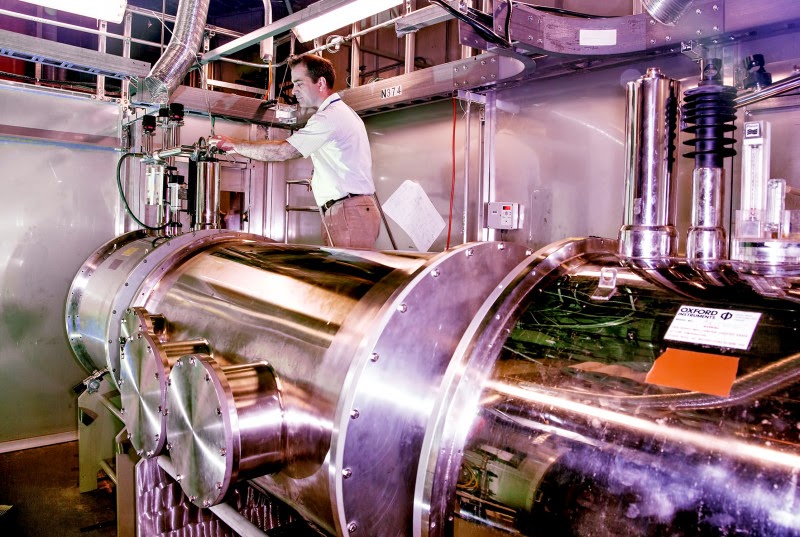
Chris Tully makes an adjustment to the PTOLEMY prototype.
Credit: Elle Starkman/PPPL Office of Communications
Billions upon billions of neutrinos speed harmlessly through everyone's body every moment of the day, according to cosmologists. The bulk of these subatomic particles are believed to come straight from the Big Bang, rather than from the sun or other sources. Experimental confirmation of this belief could yield seminal insights into the early universe and the physics of neutrinos. But how do you interrogate something so elusive that it could zip through a barrier of iron a light-year thick as if it were empty space?

At the U.S. Department of Energy's Princeton Plasma Physics Laboratory (PPPL), researchers led by Princeton University physicist Chris Tully are set to hunt for these nearly massless Big Bang relics by exploiting a curious fact: Neutrinos can be captured by tritium, a radioactive isotope of hydrogen, and provide a tiny boost of energy to the electrons -- or beta particles -- that are emitted in tritium decay.

Tully has created a prototype lab at PPPL to detect Big Bang neutrinos by measuring the extra energy they impart to the electrons -- and to achieve this with greater precision than has ever been done before. Spotting these neutrinos is akin to "detecting a faint heartbeat in a sports arena filled to the brim" said Charles Gentile, who heads engineering for the project, which Tully has dubbed PTOLEMY for "Princeton Tritium Observatory for Light, Early Universe Massive Neutrino Yield." Ptolemy was an ancient Greek astronomer who lived in Egypt during the first century.

Darkest, coldest conditions achievable

The task calls for measuring the energy of an electron with a precision comparable to detecting the mass of a neutrino, which until recently was thought to have no mass at all. Such measurements require the darkest, coldest conditions achievable in a laboratory and the use of quantum electronics -- a discipline that deals with the effect of quantum mechanics on the behavior of electrons in matter -- to detect the minute extra energy that a Big Bang neutrino would impart. Quantum mechanics describes the motion and direction of subatomic particles.

Why is the energy that a Big Bang neutrino provides so extraordinarily small? What's unique about these relics is that their wavelength has been stretched and cooled as the space-time we live in has expanded over approximately 13.7 billion years. This expansion has cooled a tremendous number of neutrinos to temperatures that are billions of times colder, and therefore less energetic, than those of neutrinos originating from the sun. When tritium captures these cold neutrinos, they create a narrow peak in energy that is just above the maximum energy of an electron from tritium decay.

The difficulty in identifying a Big Bang relic doesn't end there. Since neutrinos can take different forms, the height of the peak could be higher or lower by a factor of two, depending on whether the neutrino is like normal matter with a corresponding particle of antimatter -- an antineutrino -- or whether the neutrino is different and is in fact its own antiparticle. The extra height might not appear at all if neutrinos decay over billions of years into yet unknown, lighter particles.

Cutting-edge technology

Tully aims to show that the prototype for PTOLEMY, which is housed in a basement site at PPPL, can indeed achieve the precision needed to detect Big Bang neutrinos. The cutting-edge technology could then become the basis for a major experiment at PPPL to test long-held assumptions about the density of Big Bang neutrinos throughout the universe.

Confirming the assumptions could validate the standard model of the origin of the universe, Tully says, while refuting them could overturn the model and prompt new ideas about the Big Bang and its aftermath. Finding the neutrinos could also show if they could be a source of the invisible dark matter that scientists say makes up 20 percent of the total mass of the universe.

Such discoveries could be epochal. Could the project "make long-term contributions to the understanding of the universe?" Tully asks in presentations about PTOLEMY. "Absolutely!" he says. "We believe that we live in a sea of 14 billion-year-old neutrinos all around us. But is it true?"

The prototype at PPPL may hold the key to finding out. The device consists of a pair of superconducting magnets connected to opposite ends of a five-foot cylindrical vacuum chamber. A source containing a tiny bit of tritium sits inside one end of the chamber, with a calorimeter that Argonne National Laboratory is providing to measure electron energy set at the other end. The experiment will bind electrons from the tritium decay to magnetic field lines and pass them through filters in the vacuum chamber that will remove all but the highest-energy electrons, which the calorimeter will then measure.

Preventing "noise"

Great care will be taken to keep random thermal "noise" from disrupting the finely tuned equipment at each end of the experiment. Researchers will deposit the tritium on the nanomaterial graphene -- a layer of carbon just one atom thick -- to ensure that the electrons come off cleanly into the vacuum.

The calorimeter at the other end of the chamber will be connected to a dilution refrigerator set at between 70 and 100 millikelvins, a temperature 20 times colder than deep space and less than one-tenth of a degree above absolute zero. This deep-freeze will keep the calorimeter poised between a superconducting state -- one in which electrons can flow with virtually no resistance -- and a non-superconducting state with resistance to the flow of electrons. The delicate balance between these two states, combined with extremely low noise conditions achievable only with quantum electronics, will provide the sensitivity needed to precisely measure the energy of an electron that impinges upon the calorimeter. The setup will produce "the most precise electron-energy measurements ever made using calorimeter techniques," Tully said.

This experiment is "a perfect match for the competencies and capabilities that exist at PPPL," said Adam Cohen, deputy director for operations at PPPL and supervisor of the PTOLEMY project. Such qualities include know-how in handling tritium, a laboratory for synthesizing nanomaterial, decades of experience operating magnets and vacuum vessels, and space for an expanded experiment. "Chris and I talked about collaboration between PPPL and the University about three years ago," Cohen recalled. "Every time we pursue an activity with the campus it strengthens the bridge that exists between us."

Cross-fertilization

Looking ahead, Cohen sees PTOLEMY attracting new students, researchers and visitors, along with experts in high-energy physics, to PPPL. This could produce cross-fertilization with the Laboratory's core mission of advancing fusion and plasma science, he said.

Sun's rotating 'magnet' pulls lightning towards UK

Written By Unknown on Saturday, December 20, 2014 | 6:15 PM

Big Ben and Houses of Parliament, London, UK. The Sun may be playing a part in the generation of lightning strikes on Earth by temporarily 'bending' the Earth's magnetic field and allowing a shower of energetic particles to enter the upper atmosphere. Credit: © TTstudio / Fotolia
The Sun may be playing a part in the generation of lightning strikes on Earth by temporarily 'bending' the Earth's magnetic field and allowing a shower of energetic particles to enter the upper atmosphere.

This is according to researchers at the University of Reading who have found that over a five year period the UK experienced around 50% more lightning strikes when the Earth's magnetic field was skewed by the Sun's own magnetic field.

The Earth's magnetic field usually functions as an in-built force-field to shield against a bombardment of particles from space, known as galactic cosmic rays, which have previously been found to prompt a chain-reaction of events in thunderclouds that trigger lightning bolts.

It is hoped these new insights, which have been published today, 19 November, in IOP Publishing's journal Environmental Research Letters, could lead to a reliable lightning forecast system that could provide warnings of hazardous events many weeks in advance.

To do so, weather forecasters would need to combine conventional forecasts with accurate predictions of the Sun's spiral-shaped magnetic field known as the heliospheric magnetic field (HMF), which is spewed out as the Sun rotates and is dragged through the solar system by the solar wind.

Lead author of the research Dr Matt Owens said: "We've discovered that the Sun's powerful magnetic field is having a big influence on UK lightning rates.

"The Sun's magnetic field is like a bar magnet, so as the Sun rotates its magnetic field alternately points toward and away from the Earth, pulling the Earth's own magnetic field one way and then another."

In their study, the researchers used satellite and Met Office data to show that between 2001 and 2006, the UK experienced a 50% increase in thunderstorms when the HMF pointed towards the Sun and away from Earth.

This change of direction can skew or 'bend' the Earth's own magnetic field and the researchers believe that this could expose some regions of the upper atmosphere to more galactic cosmic rays--tiny particles from across the Universe accelerated to close to the speed of light by exploding stars.

"From our results, we propose that galactic cosmic rays are channelled to different locations around the globe, which can trigger lightning in already charged-up thunderclouds. The changes to our magnetic field could also make thunderstorms more likely by acting like an extra battery in the atmospheric electric circuit, helping to further 'charge up' clouds," Dr Owens continued.

The results build on a previous study by University of Reading researchers, also published in Environmental Research Letters, which found an unexpected link between energetic particles from the Sun and lightning rates on Earth.
Professor Giles Harrison, head of Reading's Department of Meteorology and co-author of both studies, said: "This latest finding is an important step forward in our knowledge of how the weather on Earth is influenced by what goes on in space. The University of Reading's continuing success in this area shows that new insights follow from atmospheric and space scientists working together."
Dr Owens continued: "Scientists have been reliably predicting the solar magnetic field polarity since the 1970s by watching the surface of the Sun. We just never knew it had any implications on the weather on Earth. We now plan to combine regular weather forecasts, which predict when and where thunderclouds will form, with solar magnetic field predictions. This means a reliable lightning forecast could now be a genuine possibility."

Source:  Institute of Physics

Origin of long-standing space mystery revealed: Origin of the 'theta aurora'

Written By Unknown on Friday, December 19, 2014 | 11:25 PM

The night side of the terrestrial magnetosphere forms a structured magnetotail, consisting of a plasma sheet at low latitudes that is sandwiched between two regions called the magnetotail lobes. The lobes consist of the regions in which Earth's magnetic field lines are directly connected to the magnetic field carried by the solar wind. Different plasma populations are observed in these regions -- plasma in the lobes is very cool, whereas the plasma sheet is more energetic. The diagram labels by two red dots the location of an ESA Cluster satellite and NASA's IMAGE satellite on 15 September 2005, when particular conditions of the magnetic field configuration gave rise to a phenomenon known as 'theta aurora.'  Credit: ESA/NASA/SOHO/LASCO/EIT
University of Southampton researcher has helped solve a long-standing space mystery -- the origin of the 'theta aurora'.

Auroras are the most visible manifestation of the Sun's effect on Earth. They are seen as colourful displays in the night sky, known as the Northern or Southern Lights. They are caused by the solar wind, a stream of plasma -- electrically charged atomic particles -- carrying its own magnetic field, interacting with Earth's magnetic field.

Normally, the main region for this impressive display is the 'auroral oval', which lies at around 65-70 degrees north or south of the equator, encircling the polar caps.
However, auroras can occur at even higher latitudes. One type is known as a 'theta aurora' because seen from above it looks like the Greek letter theta -- an oval with a line crossing through the centre.

While the cause of the auroral oval emissions is reasonably well understood, the origin of the theta aurora was unclear until now.

Researchers observed particles in the two 'lobe' regions of the magnetosphere. The plasma in the lobes is normally cold, but previous observations suggested that theta auroras are linked with unusually hot lobe plasma.

Dr Robert Fear from the University of Southampton (formerly at the University of Leicester, where much of the research took place), and lead author of the paper published in Science this week, says: "Previously it was unclear whether this hot plasma was a result of direct solar wind entry through the lobes of the magnetosphere, or if the plasma is somehow related to the plasma sheet on the night side of Earth.

"One idea is that the process of magnetic reconnection on the night side of Earth causes a build-up of 'trapped' hot plasma in the higher latitude lobes."
The mystery was finally solved by studying data collected simultaneously by the European Space Agency's (ESA) Cluster and NASA's IMAGE satellites on 15 September 2005. While the four Cluster satellites were located in the southern hemisphere magnetic lobe, IMAGE had a wide-field view of the southern hemisphere aurora. As one Cluster satellite observed uncharacteristically energetic plasma in the lobe, IMAGE saw the 'arc' of the theta aurora cross the magnetic footprint of Cluster.
"We found that the energetic plasma signatures occur on high-latitude magnetic field lines that have been 'closed' by the process of magnetic reconnection, which then causes the plasma to become relatively hot," says Dr Fear.

"Because the field lines are closed, the observations are incompatible with direct entry from the solar wind. By testing this and other predictions about the behaviour of the theta aurora, our observations provide strong evidence that the plasma trapping mechanism is responsible for the theta aurora," he adds.

"The study highlights the intriguing process that can occur in the magnetosphere when the interplanetary magnetic field of the solar wind points northwards," adds Philippe Escoubet, ESA's Cluster project scientist.

"This is the first time that the origin of the theta aurora phenomenon has been revealed, and it is thanks to localised measurements from Cluster combined with the wide-field view of IMAGE that we can better understand another aspect of the Sun-Earth connection," he adds.

Source: University of Southampton
 
Support : Creating Website | Johny Template | Mas Template
Copyright © 2011. The planet wall - All Rights Reserved
Template Created by Easy Blogging Published by Mas Template
Proudly powered by Blogger