Latest Post
Showing posts with label SPITZER SPACE TELESCOPES. Show all posts

Space Hubble's Little Sombrero

Written By Unknown on Friday, February 6, 2015 | 6:54 PM

European Space Agency Credit: ESA/Hubble & NASA
         European Space Agency Credit: ESA/Hubble & NASA

Galaxies can take many shapes and be oriented any way relative to us in the sky. This can make it hard to figure out their actual morphology, as a galaxy can look very different from different viewpoints. A special case is when we are lucky enough to observe a spiral galaxy directly from its edge, providing us with a spectacular view like the one seen in this picture of the week.

This is NGC 7814, also known as the “Little Sombrero.” Its larger namesake, the Sombrero Galaxy, is another stunning example of an edge-on galaxy — in fact, the “Little Sombrero” is about the same size as its bright namesake at about 60,000 light-years across, but as it lies farther away, and so appears smaller in the sky.

NGC 7814 has a bright central bulge and a bright halo of glowing gas extending outwards into space. The dusty spiral arms appear as dark streaks. They consist of dusty material that absorbs and blocks light from the galactic center behind it. The field of view of this NASA/ESA Hubble Space Telescope image would be very impressive even without NGC 7814 in front; nearly all the objects seen in this image are galaxies as well. 

Source: Nasa


NASA Observatories Take an Unprecedented Look into Superstar Eta Carinae

Written By Unknown on Thursday, February 5, 2015 | 9:13 PM

In this supercomputer simulation, the stars of Eta Carinae are shown as black dots. Lighter colors indicate greater densities in the stellar winds produced by each star. At closest approach, the fast wind of the smaller star carves a tunnel in the thicker wind of the larger star. Image Credit: NASA's Goddard Space Flight Center/T. Madura

Eta Carinae, the most luminous and massive stellar system within 10,000 light-years of Earth, is known for its surprising behavior, erupting twice in the 19th century for reasons scientists still don't understand. A long-term study led by astronomers at NASA's Goddard Space Flight Center in Greenbelt, Maryland, used NASA satellites, ground-based telescopes and theoretical modeling to produce the most comprehensive picture of Eta Carinae to date. New findings include Hubble Space Telescope images that show decade-old shells of ionized gas racing away from the largest star at a million miles an hour, and new 3-D models that reveal never-before-seen features of the stars' interactions.

"We are coming to understand the present state and complex environment of this remarkable object, but we have a long way to go to explain Eta Carinae's past eruptions or to predict its future behavior," said Goddard astrophysicist Ted Gull, who coordinates a research group that has monitored the star for more than a decade.

Located about 7,500 light-years away in the southern constellation of Carina, Eta Carinae comprises two massive stars whose eccentric orbits bring them unusually close every 5.5 years. Both produce powerful gaseous outflows called stellar winds, which enshroud the stars and stymy efforts to directly measure their properties. Astronomers have established that the brighter, cooler primary star has about 90 times the mass of the sun and outshines it by 5 million times. While the properties of its smaller, hotter companion are more contested, Gull and his colleagues think the star has about 30 solar masses and emits a million times the sun's light.
Seen in blue light emitted by doubly ionized iron atoms (4,659 angstroms), these images of Eta Carinae were captured by Hubble's STIS instrument between 2010 and 2014. Gas shells created during the binary's 2003 close approach race outward at about 1 million mph (1.6 million km/h). Image Credit: NASA's Goddard Space Flight Center/T. Gull et al.

Speaking at a press conference at the American Astronomical Society meeting in Seattle on Wednesday, the Goddard researchers discussed recent observations of Eta Carinae and how they fit with the group's current understanding of the system.

At closest approach, or periastron, the stars are 140 million miles (225 million kilometers) apart, or about the average distance between Mars and the sun. Astronomers observe dramatic changes in the system during the months before and after periastron. These include X-ray flares, followed by a sudden decline and eventual recovery of X-ray emission; the disappearance and re-emergence of structures near the stars detected at specific wavelengths of visible light; and even a play of light and shadow as the smaller star swings around the primary.
During the past 11 years, spanning three periastron passages, the Goddard group has developed a model based on routine observations of the stars using ground-based telescopes and multiple NASA satellites. "We used past observations to construct a computer simulation, which helped us predict what we would see during the next cycle, and then we feed new observations back into the model to further refine it," said Thomas Madura, a NASA Postdoctoral Program Fellow at Goddard and a theorist on the Eta Carinae team.
According to this model, the interaction of the two stellar winds accounts for many of the periodic changes observed in the system. The winds from each star have markedly different properties: thick and slow for the primary, lean and fast for the hotter companion. The primary's wind blows at nearly 1 million mph and is especially dense, carrying away the equivalent mass of our sun every thousand years. By contrast, the companion's wind carries off about 100 times less material than the primary's, but it races outward as much as six times faster.

Madura's simulations, which were performed on the Pleiades supercomputer at NASA's Ames Research Center in Moffett Field, California, reveal the complexity of the wind interaction. When the companion star rapidly swings around the primary, its faster wind carves out a spiral cavity in the dense outflow of the larger star. To better visualize this interaction, Madura converted the computer simulations to 3-D digital models and made solid versions using a consumer-grade 3-D printer. This process revealed lengthy spine-like protrusions in the gas flow along the edges of the cavity, features that hadn't been noticed before.    

"We think these structures are real and that they form as a result of instabilities in the flow in the months around closest approach," Madura said. "I wanted to make 3-D prints of the simulations to better visualize them, which turned out to be far more successful than I ever imagined." A paper detailing this research has been submitted to the journal Monthly Notices of the Royal Astronomical Society.
The team detailed a few key observations that expose some of the system's inner workings. For the past three periastron passages, ground-based telescopes in Brazil, Chile, Australia and New Zealand have monitored a single wavelength of blue light emitted by helium atoms that have lost a single electron. According to the model, the helium emission tracks conditions in the primary star's wind. 
The Space Telescope Imaging Spectrograph (STIS) aboard Hubble captures a different wavelength of blue light emitted by iron atoms that have lost two electrons, which uniquely reveals where gas from the primary star is set aglow by the intense ultraviolet light of its companion. Lastly, X-rays from the system carry information directly from the wind collision zone, where the opposing winds create shock waves that heat the gas to hundreds of millions of degrees.

"Changes in the X-rays are a direct probe of the collision zone and reflect changes in how these stars lose mass," said Michael Corcoran, an astrophysicist with the Universities Space Research Association headquartered in Columbia, Maryland. He and his colleagues compared periastron emission measured over the past 20 years by NASA's Rossi X-ray Timing Explorer, which ceased operation in 2012, and the X-ray Telescope aboard NASA's Swift satellite. In July 2014, as the stars rushed toward each other, Swift observed a series of flares culminating in the brightest X-ray emission yet seen from Eta Carinae. This implies a change in mass loss by one of the stars, but X-rays alone cannot determine which one.

Goddard's Mairan Teodoro led the ground-based campaign tracking the helium emission. "The 2014 emission is nearly identical to what we saw at the previous periastron in 2009, which suggests the primary wind has been constant and that the companion's wind is responsible for the X-ray flares," he explained.

After NASA astronauts repaired the Hubble Space Telescope's STIS instrument in 2009, Gull and his collaborators requested to use it to observe Eta Carinae. By separating the stars' light into a rainbow-like spectrum, STIS reveals the chemical make-up of their environment. But the spectrum also showed wispy structures near the stars that suggested the instrument could be used to map a region close to the binary system in never-before-seen detail.

STIS views its targets through a single narrow slit to limit contamination from other sources. Since December 2010, Gull's team has regularly mapped a region centered on the binary by capturing spectra at 41 different locations, an effort similar to building up a panoramic picture from a series of snapshots. The view spans about 430 billion miles (670 billion km), or about 4,600 times the average Earth-sun distance.

The resulting images, revealed for the first time on Wednesday, show that the doubly ionized iron emission comes from a complex gaseous structure nearly a tenth of a light-year across, which Gull likens to Maryland blue crab. By stepping through the STIS images, vast shells of gas representing the crab's "claws" can be seen racing away from the stars with measured speeds of about 1 million mph (1.6 million km/h). With each close approach, a spiral cavity forms in the larger star's wind and then expands outward along with it, creating the moving shells.
WATCH VIDEO

"These gas shells persist over thousands of times the distance between Earth and the sun," Gull explained. "Backtracking them, we find the shells began moving away from the primary star about 11 years or three periastron passages ago, providing us with an additional way to glimpse what occurred in the recent past."

When the stars approach, the companion becomes immersed in the thickest part of the primary's wind, which absorbs its UV light and prevents the radiation from reaching the distant gas shells. Without this energy to excite it, the doubly ionized iron stops emitting light and the crab structure disappears at this wavelength. Once the companion swings around the primary and clears the densest wind, its UV light escapes, re-energizes iron atoms in the shells, and the crab returns. 
Eta Carinae's great eruption in the 1840s created the billowing Homunculus Nebula, imaged here by Hubble. Now about a light-year long, the expanding cloud contains enough material to make at least 10 copies of our sun. Astronomers cannot yet explain what caused this eruption. Image Credit: NASA, ESA, and the Hubble SM4 ERO Team

Both of the massive stars of Eta Carinae may one day end their lives in supernova explosions. For stars, mass is destiny, and what will determine their ultimate fate is how much matter they can lose -- through stellar winds or as-yet-inexplicable eruptions -- before they run out of fuel and collapse under their own weight.

For now, the researchers say, there is no evidence to suggest an imminent demise of either star. They are exploring the rich dataset from the 2014 periastron passage to make new predictions, which will be tested when the stars again race together in February 2020.

NASA is exploring our solar system and beyond to understand the universe and our place in it. We seek to unravel the secrets of our universe, its origins and evolution, and search for life among the stars.

Source: Nasa

Telescope on NASA’s SDO Collects Its 100-Millionth Image

Written By Unknown on Friday, January 30, 2015 | 5:10 PM

The Atmospheric Imaging Assembly on NASA's Solar Dynamics Observatory captured its 100 millionth image of the sun on Jan. 19, 2015. The dark areas at the bottom and the top of the image are coronal holes -- areas of less dense gas, where solar material has flowed away from the sun. Credit: NASA/SDO/AIA/LMSAL
On Jan. 19, 2015, at 12:49 p.m. EST, an instrument on NASA's Solar Dynamics Observatory captured its 100 millionth image of the sun. The instrument is the Atmospheric Imaging Assembly, or AIA, which uses four telescopes working parallel to gather eight images of the sun – cycling through 10 different wavelengths -- every 12 seconds.

Between the AIA and two other instruments on board, the Helioseismic Magnetic Imager and the Extreme Ultraviolet Variability Experiment, SDO sends down a whopping 1.5 terabytes of data a day. AIA is responsible for about half of that. Every day it provides 57,600 detailed images of the sun that show the dance of how solar material sways and sometimes erupts in the solar atmosphere, the corona.

In the almost five years since its launch on Feb. 11, 2010, SDO has provided images of the sun to help scientists better understand how the roiling corona gets to temperatures some 1000 times hotter than the sun's surface, what causes giant eruptions such as solar flares, and why the sun's magnetic fields are constantly on the move.

In honor of the 100 millionth image, Dean Pesnell, SDO's project scientist at NASA's Goddard Space Flight Center in Greenbelt, Maryland and Karel Schrijver, the AIA principal investigator at Lockheed Martin in Palo Alto, California, chose some of their favorite images produced by SDO so far.

Source: Nasa

Black hole on a diet creates a 'changing look' quasar

Written By Unknown on Thursday, January 29, 2015 | 1:40 AM

This artist's rending shows "before" and "after" images of a changing look quasar.
Credit: By Jim Shelton
Yale University astronomers have identified the first “changing look” quasar, a gleaming object in deep space that appears to have its own dimmer switch.

The discovery may offer a glimpse into the life story of the universe’s great beacons.

Quasars are massive, luminous objects that draw their energy from black holes. Until now, scientists have been unable to study both the bright and dim phases of a quasar in a single source.

As described in an upcoming edition of The Astrophysical Journal, Yale-led researchers spotted a quasar that had dimmed by a factor of six or seven, compared with observations from a few years earlier.

“We’ve looked at hundreds of thousands of quasars at this point, and now we’ve found one that has switched off,” said C. Megan Urry, Yale’s Israel Munson Professor of Astronomy and Astrophysics, and the study’s co-author. “This may tell us something about their lifetimes.”

Stephanie LaMassa, a Yale associate research scientist and principal investigator for the study, noticed the phenomenon during an ongoing probe of Stripe 82 — a sliver of the sky found along the Celestial Equator. Stripe 82 has been scanned in numerous astronomical surveys, including the Sloan Digital Sky Survey.

“This is like a dimmer switch,” LaMassa said. “The power source just went dim. Because the life cycle of a quasar is one of the big unknowns, catching one as it changes, within a human lifetime, is amazing.”

Even more significant for astronomers was the weakening of the quasar’s broad emission lines. Visible on the optical spectrum, these broad emission lines are signatures of gas that is too distant to be consumed by a black hole, yet close enough to be “excited” by energy from material that does fall into a black hole.

The change in the emission lines is what told researchers that the black hole had essentially gone on a diet, and was giving off less energy as a result. That’s when the “changing look” quasar hit its dimmer switch, and most of its broad emission lines disappeared.

The Yale team analyzed a variety of observation data, including recent optical spectra information and archival optical photometry and X-ray spectra information. They needed to rule out the possibility the quasar merely appeared to lose brightness, due to a gas cloud or other object passing in front of it.

The findings may prove invaluable on several fronts. First, they provide direct information about the intermittent nature of quasar activity; even more intriguingly, they hint at the sporadic activity of black holes.

“It makes a difference to know how black holes grow,” Urry said, noting that all galaxies have black holes, and quasars are a phase that black holes go through before becoming dormant. “This perhaps has implications for how the Milky Way looks today.”

Additionally, there is the chance the quasar may fire up again, showing astronomers yet another changing look.

“Even though astronomers have been studying quasars for more than 50 years, it’s exciting that someone like me, who has studied black holes for almost a decade, can find something completely new,” LaMassa said.

(Illustration by Michael S. Helfenbein)

Source: Yale university

Tail discovered on long-known asteroids

Written By Unknown on Monday, January 26, 2015 | 7:48 PM

The faint tail can be seen in active asteroid 62412. Image courtesy of Scott Sheppard
Washington, D.C.--A two-person team of Carnegie's Scott Sheppard and Chadwick Trujillo of the Gemini Observatory has discovered a new active asteroid, called 62412, in the Solar System's main asteroid belt between Mars and Jupiter. It is the first comet-like object seen in the Hygiea family of asteroids. Sheppard will present his team's findings at the American Astronomical Society's Division of Planetary Sciences meeting and participate today in a press conference organized by the society.

Active asteroids are a newly recognized phenomenon. 62412 is only the 13th known active asteroid in the main asteroid belt. Sheppard and Trujillo estimate that there are likely about 100 of them in the main asteroid belt, based on their discovery.

Active asteroids have stable orbits between Mars and Jupiter like other asteroids. However, unlike other asteroids, they sometimes have the appearance of comets, when dust or gas is ejected from their surfaces to create a sporadic tail effect. Sheppard and Trujillo discovered an unexpected tail on 62412, an object which had been known as a typical asteroid for over a decade. Their findings reclassify it as an active asteroid. The reasons for this loss of material and subsequent tail in active asteroids are unknown, although there are several theories such as recent impacts or sublimation from solid to gas of exposed ices.

"Until about ten years ago, it was pretty obvious what a comet was and what a comet wasn't, but that is all changing as we realize that not all of these objects show activity all of the time," Sheppard said.

In the past, asteroids were thought to be mostly unchanging objects, but an improved ability to observe them has allowed scientists to discover tails and comas, which are the thin envelope of an atmosphere that surrounds a comet's nucleus.

"We're actually looking anew through our deep survey at a population of objects that other people cannot easily observe, because we're going much deeper," Sheppard said, explaining why they were able to see that 62412 was active when it had been considered a typical main belt asteroid for 15 years.;

Discoveries such as this one can help researchers determine the processes that cause some asteroids to become active. Sheppard will discuss his and Trujillo's theories about the genesis of 62412's activity. They found that 62412 has a very fast rotation that likely shifts material around its surface, some of which may be emitted to form the comet-like appearance. The tail may be created directly from ejected material off the fast rotating nucleus, or from ice within the asteroid subliming into water vapor after being freshly exposed on the surface. They also find a density for 62412 typical of primitive asteroids and not consistent with the much lower-density comets. Further monitoring of this unusual object will help confirm the activity's source.

Sheppard and Trujillo have a paper about this work in press at The Astronomical Journal.


Source: NASA

The Cosmic radio burst caught red-handed

A schematic illustration of CSIRO’s Parkes radio telescope receiving the polarised signal from the new ‘fast radio burst’. Credit: Swinburne Astronomy Productions.
Pasadena, CA— Fast radio bursts are quick, bright flashes of radio waves from an unknown source in space. They are a mysterious phenomenon that last only a few milliseconds, and until now they have not been observed in real time. An international team of astronomers, including three from the Carnegie Observatories, has for the first time observed a fast radio burst happening live. Their work is published in Monthly Notices of the Royal Astronomical Society.

There is a great deal of scientific interest in fast radio bursts, particularly in uncovering their origin.

“These events are one of the biggest mysteries in the Universe” noted Carnegie Observatories' Acting Director John Mulchaey. “Until now, astronomers were not able to catch one of these events in the act.”

Only seven fast radio bursts have previously been discovered, since the first one found in 2007. All were found retroactively by combing through data from the Parkes radio telescope in eastern Australia and the Arecibo telescope in Puerto Rico.

“These bursts were generally discovered weeks or months or even more than a decade after they happened! We’re the first to catch one in real time,” said Emily Petroff, a PhD candidate from Swinburne University of Technology in Melbourne, Australia and lead author of the publication.
Swinburne is a member institution of the ARC Centre of Excellence for All-sky Astrophysics (CAASTRO).

In order to observe the fast radio burst in real time, the team mobilized 12 telescopes around the world and in space, including Carnegie’s Magellan and Swope telescopes. Each telescope followed-up on the original burst observation at different wavelengths.

Measurements of the interaction between previously detected fast radio burst’s flashes and the free electrons their signals encountered in space as they traveled to reach us had previously indicated that the bursts likely originated far outside of our galaxy. But the idea was controversial.

The team’s data indicates that the burst originated up to 5.5 billion light years away. This means that the sources of theses bursts are extremely bright and could perhaps be used as a cosmological tool for measuring and understanding our universe once we come to understand them better.

“Together, our observations allowed the team to rule out some of the previously proposed sources for the bursts, including nearby supernovae,” explained Carnegie’s Mansi Kasliwal who was on the team along with Mulchaey and colleague Yue Shen. “Short gamma-ray bursts are still a possibility, as are distant magnetic neutron stars called magnetars, but not long gamma ray bursts.”

Gamma ray bursts are high-energy explosions that form some of the brightest celestial events. Long bursts can signify energy released during a supernova and are followed by an afterglow, which emits lower wavelength radiation than the original explosion.

Another interesting piece of information the team was able to gather about the burst is its polarization. The orientation of the radio waves indicates that the burst likely originated near or passed through a magnetic field, information that can help narrow down potential sources going forward.

“As we continue to search for the source of fast radio bursts, Carnegie is well positioned to make big strides in the field,” Mulchaey said. “Quick access to big telescopes like Magellan may be the key to solving this mystery.”

Caption: A schematic illustration of CSIRO’s Parkes radio telescope receiving the polarised signal from the new fast radio burst. Image is credited to Swinburne Astronomy Productions.

Other co-authors are: M. Bailes (Swinburne University of Technology and ARC Centre of Excellence for All-sky Astrophysics); E.D. Barr (Swinburne University of Technology and ARC Centre of Excellence for All-sky Astrophysics); B. R. Barsdell (Harvard-Smithsonian Center for Astrophysics); N. D. R. Bhat (ARC Centre of Excellence for All-sky Astrophysics and Curtin University) ; F. Bian (Australian National University); S. Burke-Spolaor (Caltech); M. Caleb(Australian National University, Swinburne University of Technology, ARC Centre of Excellence for All-sky Astrophysics); D. Champion (Max Planck Institut fรผr Radioastronomie); P. Chandra (Tata Institute of Fundamental Research Pune University Campus); G. Da Costa (Australian National University); C. Delvaux (Max-Planck-Institut fรผr extraterrestrische Physik); C. Flynn (Swinburne University of Technology and ARC Centre of Excellence for All-sky Astrophysics); N. Gehrels (NASA Goddard Space Flight Center); J. Greiner (Max-Planck-Institut fรผr extraterrestrische Physik); A. Jameson (Swinburne University of Technology and ARC Centre of Excellence for All-sky Astrophysics); S. Johnston (CSIRO Astronomy & Space Science Australia Telescope National Facility); E. F. Keane (Swinburne University of Technology and ARC Centre of Excellence for All-sky Astrophysics); S. Keller (Australian National University); J. Kocz (Harvard-Smithsonian Center for Astrophysics and Jet Propulsion Laboratory, Caltech); M. Kramer (Max Planck Institut fรผr Radioastronomie and University of Manchester) G. Leloudas (University of Copenhagen and Weizmann Institute of Science); D. Malesani (University of Copenhagen); C. Ng (Max Planck Institut fรผr Radioastronomie); E. O. Ofek (Weizmann Institute of Science); D. A. Perley (Caltech); A. Possenti (Osservatorio Astronomico di Cagliari); B. P. Schmidt (Australian National University and ARC Centre of Excellence for All-sky Astrophysics); B. Stappers (University of Manchester); P. Tisserand (Australian National University and ARC Centre of Excellence for All-sky Astrophysics); W. van Straten (Swinburne University of Technology and ARC Centre of Excellence for All-sky Astrophysics ); and C. Wolf (Australian National University and ARC Centre of Excellence for All-sky Astrophysics).

The Parkes radio telescope and the Australia Telescope Compact Array are part of the Australia Telescope National Facility, which is funded by the Commonwealth of Australia for operation as a National Facility and managed by CSIRO. Parts of this research were conducted by the Australian Research Council Centre of Excellence for All-sky Astrophysics (CAASTRO). GMRT is run by the National Centre for Radio Astrophysics of the Tata Institute of Fundamental Research. Research with the ANU SkyMapper telescope is supported in part through an ARC Discovery Grant. Part of the funding for GROND was granted from a Leibniz-Prize. The Dark Cosmology Centre is supported by the Danish National Research council. Other support came from Curtin Research Fellowship;, EXTraS, funded from the European Union's Seventh Framework Programme for research, technological development and demonstration; Hubble Fellowships; a Carnegie-Princeton Fellowship; the Arye Dissentshik career development; the Willner Family Leadership Institute Ilan Gluzman (Secaucus, N.J.), the Israeli Ministry of Science; Israel Science Foundation; Minerv;, Weizmann-UK; the I-CORE Program of the Planning and Budgeting Committee.

The Carnegie Institution for Science (carnegiescience.edu) is a private, nonprofit organization headquartered in Washington, D.C., with six research departments throughout the U.S. Since its founding in 1902, the Carnegie Institution has been a pioneering force in basic scientific research. Carnegie scientists are leaders in plant biology, developmental biology, astronomy, materials science, global ecology, and Earth and planetary science.

watch video


Source: Royal Astronomical Society

Record-breaking black hole outburst detected

Written By Unknown on Monday, January 5, 2015 | 9:30 PM

An image of a simulation of the gas cloud’s encounter with Sgr A*. The blue lines mark the orbits of the so-called “S” stars that are in close orbits around the supermassive black hole.
Credit: Image by ESO/MPE/Marc Schartmann
Last September, after years of watching, a team of scientists led by Amherst College astronomy professor Daryl Haggard observed and recorded the largest-ever flare in X-rays from a supermassive black hole at the center of the Milky Way. The astronomical event, which was detected by NASA's Chandra X-ray Observatory, puts the scientific community one step closer to understanding the nature and behavior of supermassive black holes.

Haggard and her colleagues discussed the flare today during this year's meeting of the American Astronomical Society in Seattle.

Supermassive black holes are the largest of black holes, and all large galaxies have one. The one at the center of our galaxy, the Milky Way, is called Sagittarius A* (or, Sgr A*, as it is called), and scientists estimate that it contains about four and a half million times the mass of our Sun.

Scientists working with Chandra have observed Sgr A* repeatedly since the telescope was launched into space in 1999. Haggard and fellow astronomers were originally using Chandra to see if Sgr A* would consume parts of a cloud of gas, known as G2.

"Unfortunately, the G2 gas cloud didn't produce the fireworks we were hoping for when it got close to Sgr A*," she said. "However, nature often surprises us and we saw something else that was really exciting."

Haggard and her team detected an X-ray outburst last September that was 400 times brighter than the usual X-ray output from Sgr A*. This "megaflare" was nearly three times brighter than the previous record holder that was seen in early 2012. A second enormous X-ray flare, 200 times brighter than Sgr A* in its quiet state, was observed with Chandra on October 20, 2014.

Haggard and her team have two main ideas about what could be causing Sgr A* to erupt in this extreme way. One hypothesis is that the gravity of the supermassive black hole has torn apart a couple of asteroids that wandered too close. The debris from such a "tidal disruption" would become very hot and produce X-rays before disappearing forever across the black hole's point of no return (called the "event horizon").

"If an asteroid was torn apart, it would go around the black hole for a couple of hours -- like water circling an open drain -- before falling in," said colleague and co-principal investigator Fred Baganoff of the Massachusetts Institute of Technology in Cambridge, MA. "That's just how long we saw the brightest X-ray flare last, so that is an intriguing clue for us to consider."

If that theory holds up, it means astronomers have found evidence for the largest asteroid ever to be torn apart by the Milky Way's black hole.

Another, different idea is that the magnetic field lines within the material flowing towards Sgr A* are packed incredibly tightly. If this were the case, these field lines would occasionally interconnect and reconfigure themselves. When this happens, their magnetic energy is converted into the energy of motion, heat and the acceleration of particles -- which could produce a bright X-ray flare. Such magnetic flares are seen on the Sun, and the Sgr A* flares have a similar pattern of brightness levels to the solar events.

"At the moment, we can't distinguish between these two very different ideas," said Haggard. "It's exciting to identify tensions between models and to have a chance to resolve them with present and future observations."

In addition to the giant flares, Haggard and her team also collected more data on a magnetar -- a neutron star with a strong magnetic field -- located close to Sgr A*. This magnetar is undergoing a long X-ray outburst, and the Chandra data are allowing astronomers to better understand this unusual object.

As for the G2: Astronomers estimate that the gas cloud made its closest approach -- still about 15 billion miles away from the edge of the black hole -- in the spring of 2014. The researchers estimate the record breaking X-ray flares were produced about a hundred times closer to the black hole, making it very unlikely that the Chandra flares were associated with G2.

Milky Way core drives wind at 2 million miles per hour

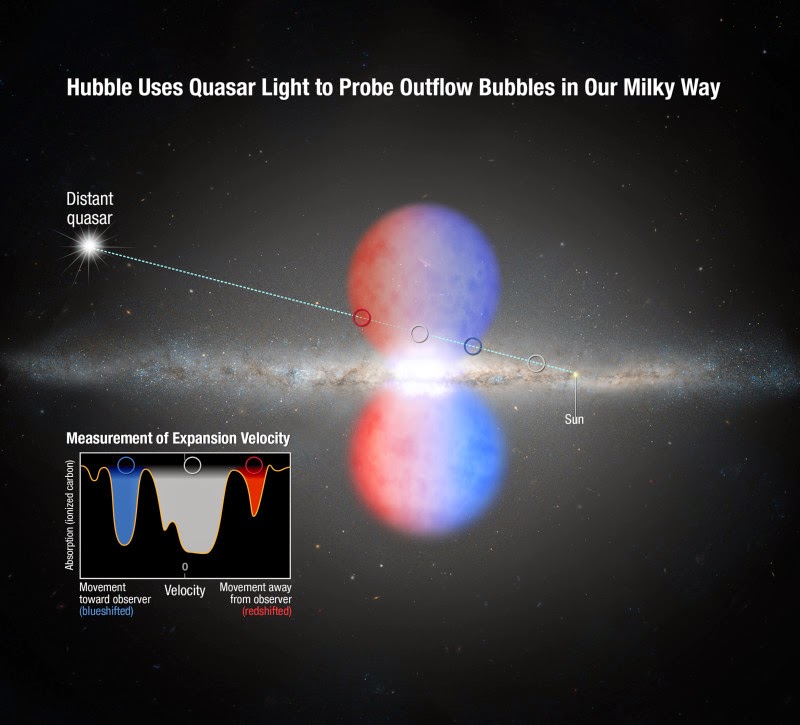
This graphic shows how NASA's Hubble Space Telescope probed the light from a distant quasar to analyze the so-called Fermi Bubbles, two lobes of material being blown out of the core of our Milky Way galaxy. The quasar's light passed through one of the bubbles. Imprinted on that light is information about the outflow's speed, composition, and eventually mass. The outflow was produced by a violent event that happened about 2 million years ago in our galaxy's core.
Credit: NASA, ESA, and A. Feild (STScI); Science: NASA, ESA, and A. Fox (STScI)
At a time when our earliest human ancestors had recently mastered walking upright, the heart of our Milky Way galaxy underwent a titanic eruption, driving gases and other material outward at 2 million miles per hour.

Now, at least 2 million years later, astronomers are witnessing the aftermath of the explosion: billowing clouds of gas towering about 30,000 light-years above and below the plane of our galaxy.

The enormous structure was discovered five years ago as a gamma-ray glow on the sky in the direction of the galactic center. The balloon-like features have since been observed in X-rays and radio waves. But astronomers needed NASA's Hubble Space Telescope to measure for the first time the velocity and composition of the mystery lobes. They now seek to calculate the mass of the material being blown out of our galaxy, which could lead them to determine the outburst's cause from several competing scenarios.

Astronomers have proposed two possible origins for the bipolar lobes: a firestorm of star birth at the Milky Way's center or the eruption of its supermassive black hole. Although astronomers have seen gaseous winds, composed of streams of charged particles, emanating from the cores of other galaxies, they are getting a unique, close-up view of our galaxy's own fireworks.

"When you look at the centers of other galaxies, the outflows appear much smaller because the galaxies are farther away," said Andrew Fox of the Space Telescope Science Institute in Baltimore, Maryland, lead researcher of the study. "But the outflowing clouds we're seeing are only 25,000 light-years away in our galaxy. We have a front-row seat. We can study the details of these structures. We can look at how big the bubbles are and can measure how much of the sky they are covering."

Fox's results will be published in The Astrophysical Journal Letters and will be presented at the American Astronomical Society meeting in Seattle, Washington.

The giant lobes, dubbed Fermi Bubbles, initially were spotted using NASA's Fermi Gamma-ray Space Telescope. The detection of high-energy gamma rays suggested that a violent event in the galaxy's core aggressively launched energized gas into space. To provide more information about the outflows, Fox used Hubble's Cosmic Origins Spectrograph (COS) to probe the ultraviolet light from a distant quasar that lies behind the base of the northern bubble. Imprinted on that light as it travels through the lobe is information about the velocity, composition, and temperature of the expanding gas inside the bubble, which only COS can provide.

Fox's team was able to measure that the gas on the near side of the bubble is moving toward Earth and the gas on the far side is travelling away. COS spectra show that the gas is rushing from the galactic center at roughly 2 million miles an hour (3 million kilometers an hour).

"This is exactly the signature we knew we would get if this was a bipolar outflow," explained Rongmon Bordoloi of the Space Telescope Science Institute, a co-author on the science paper. "This is the closest sightline we have to the galaxy's center where we can see the bubble being blown outward and energized."

The COS observations also measure, for the first time, the composition of the material being swept up in the gaseous cloud. COS detected silicon, carbon, and aluminum, indicating that the gas is enriched in the heavy elements produced inside stars and represents the fossil remnants of star formation.

COS measured the temperature of the gas at approximately 17,500 degrees Fahrenheit, which is much cooler than most of the super-hot gas in the outflow, thought to be at about 18 million degrees Fahrenheit. "We are seeing cooler gas, perhaps interstellar gas in our galaxy's disk, being swept up into that hot outflow," Fox explained.

This is the first result in a survey of 20 faraway quasars whose light passes through gas inside or just outside the Fermi Bubbles -- like a needle piercing a balloon. An analysis of the full sample will yield the amount of mass being ejected. The astronomers can then compare the outflow mass with the velocities at various locations in the bubbles to determine the amount of energy needed to drive the outburst and possibly the origin of the explosive event.

One possible cause for the outflows is a star-making frenzy near the galactic center that produces supernovas, which blow out gas. Another scenario is a star or a group of stars falling onto the Milky Way's supermassive black hole. When that happens, gas superheated by the black hole blasts deep into space. Because the bubbles are short-lived compared to the age of our galaxy, it suggests this may be a repeating phenomenon in the Milky Way's history. Whatever the trigger is, it likely occurs episodically, perhaps only when the black hole gobbles up a concentration of material.

"It looks like the outflows are a hiccup," Fox said. "There may have been repeated ejections of material that have blown up, and we're catching the latest one. By studying the light from the other quasars in our program, we may be able to detect the fossils of previous outflows."
Galactic winds are common in star-forming galaxies, such as M82, which is furiously making stars in its core. "It looks like there's a link between the amount of star formation and whether or not these outflows happen," Fox said. "Although the Milky Way overall currently produces a moderate one to two stars a year, there is a high concentration of star formation close to the core of the galaxy."

Source: Space Telescope Science Institute (STScI)

Hubble goes high def to revisit the iconic ‘Pillars of Creation'

NASA's Hubble Space Telescope has revisited the famous Pillars of Creation, revealing a sharper and wider view of the structures in this visible-light image. Astronomers combined several Hubble exposures to assemble the wider view. The towering pillars are about 5 light-years tall. The dark, finger-like feature at bottom right may be a smaller version of the giant pillars. The new image was taken with Hubble's versatile and sharp-eyed Wide Field Camera 3. The pillars are bathed in the blistering ultraviolet light from a grouping of young, massive stars located off the top of the image. Streamers of gas can be seen bleeding off the pillars as the intense radiation heats and evaporates it into space. Denser regions of the pillars are shadowing material beneath them from the powerful radiation. Stars are being born deep inside the pillars, which are made of cold hydrogen gas laced with dust. The pillars are part of a small region of the Eagle Nebula, a vast star-forming region 6,500 light-years from Earth. The colors in the image highlight emission from several chemical elements. Oxygen emission is blue, sulfur is orange, and hydrogen and nitrogen are green. Credit: NASA, ESA, and the Hubble Heritage Team (STScI/AURA)
Although NASA's Hubble Space Telescope has taken many breathtaking images of the universe, one snapshot stands out from the rest: the iconic view of the so-called "Pillars of Creation." The jaw-dropping photo, taken in 1995, revealed never-before-seen details of three giant columns of cold gas bathed in the scorching ultraviolet light from a cluster of young, massive stars in a small region of the Eagle Nebula, or M16.

Though such butte-like features are common in star-forming regions, the M16 structures are by far the most photogenic and evocative. The Hubble image is so popular that it has appeared in movies and television shows, on tee-shirts and pillows, and even on a postage stamp.

And now, in celebration of its 25th anniversary, Hubble has revisited the famous pillars, providing astronomers with a sharper and wider view. As a bonus, the pillars have been photographed in near-infrared light, as well as visible light. The infrared view transforms the pillars into eerie, wispy silhouettes seen against a background of myriad stars. That's because the infrared light penetrates much of the gas and dust, except for the densest regions of the pillars. Newborn stars can be seen hidden away inside the pillars. The new images are being unveiled at the American Astronomical Society meeting in Seattle, Washington.

Although the original image was dubbed the Pillars of Creation, the new image hints that they are also pillars of destruction. "I'm impressed by how transitory these structures are. They are actively being ablated away before our very eyes. The ghostly bluish haze around the dense edges of the pillars is material getting heated up and evaporating away into space. We have caught these pillars at a very unique and short-lived moment in their evolution," explained Paul Scowen of Arizona State University in Tempe, who, with astronomer Jeff Hester, formerly of Arizona State University, led the original Hubble observations of the Eagle Nebula.

The infrared image shows that the very ends of the pillars are dense knots of gas and dust, and they shadow the gas below them, creating the long, column-like structures. The gas in between the pillars has long since been blown away by the ionizing winds from the central star cluster located above the pillars.

At the top edge of the left-hand pillar, a gaseous fragment has been heated up and is flying away from the structure, underscoring the violent nature of star-forming regions. "These pillars represent a very dynamic, active process," Scowen said. "The gas is not being passively heated up and gently wafting away into space. The gaseous pillars are actually getting ionized (a process by which electrons are stripped off of atoms) and heated up by radiation from the massive stars. And then they are being eroded by the stars' strong winds (barrage of charged particles), which are sandblasting away the tops of these pillars."

When Scowen and Hester used Hubble to make the initial observations of the Eagle Nebula in 1995, astronomers had seen the pillar-like structures in ground-based images, but not in detail. They knew that the physical processes are not unique to the Eagle Nebula because star birth takes place across the universe. But at a distance of just 6,500 light-years, M16 is the most dramatic nearby example, as the team soon realized.

As Scowen was piecing together the Hubble exposures of the Eagle, he was amazed at what he saw. "I called Jeff Hester on his phone and said, 'You need to get here now,'" Scowen recalled. "We laid the pictures out on the table, and we were just gushing because of all the incredible detail that we were seeing for the very first time."

The first features that jumped out at the team in 1995 were the streamers of gas seemingly floating away from the columns. Astronomers had previously debated what effect nearby massive stars would have on the surrounding gas in stellar nurseries. "There is only one thing that can light up a neighborhood like this: massive stars kicking out enough horsepower in ultraviolet light to ionize the gas clouds and make them glow," Scowen said. 

"Nebulous star-forming regions like M16 are the interstellar neon signs that say, 'We just made a bunch of massive stars here.' This was the first time we had directly seen observational evidence that the erosionary process, not only the radiation but the mechanical stripping away of the gas from the columns, was actually being seen."

By comparing the 1995 and 2014 pictures, astronomers also noticed a lengthening of a narrow jet-like feature that may have been ejected from a newly forming star. The jet looks like a stream of water from a garden hose. Over the intervening 19 years, this jet has stretched farther into space, across an additional 60 billion miles, at an estimated speed of about 450,000 miles per hour.

Our Sun probably formed in a similar turbulent star-forming region. There is evidence that the forming solar system was seasoned with radioactive shrapnel from a nearby supernova. That means that our Sun was formed as part of a cluster that included stars massive enough to produce powerful ionizing radiation, such as is seen in the Eagle Nebula. "That's the only way the nebula from which the Sun was born could have been exposed to a supernova that quickly, in the short period of time that represents, because supernovae only come from massive stars, and those stars only live a few tens of millions of years," Scowen explained. 

"What that means is when you look at the environment of the Eagle Nebula or other star-forming regions, you're looking at exactly the kind of nascent environment that our Sun formed in."

New instrument reveals recipe for other Earths

How do you make an Earth-like planet? The 'test kitchen' of Earth has given us a detailed recipe, but it wasn't clear whether other planetary systems would follow the same formula. Now, astronomers have found evidence that the recipe for Earth also applies to terrestrial exoplanets orbiting distant stars. Credit: David A. Aguilar (CfA)
How do you make an Earth-like planet? The "test kitchen" of Earth has given us a detailed recipe, but it wasn't clear whether other planetary systems would follow the same formula. Now, astronomers have found evidence that the recipe for Earth also applies to terrestrial exoplanets orbiting distant stars.

"Our solar system is not as unique as we might have thought," says lead author Courtney Dressing of the Harvard-Smithsonian Center for Astrophysics (CfA). "It looks like rocky exoplanets use the same basic ingredients."

Dressing presented the research today at a meeting of the American Astronomical Society.
The key to the discovery was the HARPS-North instrument on the 3.6-meter Telescopio Nazionale Galileo in the Canary Islands. (HARPS stands for High-Accuracy Radial velocity Planet Searcher.) It is designed to accurately measure the masses of small, Earth-sized worlds. Those measurements are crucial to determine densities and therefore compositions.

"Our strategy for using HARPS-North over the past year has been to focus on planets less than two times the diameter of Earth and to study a few planets really well," explains Harvard astronomer David Charbonneau (CfA), who currently heads up the HARPS-North Science Team.

Most recently the team targeted Kepler-93b, a planet 1.5 times the size of Earth in a tight, 4.7-day orbit around its star. The mass and composition of this world were uncertain. HARPS-North nailed the mass at 4.02 times Earth, meaning that the planet has a rocky composition.

The researchers then compared all ten known exoplanets with a diameter less than 2.7 times Earth's that had accurately measured masses. They found that the five planets with diameters smaller than 1.6 times Earth showed a tight relationship between mass and size. Moreover, Venus and Earth fit onto the same line, suggesting that all these worlds have similar rock-iron compositions.

As for the larger and more massive exoplanets, their densities proved to be significantly lower, meaning that they include a large fraction of water or other volatiles, hydrogen and/or helium. They also showed more diverse compositions rather than fitting into a single group like the smaller terrestrial worlds.

The team also noted that not all planets less than six times the mass of Earth are rocky. Some low-mass worlds with very low densities are known (such as the planets in the Kepler-11 system). But for typical close-in small planets, the chances are high that they share an Earth-like composition.

"To find a truly Earth-like world, we should focus on planets less than 1.6 times the size of 
Earth, because those are the rocky worlds," recommends Dressing.

Making Other Earths

Makes one small model planet

Ingredients:
  • 1 cup magnesium
  • 1 cup silicon
  • 2 cups iron
  • 2 cups oxygen
  • 1/2 teaspoon aluminum
  • 1/2 teaspoon nickel
  • 1/2 teaspoon calcium
  • 1/4 teaspoon sulfur
  • dash of water delivered by asteroids
Blend well in a large bowl, shape into a round ball with your hands and place it neatly in a habitable zone area around a young star. Do not over mix. Heat until mixture becomes a white hot glowing ball. Bake for a few million years. Cool until color changes from white to yellow to red and a golden-brown crust forms. It should not give off light anymore. Season with a dash of water and organic compounds. It will shrink a bit as steam escapes and clouds and oceans form. Stand back and wait a few more million years to see what happens. If you are lucky, a thin frosting of life may appear on the surface of your new world.

Source: Harvard-Smithsonian Center for Astrophysics

Green light for European Extremely Large Telescope construction

This artist’s impression shows the European Extremely Large Telescope (E-ELT) in its enclosure. The E-ELT will be a 39-metre aperture optical and infrared telescope sited on Cerro Armazones in the Chilean Atacama Desert, 20 kilometres from ESO’s Very Large Telescope on Cerro Paranal. It will be the world’s largest “eye on the sky”. Credit: ESO/L. Calรงada
At a recent meeting ESO's main governing body, the Council* gave the green light for the construction of the European Extremely Large Telescope (E-ELT) in two phases. Spending of around one billion euros has been authorised for the first phase, which will cover the construction costs of a fully working telescope with a suite of powerful instruments and first light targeted in ten years time. It will enable tremendous scientific discoveries in the fields of exoplanets, the stellar composition of nearby galaxies and the deep Universe. The largest ESO contract ever, for the telescope dome and main structure, will be placed within the next year.

The E-ELT will be a 39-metre aperture optical and infrared telescope sited on Cerro Armazones in the Chilean Atacama Desert, 20 kilometres from ESO's Very Large Telescope on Cerro Paranal. It will be the world's largest "eye on the sky."

"The decision taken by Council means that the telescope can now be built, and that major industrial construction work for the E-ELT is now funded and can proceed according to plan. There is already a lot of progress in Chile on the summit of Armazones and the next few years will be very exciting," said Tim de Zeeuw, ESO's Director General.

The construction of the E-ELT was approved by ESO's Council in June 2012 under the condition that contracts with a value larger than 2 million euros could only be awarded once the total cost of the telescope (1083 million euros at 2012 prices) was funded to a 90% level. An exception was granted for the civil works at the site, which started with the groundbreaking ceremony in June 2014 and are making good progress.

For the time being, 10% of the overall project costs have been shifted to a second phase. With the accession of Poland to ESO, the current funding commitments to the E-ELT have now reached more than 90% of the total cost of the first phase that will bring a fully working E-ELT. Additional commitments from upcoming Member State Brazil are expected in the coming years.

To prevent the project from slipping, the ESO Council has decided that construction of the first phase of the 39-metre telescope can now proceed. This funded work includes the contract for the telescope's dome and main structure -- the largest in ESO's history -- which will be awarded in late 2015, and leads to the construction of a fully working E-ELT.

Telescope components that are not yet funded include parts of the adaptive optics system, some of the instrument work, the innermost five rings of segments of the telescope's main mirror (210 mirror segments) and a spare set of primary mirror segments needed for more efficient telescope operation in the future. The construction of these components, whose postponement does not reduce the extraordinary scientific achievements the telescope will already be able to accomplish at the end of phase one, will be approved as additional funding becomes available, including that expected from the upcoming Member State Brazil.

"The funds that are now committed will allow the construction of a fully working E-ELT that will be the most powerful of all the extremely large telescope projects currently planned, with superior light collecting area and instrumentation. It will allow the initial characterisation of Earth-mass exoplanets, the study of the resolved stellar populations in nearby galaxies as well as ultra-sensitive observations of the deep Universe," concludes Tim de Zeeuw.

*The decision needed ten positive votes (out of fourteen). Eleven positive votes were obtained. Three out of the fourteen votes are ad referendum votes, which means that they are to be considered as provisionally positive and are subject to confirmation by the authorities in these three Member States, before the next Council meeting.

Ground-based detection of super-Earth transit paves way to remote sensing of exoplanets

This artist's conception shows the super-Earth 55 Cancri e (right) compared to the Earth (left). Astronomers using a ground-based telescope have measure the transit of 55 Cancri e for the first time. It is the shallowest transit ever detected from the ground. Credit: NASA/JPL
Astronomers have measured the passing of a super-Earth in front of a bright, nearby Sun-like star using a ground-based telescope for the first time. The transit of the exoplanet 55 Cancri e is the shallowest detected from the ground yet. Since detecting a transit is the first step in analyzing a planet's atmosphere, this success bodes well for characterizing the many small planets that upcoming space missions are expected to discover in the next few years.

The international research team used the 2.5-meter Nordic Optical Telescope on the island of La Palma, Spain, a moderate-sized facility by today's standards but equipped with state-of-the-art instruments, to make the detection. Previous observations of this planet transit had to rely on space-borne telescopes.

The host star, 55 Cancri, is located just 40 light-years away from us and is visible to the naked eye. During its transit, the planet crosses 55 Cancri and blocks a tiny fraction of the starlight, dimming the star by 1/2000th (or 0.05%) for almost two hours. This shows that the planet is about twice the size of Earth, or 16,000 miles in diameter.

"Our observations show that we can detect the transits of small planets around Sun-like stars using ground-based telescopes," says Ernst de Mooij of Queen's University Belfast in the United Kingdom, lead author of the study.

He continues, "This is especially important because upcoming space missions such as TESS and PLATO should find many small planets around bright stars and we will want to follow up the discoveries with ground-based instruments."

TESS is a NASA mission scheduled for launch in 2017, while PLATO is to be launched in 2024 by the European Space Agency; both will search for transiting terrestrial planets around nearby bright stars.

"With this result we are also closing in on the detection of the atmospheres of small planets with ground-based telescopes," says co-author Mercedes Lopez-Morales of the Harvard-Smithsonian Center for Astrophysics (CfA). "We are slowly paving the way toward the detection of bio-signatures in Earth-like planets around nearby stars."

"It's remarkable what we can do by pushing the limits of existing telescopes and instruments, despite the complications posed by the Earth's own turbulent atmosphere," says study co-author Ray Jayawardhana of York Univerity in Canada. "Remote sensing across tens of light-years isn't easy, but it can be done with the right technique and a bit of ingenuity."

The planet 55 Cancri e is about twice as big and eight times as massive as Earth. With a period of 18 hours, it is the innermost of five planets in the system. Because of its proximity to the host star, the planet's dayside temperature reaches over 3100° Fahrenheit (1700° Celsius), hot enough to melt metal, with conditions far from hospitable to life. Initially identified a decade ago through radial velocity measurements, it was later confirmed through transit observations with the MOST and Spitzer space telescopes.

Until now, the transits of only one other super-Earth, GJ 1214b circling a red dwarf, had been observed with ground-based telescopes. The Earth's roiling air makes such observations extremely difficult. But the team's success with 55 Cancri e raises the prospects of characterizing dozens of super-Earths likely to be revealed by upcoming surveys.

"We expect these surveys to find so many nearby, terrestrial worlds that space telescopes simply won't be able to follow up on all of them. Future ground-based instrumentation will be key, and this study shows it can be done," adds Lopez-Morales.

The research team also includes Raine Karjalainen and Marie Hrudkova of the Isaac Newton Group of Telescopes. Their findings appear in a paper to be published in The Astrophysical Journal Letters.

Headquartered in Cambridge, Mass., the Harvard-Smithsonian Center for Astrophysics (CfA) is a joint collaboration between the Smithsonian Astrophysical Observatory and the Harvard College Observatory. CfA scientists, organized into six research divisions, study the origin, evolution and ultimate fate of the universe.

Source: Harvard-Smithsonian Center for Astrophysics

Astronomy: Debris-strewn exoplanetary construction yards

This is a set of images from a NASA Hubble Space Telescope survey of the architecture of debris systems around young stars. Ten previously discovered circumstellar debris systems, plus MP Mus (a mature protoplanetary disk of age comparable to the youngest of the debris disks), were studied. Hubble's sharp view uncovers an unexpected diversity and complexity in the structures. The disk-like structures are vast, many times larger than the planetary distribution in our solar system. Some disks are tilted edge-on to our view, others nearly face-on. Asymmetries and warping in the disks might be caused by the host star's passage though interstellar space. Alternatively, the disks may be affected by the action of unseen planets. In particular, the asymmetry in HD 181327 looks like a spray of material that is very distant from its host star. It might be the aftermath of a collision between two small bodies, suggesting that the unseen planetary system may be chaotic. The stars surveyed may be as young as 10 million years old and as mature as more than 1 billion years old. The visible-light survey was done with the Space Telescope Imaging Spectrograph (STIS). The STIS coronagraph blocks out the light from the host star so that the very faint reflected light from the dust structures can be seen. The images have been artificially colored to enhance detail. Credit: NASA, ESA, G. Schneider (University of Arizona), and the HST/GO 12228 Team
Astronomers using NASA's Hubble Space Telescope have completed the largest and most sensitive visible-light imaging survey of dusty debris disks around other stars. These dusty disks, likely created by collisions between leftover objects from planet formation, were imaged around stars as young as 10 million years old and as mature as more than 1 billion years old.

"It's like looking back in time to see the kinds of destructive events that once routinely happened in our solar system after the planets formed," said survey leader Glenn Schneider of the University of Arizona's Steward Observatory. The survey's results appeared in the Oct. 1, 2014, issue of The Astronomical Journal.

Once thought to be simply pancake-like structures, the unexpected diversity and complexity and varying distribution of dust among these debris systems strongly suggest these disks are gravitationally affected by unseen planets orbiting the star. Alternatively, these effects could result from the stars' passing through interstellar space.

The researchers discovered that no two "disks" of material surrounding stars look the same. 
"We find that the systems are not simply flat with uniform surfaces," Schneider said. "These are actually pretty complicated three-dimensional debris systems, often with embedded smaller structures. Some of the substructures could be signposts of unseen planets." The astronomers used Hubble's Space Telescope Imaging Spectrograph to study 10 previously discovered circumstellar debris systems, plus comparatively, MP Mus, a mature protoplanetary disk of age comparable to the youngest of the debris disks.

Irregularities observed in one ring-like system in particular, around a star called HD 181327, resemble the ejection of a huge spray of debris into the outer part of the system from the recent collision of two bodies.

"This spray of material is fairly distant from its host star -- roughly twice the distance that Pluto is from the Sun," said co-investigator Christopher Stark of NASA's Goddard Space Flight Center, Greenbelt, Maryland. "Catastrophically destroying an object that massive at such a large distance is difficult to explain, and it should be very rare. If we are in fact seeing the recent aftermath of a massive collision, the unseen planetary system may be quite chaotic."

Another interpretation for the irregularities is that the disk has been mysteriously warped by the star's passage through interstellar space, directly interacting with unseen interstellar material. "Either way, the answer is exciting," Schneider said. "Our team is currently analyzing follow-up observations that will help reveal the true cause of the irregularity."

Over the past few years astronomers have found an incredible diversity in the architecture of exoplanetary systems -- planets are arranged in orbits that are markedly different than found in our solar system. "We are now seeing a similar diversity in the architecture of accompanying debris systems," Schneider said. "How are the planets affecting the disks, and how are the disks affecting the planets? There is some sort of interdependence between a planet and the accompanying debris that might affect the evolution of these exoplanetary debris systems."

From this small sample, the most important message to take away is one of diversity, Schneider said. He added that astronomers really need to understand the internal and external influences on these systems, such as stellar winds and interactions with clouds of interstellar material, and how they are influenced by the mass and age of the parent star, and the abundance of heavier elements needed to build planets.

Though astronomers have found nearly 4,000 exoplanet candidates since 1995, mostly by indirect detection methods, only about two dozen light-scattering, circumstellar debris systems have been imaged over that same time period. That's because the disks are typically 100,000 times fainter than, and often very close to, their bright parent stars. The majority have been seen because of Hubble's ability to perform high-contrast imaging, in which the overwhelming light from the star is blocked to reveal the faint disk that surrounds the star.

The new imaging survey also yields insight into how our solar system formed and evolved 4.6 billion years ago. In particular, the suspected planet collision seen in the disk around HD 181327 may be similar to how the Earth-Moon system formed, as well as the Pluto-Charon system over 4 billion years ago. In those cases, collisions between planet-sized bodies cast debris that then coalesced into a companion moon.

Source: Space Telescope Science Institute (STScI)
 
Support : Creating Website | Johny Template | Mas Template
Copyright © 2011. The planet wall - All Rights Reserved
Template Created by Easy Blogging Published by Mas Template
Proudly powered by Blogger