 |
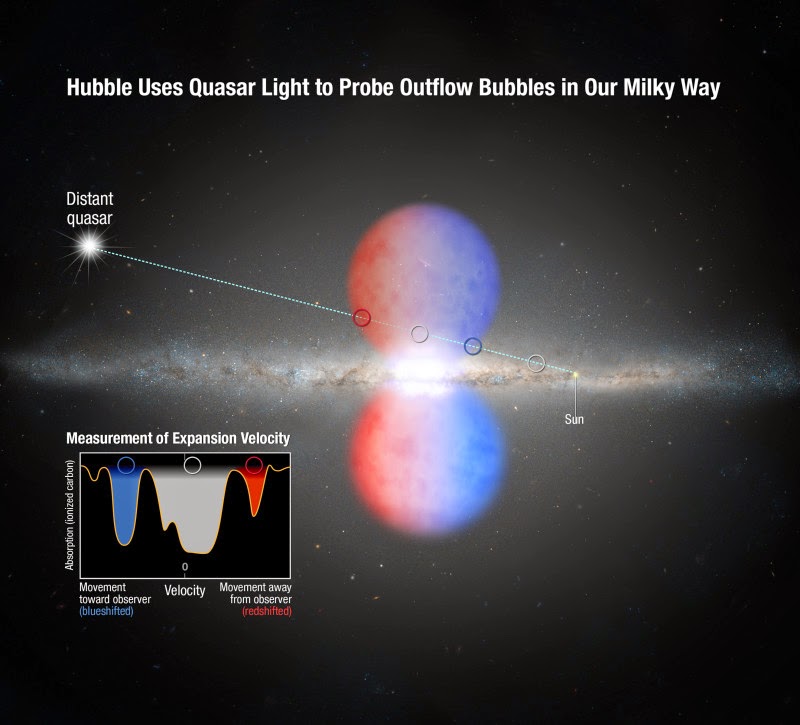
| This graphic shows how NASA's Hubble Space Telescope probed the light from a distant quasar to analyze the so-called Fermi Bubbles, two lobes of material being blown out of the core of our Milky Way galaxy. The quasar's light passed through one of the bubbles. Imprinted on that light is information about the outflow's speed, composition, and eventually mass. The outflow was produced by a violent event that happened about 2 million years ago in our galaxy's core. Credit: NASA, ESA, and A. Feild (STScI); Science: NASA, ESA, and A. Fox (STScI) |
Now, at least 2 million years later, astronomers are witnessing the aftermath of the explosion: billowing clouds of gas towering about 30,000 light-years above and below the plane of our galaxy.
The enormous structure was discovered five years ago as a gamma-ray glow on the sky in the direction of the galactic center. The balloon-like features have since been observed in X-rays and radio waves. But astronomers needed NASA's Hubble Space Telescope to measure for the first time the velocity and composition of the mystery lobes. They now seek to calculate the mass of the material being blown out of our galaxy, which could lead them to determine the outburst's cause from several competing scenarios.
Astronomers have proposed two possible origins for the bipolar lobes: a firestorm of star birth at the Milky Way's center or the eruption of its supermassive black hole. Although astronomers have seen gaseous winds, composed of streams of charged particles, emanating from the cores of other galaxies, they are getting a unique, close-up view of our galaxy's own fireworks.
"When you look at the centers of other galaxies, the outflows appear much smaller because the galaxies are farther away," said Andrew Fox of the Space Telescope Science Institute in Baltimore, Maryland, lead researcher of the study. "But the outflowing clouds we're seeing are only 25,000 light-years away in our galaxy. We have a front-row seat. We can study the details of these structures. We can look at how big the bubbles are and can measure how much of the sky they are covering."
Fox's results will be published in The Astrophysical Journal Letters and will be presented at the American Astronomical Society meeting in Seattle, Washington.
The giant lobes, dubbed Fermi Bubbles, initially were spotted using NASA's Fermi Gamma-ray Space Telescope. The detection of high-energy gamma rays suggested that a violent event in the galaxy's core aggressively launched energized gas into space. To provide more information about the outflows, Fox used Hubble's Cosmic Origins Spectrograph (COS) to probe the ultraviolet light from a distant quasar that lies behind the base of the northern bubble. Imprinted on that light as it travels through the lobe is information about the velocity, composition, and temperature of the expanding gas inside the bubble, which only COS can provide.
Fox's team was able to measure that the gas on the near side of the bubble is moving toward Earth and the gas on the far side is travelling away. COS spectra show that the gas is rushing from the galactic center at roughly 2 million miles an hour (3 million kilometers an hour).
"This is exactly the signature we knew we would get if this was a bipolar outflow," explained Rongmon Bordoloi of the Space Telescope Science Institute, a co-author on the science paper. "This is the closest sightline we have to the galaxy's center where we can see the bubble being blown outward and energized."
The COS observations also measure, for the first time, the composition of the material being swept up in the gaseous cloud. COS detected silicon, carbon, and aluminum, indicating that the gas is enriched in the heavy elements produced inside stars and represents the fossil remnants of star formation.
COS measured the temperature of the gas at approximately 17,500 degrees Fahrenheit, which is much cooler than most of the super-hot gas in the outflow, thought to be at about 18 million degrees Fahrenheit. "We are seeing cooler gas, perhaps interstellar gas in our galaxy's disk, being swept up into that hot outflow," Fox explained.
This is the first result in a survey of 20 faraway quasars whose light passes through gas inside or just outside the Fermi Bubbles -- like a needle piercing a balloon. An analysis of the full sample will yield the amount of mass being ejected. The astronomers can then compare the outflow mass with the velocities at various locations in the bubbles to determine the amount of energy needed to drive the outburst and possibly the origin of the explosive event.
One possible cause for the outflows is a star-making frenzy near the galactic center that produces supernovas, which blow out gas. Another scenario is a star or a group of stars falling onto the Milky Way's supermassive black hole. When that happens, gas superheated by the black hole blasts deep into space. Because the bubbles are short-lived compared to the age of our galaxy, it suggests this may be a repeating phenomenon in the Milky Way's history. Whatever the trigger is, it likely occurs episodically, perhaps only when the black hole gobbles up a concentration of material.
"It looks like the outflows are a hiccup," Fox said. "There may have been repeated ejections of material that have blown up, and we're catching the latest one. By studying the light from the other quasars in our program, we may be able to detect the fossils of previous outflows."
Galactic winds are common in star-forming galaxies, such as M82, which is furiously making stars in its core. "It looks like there's a link between the amount of star formation and whether or not these outflows happen," Fox said. "Although the Milky Way overall currently produces a moderate one to two stars a year, there is a high concentration of star formation close to the core of the galaxy."
Source: Space Telescope Science Institute (STScI)


