Latest Post
Showing posts with label GALAXIES. Show all posts

Space Hubble's Little Sombrero

Written By Unknown on Friday, February 6, 2015 | 6:54 PM

European Space Agency Credit: ESA/Hubble & NASA
         European Space Agency Credit: ESA/Hubble & NASA

Galaxies can take many shapes and be oriented any way relative to us in the sky. This can make it hard to figure out their actual morphology, as a galaxy can look very different from different viewpoints. A special case is when we are lucky enough to observe a spiral galaxy directly from its edge, providing us with a spectacular view like the one seen in this picture of the week.

This is NGC 7814, also known as the “Little Sombrero.” Its larger namesake, the Sombrero Galaxy, is another stunning example of an edge-on galaxy — in fact, the “Little Sombrero” is about the same size as its bright namesake at about 60,000 light-years across, but as it lies farther away, and so appears smaller in the sky.

NGC 7814 has a bright central bulge and a bright halo of glowing gas extending outwards into space. The dusty spiral arms appear as dark streaks. They consist of dusty material that absorbs and blocks light from the galactic center behind it. The field of view of this NASA/ESA Hubble Space Telescope image would be very impressive even without NGC 7814 in front; nearly all the objects seen in this image are galaxies as well. 

Source: Nasa


Black holes follow the rules

Written By Unknown on Wednesday, January 28, 2015 | 1:10 AM

Artist's impression of a black hole at the centre of a galaxy. Credit: Gabriel Pérez Díaz.
Rather than having random sizes, massive black holes seem to follow a predictable rule in relation to the physical properties of the galaxy in which they are located.

Research at Swinburne University of Technology has shown that it is possible to predict the masses of black holes in galaxies for which it was previously thought not possible.

In large galaxies, the central black hole is related to the mass of the spheroid-shaped distribution of stars at the centre of the galaxy, known as the galaxy’s 'bulge'.

Some astronomers have claimed that the size of black holes at the centres of galaxies with small bulges was unrelated to the bulge.

Even the four million solar mass black hole in the bulge of our Milky Way galaxy was thought to be arbitrarily low relative to trends defined by their more massive, and therefore easier to detect, counterparts.

However, in previous work Swinburne Professor Alister Graham, lead-author of the current research, identified a new relationship involving black holes in galaxies with small bulges.  He demonstrated that the black hole in the bulge of the Milky Way was not set by chance but instead followed an astronomical rule.

“The formula is quadratic, in that the black hole mass quadruples every time the bulge mass doubles,” Professor Graham said. “Therefore, if the bulge mass increases 10 times, the black hole mass increases 100 times.”

Now, after studying more than 100 galaxies with black holes 4 to 40 times less massive than our Milky Way's black hole, they too have been found to follow this same rule.

"It turns out that there is yet more order in our Universe than previously appreciated,” Professor Graham said.

"This is exciting not just because it provides further insight into the mechanics of black hole formation, but because of the predictions it allows us to make."

The gravitational collapse of massive stars can produce black holes up to a few tens of times the mass of our Sun. And black holes that are one-tenth of a million to ten billion times the mass of our Sun have been identified at the centres of giant galaxies. However, there is a missing population of intermediate-mass black holes.

Astronomers don't know if this is because of observational difficulties in finding them, or if the massive black holes at the centres of galaxies start life as 100,000 solar mass seed black holes that formed in the early Universe.

This latest result, which extends the new rule to 40-times lower masses, gives astronomers some confidence that it may extend even further, so the smallest bulges might host these missing intermediate-mass black holes. 

"If confirmed, it would imply tremendous black hole appetites", co-author of the study, Dr Nicholas Scott, said. "There would need to be a dramatic growth of these small black holes relative to their host bulge, with the bulges growing via the creation of stars out of gas clouds while the black holes devour both gas and stars."

The researchers have identified a few dozen candidate galaxies in which they think intermediate-mass black holes may be hiding.  Future observations, with facilities such as the Square Kilometre Array and space-based X-ray telescopes, are expected to help resolve this black hole mystery.

Source: Swinburne

Record-breaking black hole outburst detected

Written By Unknown on Monday, January 5, 2015 | 9:30 PM

An image of a simulation of the gas cloud’s encounter with Sgr A*. The blue lines mark the orbits of the so-called “S” stars that are in close orbits around the supermassive black hole.
Credit: Image by ESO/MPE/Marc Schartmann
Last September, after years of watching, a team of scientists led by Amherst College astronomy professor Daryl Haggard observed and recorded the largest-ever flare in X-rays from a supermassive black hole at the center of the Milky Way. The astronomical event, which was detected by NASA's Chandra X-ray Observatory, puts the scientific community one step closer to understanding the nature and behavior of supermassive black holes.

Haggard and her colleagues discussed the flare today during this year's meeting of the American Astronomical Society in Seattle.

Supermassive black holes are the largest of black holes, and all large galaxies have one. The one at the center of our galaxy, the Milky Way, is called Sagittarius A* (or, Sgr A*, as it is called), and scientists estimate that it contains about four and a half million times the mass of our Sun.

Scientists working with Chandra have observed Sgr A* repeatedly since the telescope was launched into space in 1999. Haggard and fellow astronomers were originally using Chandra to see if Sgr A* would consume parts of a cloud of gas, known as G2.

"Unfortunately, the G2 gas cloud didn't produce the fireworks we were hoping for when it got close to Sgr A*," she said. "However, nature often surprises us and we saw something else that was really exciting."

Haggard and her team detected an X-ray outburst last September that was 400 times brighter than the usual X-ray output from Sgr A*. This "megaflare" was nearly three times brighter than the previous record holder that was seen in early 2012. A second enormous X-ray flare, 200 times brighter than Sgr A* in its quiet state, was observed with Chandra on October 20, 2014.

Haggard and her team have two main ideas about what could be causing Sgr A* to erupt in this extreme way. One hypothesis is that the gravity of the supermassive black hole has torn apart a couple of asteroids that wandered too close. The debris from such a "tidal disruption" would become very hot and produce X-rays before disappearing forever across the black hole's point of no return (called the "event horizon").

"If an asteroid was torn apart, it would go around the black hole for a couple of hours -- like water circling an open drain -- before falling in," said colleague and co-principal investigator Fred Baganoff of the Massachusetts Institute of Technology in Cambridge, MA. "That's just how long we saw the brightest X-ray flare last, so that is an intriguing clue for us to consider."

If that theory holds up, it means astronomers have found evidence for the largest asteroid ever to be torn apart by the Milky Way's black hole.

Another, different idea is that the magnetic field lines within the material flowing towards Sgr A* are packed incredibly tightly. If this were the case, these field lines would occasionally interconnect and reconfigure themselves. When this happens, their magnetic energy is converted into the energy of motion, heat and the acceleration of particles -- which could produce a bright X-ray flare. Such magnetic flares are seen on the Sun, and the Sgr A* flares have a similar pattern of brightness levels to the solar events.

"At the moment, we can't distinguish between these two very different ideas," said Haggard. "It's exciting to identify tensions between models and to have a chance to resolve them with present and future observations."

In addition to the giant flares, Haggard and her team also collected more data on a magnetar -- a neutron star with a strong magnetic field -- located close to Sgr A*. This magnetar is undergoing a long X-ray outburst, and the Chandra data are allowing astronomers to better understand this unusual object.

As for the G2: Astronomers estimate that the gas cloud made its closest approach -- still about 15 billion miles away from the edge of the black hole -- in the spring of 2014. The researchers estimate the record breaking X-ray flares were produced about a hundred times closer to the black hole, making it very unlikely that the Chandra flares were associated with G2.

Milky Way core drives wind at 2 million miles per hour

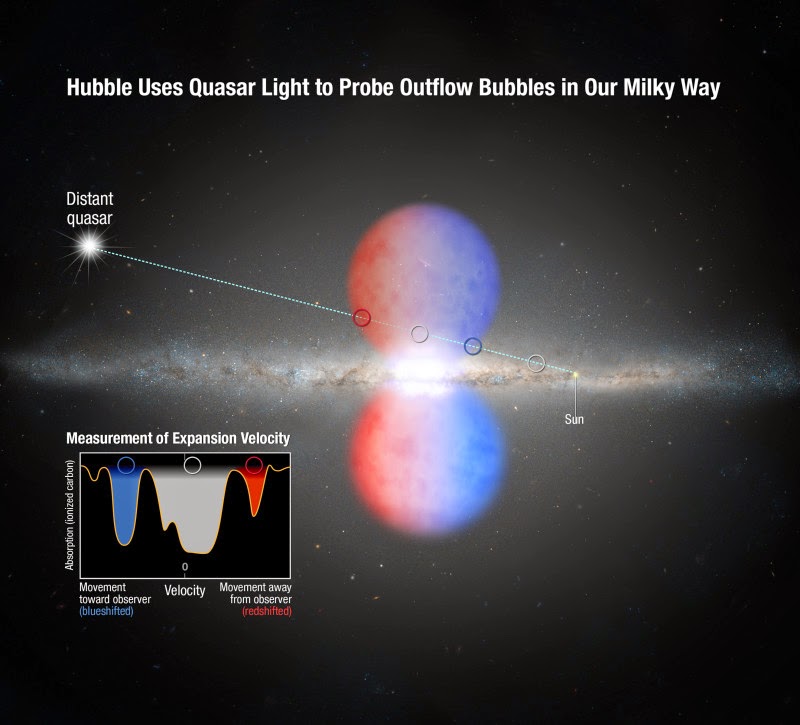
This graphic shows how NASA's Hubble Space Telescope probed the light from a distant quasar to analyze the so-called Fermi Bubbles, two lobes of material being blown out of the core of our Milky Way galaxy. The quasar's light passed through one of the bubbles. Imprinted on that light is information about the outflow's speed, composition, and eventually mass. The outflow was produced by a violent event that happened about 2 million years ago in our galaxy's core.
Credit: NASA, ESA, and A. Feild (STScI); Science: NASA, ESA, and A. Fox (STScI)
At a time when our earliest human ancestors had recently mastered walking upright, the heart of our Milky Way galaxy underwent a titanic eruption, driving gases and other material outward at 2 million miles per hour.

Now, at least 2 million years later, astronomers are witnessing the aftermath of the explosion: billowing clouds of gas towering about 30,000 light-years above and below the plane of our galaxy.

The enormous structure was discovered five years ago as a gamma-ray glow on the sky in the direction of the galactic center. The balloon-like features have since been observed in X-rays and radio waves. But astronomers needed NASA's Hubble Space Telescope to measure for the first time the velocity and composition of the mystery lobes. They now seek to calculate the mass of the material being blown out of our galaxy, which could lead them to determine the outburst's cause from several competing scenarios.

Astronomers have proposed two possible origins for the bipolar lobes: a firestorm of star birth at the Milky Way's center or the eruption of its supermassive black hole. Although astronomers have seen gaseous winds, composed of streams of charged particles, emanating from the cores of other galaxies, they are getting a unique, close-up view of our galaxy's own fireworks.

"When you look at the centers of other galaxies, the outflows appear much smaller because the galaxies are farther away," said Andrew Fox of the Space Telescope Science Institute in Baltimore, Maryland, lead researcher of the study. "But the outflowing clouds we're seeing are only 25,000 light-years away in our galaxy. We have a front-row seat. We can study the details of these structures. We can look at how big the bubbles are and can measure how much of the sky they are covering."

Fox's results will be published in The Astrophysical Journal Letters and will be presented at the American Astronomical Society meeting in Seattle, Washington.

The giant lobes, dubbed Fermi Bubbles, initially were spotted using NASA's Fermi Gamma-ray Space Telescope. The detection of high-energy gamma rays suggested that a violent event in the galaxy's core aggressively launched energized gas into space. To provide more information about the outflows, Fox used Hubble's Cosmic Origins Spectrograph (COS) to probe the ultraviolet light from a distant quasar that lies behind the base of the northern bubble. Imprinted on that light as it travels through the lobe is information about the velocity, composition, and temperature of the expanding gas inside the bubble, which only COS can provide.

Fox's team was able to measure that the gas on the near side of the bubble is moving toward Earth and the gas on the far side is travelling away. COS spectra show that the gas is rushing from the galactic center at roughly 2 million miles an hour (3 million kilometers an hour).

"This is exactly the signature we knew we would get if this was a bipolar outflow," explained Rongmon Bordoloi of the Space Telescope Science Institute, a co-author on the science paper. "This is the closest sightline we have to the galaxy's center where we can see the bubble being blown outward and energized."

The COS observations also measure, for the first time, the composition of the material being swept up in the gaseous cloud. COS detected silicon, carbon, and aluminum, indicating that the gas is enriched in the heavy elements produced inside stars and represents the fossil remnants of star formation.

COS measured the temperature of the gas at approximately 17,500 degrees Fahrenheit, which is much cooler than most of the super-hot gas in the outflow, thought to be at about 18 million degrees Fahrenheit. "We are seeing cooler gas, perhaps interstellar gas in our galaxy's disk, being swept up into that hot outflow," Fox explained.

This is the first result in a survey of 20 faraway quasars whose light passes through gas inside or just outside the Fermi Bubbles -- like a needle piercing a balloon. An analysis of the full sample will yield the amount of mass being ejected. The astronomers can then compare the outflow mass with the velocities at various locations in the bubbles to determine the amount of energy needed to drive the outburst and possibly the origin of the explosive event.

One possible cause for the outflows is a star-making frenzy near the galactic center that produces supernovas, which blow out gas. Another scenario is a star or a group of stars falling onto the Milky Way's supermassive black hole. When that happens, gas superheated by the black hole blasts deep into space. Because the bubbles are short-lived compared to the age of our galaxy, it suggests this may be a repeating phenomenon in the Milky Way's history. Whatever the trigger is, it likely occurs episodically, perhaps only when the black hole gobbles up a concentration of material.

"It looks like the outflows are a hiccup," Fox said. "There may have been repeated ejections of material that have blown up, and we're catching the latest one. By studying the light from the other quasars in our program, we may be able to detect the fossils of previous outflows."
Galactic winds are common in star-forming galaxies, such as M82, which is furiously making stars in its core. "It looks like there's a link between the amount of star formation and whether or not these outflows happen," Fox said. "Although the Milky Way overall currently produces a moderate one to two stars a year, there is a high concentration of star formation close to the core of the galaxy."

Source: Space Telescope Science Institute (STScI)

Hubble goes high def to revisit the iconic ‘Pillars of Creation'

NASA's Hubble Space Telescope has revisited the famous Pillars of Creation, revealing a sharper and wider view of the structures in this visible-light image. Astronomers combined several Hubble exposures to assemble the wider view. The towering pillars are about 5 light-years tall. The dark, finger-like feature at bottom right may be a smaller version of the giant pillars. The new image was taken with Hubble's versatile and sharp-eyed Wide Field Camera 3. The pillars are bathed in the blistering ultraviolet light from a grouping of young, massive stars located off the top of the image. Streamers of gas can be seen bleeding off the pillars as the intense radiation heats and evaporates it into space. Denser regions of the pillars are shadowing material beneath them from the powerful radiation. Stars are being born deep inside the pillars, which are made of cold hydrogen gas laced with dust. The pillars are part of a small region of the Eagle Nebula, a vast star-forming region 6,500 light-years from Earth. The colors in the image highlight emission from several chemical elements. Oxygen emission is blue, sulfur is orange, and hydrogen and nitrogen are green. Credit: NASA, ESA, and the Hubble Heritage Team (STScI/AURA)
Although NASA's Hubble Space Telescope has taken many breathtaking images of the universe, one snapshot stands out from the rest: the iconic view of the so-called "Pillars of Creation." The jaw-dropping photo, taken in 1995, revealed never-before-seen details of three giant columns of cold gas bathed in the scorching ultraviolet light from a cluster of young, massive stars in a small region of the Eagle Nebula, or M16.

Though such butte-like features are common in star-forming regions, the M16 structures are by far the most photogenic and evocative. The Hubble image is so popular that it has appeared in movies and television shows, on tee-shirts and pillows, and even on a postage stamp.

And now, in celebration of its 25th anniversary, Hubble has revisited the famous pillars, providing astronomers with a sharper and wider view. As a bonus, the pillars have been photographed in near-infrared light, as well as visible light. The infrared view transforms the pillars into eerie, wispy silhouettes seen against a background of myriad stars. That's because the infrared light penetrates much of the gas and dust, except for the densest regions of the pillars. Newborn stars can be seen hidden away inside the pillars. The new images are being unveiled at the American Astronomical Society meeting in Seattle, Washington.

Although the original image was dubbed the Pillars of Creation, the new image hints that they are also pillars of destruction. "I'm impressed by how transitory these structures are. They are actively being ablated away before our very eyes. The ghostly bluish haze around the dense edges of the pillars is material getting heated up and evaporating away into space. We have caught these pillars at a very unique and short-lived moment in their evolution," explained Paul Scowen of Arizona State University in Tempe, who, with astronomer Jeff Hester, formerly of Arizona State University, led the original Hubble observations of the Eagle Nebula.

The infrared image shows that the very ends of the pillars are dense knots of gas and dust, and they shadow the gas below them, creating the long, column-like structures. The gas in between the pillars has long since been blown away by the ionizing winds from the central star cluster located above the pillars.

At the top edge of the left-hand pillar, a gaseous fragment has been heated up and is flying away from the structure, underscoring the violent nature of star-forming regions. "These pillars represent a very dynamic, active process," Scowen said. "The gas is not being passively heated up and gently wafting away into space. The gaseous pillars are actually getting ionized (a process by which electrons are stripped off of atoms) and heated up by radiation from the massive stars. And then they are being eroded by the stars' strong winds (barrage of charged particles), which are sandblasting away the tops of these pillars."

When Scowen and Hester used Hubble to make the initial observations of the Eagle Nebula in 1995, astronomers had seen the pillar-like structures in ground-based images, but not in detail. They knew that the physical processes are not unique to the Eagle Nebula because star birth takes place across the universe. But at a distance of just 6,500 light-years, M16 is the most dramatic nearby example, as the team soon realized.

As Scowen was piecing together the Hubble exposures of the Eagle, he was amazed at what he saw. "I called Jeff Hester on his phone and said, 'You need to get here now,'" Scowen recalled. "We laid the pictures out on the table, and we were just gushing because of all the incredible detail that we were seeing for the very first time."

The first features that jumped out at the team in 1995 were the streamers of gas seemingly floating away from the columns. Astronomers had previously debated what effect nearby massive stars would have on the surrounding gas in stellar nurseries. "There is only one thing that can light up a neighborhood like this: massive stars kicking out enough horsepower in ultraviolet light to ionize the gas clouds and make them glow," Scowen said. 

"Nebulous star-forming regions like M16 are the interstellar neon signs that say, 'We just made a bunch of massive stars here.' This was the first time we had directly seen observational evidence that the erosionary process, not only the radiation but the mechanical stripping away of the gas from the columns, was actually being seen."

By comparing the 1995 and 2014 pictures, astronomers also noticed a lengthening of a narrow jet-like feature that may have been ejected from a newly forming star. The jet looks like a stream of water from a garden hose. Over the intervening 19 years, this jet has stretched farther into space, across an additional 60 billion miles, at an estimated speed of about 450,000 miles per hour.

Our Sun probably formed in a similar turbulent star-forming region. There is evidence that the forming solar system was seasoned with radioactive shrapnel from a nearby supernova. That means that our Sun was formed as part of a cluster that included stars massive enough to produce powerful ionizing radiation, such as is seen in the Eagle Nebula. "That's the only way the nebula from which the Sun was born could have been exposed to a supernova that quickly, in the short period of time that represents, because supernovae only come from massive stars, and those stars only live a few tens of millions of years," Scowen explained. 

"What that means is when you look at the environment of the Eagle Nebula or other star-forming regions, you're looking at exactly the kind of nascent environment that our Sun formed in."

A colorful gathering of middle-aged stars

The MPG/ESO 2.2-metre telescope at ESO's La Silla Observatory in Chile captured this richly colourful view of the bright star cluster NGC 3532. Some of the stars still shine with a hot bluish colour, but many of the more massive ones have become red giants and glow with a rich orange hue. Credit: ESO/G. Beccari
The MPG/ESO 2.2-metre telescope at ESO's La Silla Observatory in Chile has captured a richly colourful view of the bright star cluster NGC 3532. Some of the stars still shine with a hot bluish colour, but many of the more massive ones have become red giants and glow with a rich orange hue.

NGC 3532 is a bright open cluster located some 1300 light-years away in the constellation of Carina (The Keel of the ship Argo). It is informally known as the Wishing Well Cluster, as it resembles scattered silver coins which have been dropped into a well. It is also referred to as the Football Cluster, although how appropriate this is depends on which side of the Atlantic you live. It acquired the name because of its oval shape, which citizens of rugby-playing nations might see as resembling a rugby ball.

This very bright star cluster is easily seen with the naked eye from the southern hemisphere. It was discovered by French astronomer Nicolas Louis de Lacaille whilst observing from South Africa in 1752 and was catalogued three years later in 1755. It is one of the most spectacular open star clusters in the whole sky.

NGC 3532 covers an area of the sky that is almost twice the size of the full Moon. It was described as a binary-rich cluster by John Herschel who observed "several elegant double stars" here during hisstay in southern Africa in the 1830s. Of additional, much more recent, historical relevance, NGC 3532 was the first target to be observed by the NASA/ESA Hubble Space Telescope, on 20 May 1990.

This grouping of stars is about 300 million years old. This makes it middle-aged by open star cluster standards.* The cluster stars that started off with moderate masses are still shining brightly with blue-white colours, but the more massive ones have already exhausted their supplies of hydrogen fuel and have become red giant stars. As a result the cluster appears rich in both blue and orange stars. The most massive stars in the original cluster will have already run through their brief but brilliant lives and exploded as supernovae long ago. There are also numerous less conspicuous fainter stars of lower mass that have longer lives and shine with yellow or red hues. NGC 3532 consists of around 400 stars in total.

The background sky here in a rich part of the Milky Way is very crowded with stars. Some glowing red gas is also apparent, as well as subtle lanes of dust that block the view of more distant stars. These are probably not connected to the cluster itself, which is old enough to have cleared away any material in its surroundings long ago.

This image of NGC 3532 was captured by the Wide Field Imager instrument at ESO's La Silla Observatory in February 2013.

* Stars with masses many times greater than the Sun have lives of just a few million years, the Sun is expected to live for about ten billion years and low-mass stars have expected lives of hundreds of billions of years -- much greater than the current age of the Universe.

Astronomy: Debris-strewn exoplanetary construction yards

This is a set of images from a NASA Hubble Space Telescope survey of the architecture of debris systems around young stars. Ten previously discovered circumstellar debris systems, plus MP Mus (a mature protoplanetary disk of age comparable to the youngest of the debris disks), were studied. Hubble's sharp view uncovers an unexpected diversity and complexity in the structures. The disk-like structures are vast, many times larger than the planetary distribution in our solar system. Some disks are tilted edge-on to our view, others nearly face-on. Asymmetries and warping in the disks might be caused by the host star's passage though interstellar space. Alternatively, the disks may be affected by the action of unseen planets. In particular, the asymmetry in HD 181327 looks like a spray of material that is very distant from its host star. It might be the aftermath of a collision between two small bodies, suggesting that the unseen planetary system may be chaotic. The stars surveyed may be as young as 10 million years old and as mature as more than 1 billion years old. The visible-light survey was done with the Space Telescope Imaging Spectrograph (STIS). The STIS coronagraph blocks out the light from the host star so that the very faint reflected light from the dust structures can be seen. The images have been artificially colored to enhance detail. Credit: NASA, ESA, G. Schneider (University of Arizona), and the HST/GO 12228 Team
Astronomers using NASA's Hubble Space Telescope have completed the largest and most sensitive visible-light imaging survey of dusty debris disks around other stars. These dusty disks, likely created by collisions between leftover objects from planet formation, were imaged around stars as young as 10 million years old and as mature as more than 1 billion years old.

"It's like looking back in time to see the kinds of destructive events that once routinely happened in our solar system after the planets formed," said survey leader Glenn Schneider of the University of Arizona's Steward Observatory. The survey's results appeared in the Oct. 1, 2014, issue of The Astronomical Journal.

Once thought to be simply pancake-like structures, the unexpected diversity and complexity and varying distribution of dust among these debris systems strongly suggest these disks are gravitationally affected by unseen planets orbiting the star. Alternatively, these effects could result from the stars' passing through interstellar space.

The researchers discovered that no two "disks" of material surrounding stars look the same. 
"We find that the systems are not simply flat with uniform surfaces," Schneider said. "These are actually pretty complicated three-dimensional debris systems, often with embedded smaller structures. Some of the substructures could be signposts of unseen planets." The astronomers used Hubble's Space Telescope Imaging Spectrograph to study 10 previously discovered circumstellar debris systems, plus comparatively, MP Mus, a mature protoplanetary disk of age comparable to the youngest of the debris disks.

Irregularities observed in one ring-like system in particular, around a star called HD 181327, resemble the ejection of a huge spray of debris into the outer part of the system from the recent collision of two bodies.

"This spray of material is fairly distant from its host star -- roughly twice the distance that Pluto is from the Sun," said co-investigator Christopher Stark of NASA's Goddard Space Flight Center, Greenbelt, Maryland. "Catastrophically destroying an object that massive at such a large distance is difficult to explain, and it should be very rare. If we are in fact seeing the recent aftermath of a massive collision, the unseen planetary system may be quite chaotic."

Another interpretation for the irregularities is that the disk has been mysteriously warped by the star's passage through interstellar space, directly interacting with unseen interstellar material. "Either way, the answer is exciting," Schneider said. "Our team is currently analyzing follow-up observations that will help reveal the true cause of the irregularity."

Over the past few years astronomers have found an incredible diversity in the architecture of exoplanetary systems -- planets are arranged in orbits that are markedly different than found in our solar system. "We are now seeing a similar diversity in the architecture of accompanying debris systems," Schneider said. "How are the planets affecting the disks, and how are the disks affecting the planets? There is some sort of interdependence between a planet and the accompanying debris that might affect the evolution of these exoplanetary debris systems."

From this small sample, the most important message to take away is one of diversity, Schneider said. He added that astronomers really need to understand the internal and external influences on these systems, such as stellar winds and interactions with clouds of interstellar material, and how they are influenced by the mass and age of the parent star, and the abundance of heavier elements needed to build planets.

Though astronomers have found nearly 4,000 exoplanet candidates since 1995, mostly by indirect detection methods, only about two dozen light-scattering, circumstellar debris systems have been imaged over that same time period. That's because the disks are typically 100,000 times fainter than, and often very close to, their bright parent stars. The majority have been seen because of Hubble's ability to perform high-contrast imaging, in which the overwhelming light from the star is blocked to reveal the faint disk that surrounds the star.

The new imaging survey also yields insight into how our solar system formed and evolved 4.6 billion years ago. In particular, the suspected planet collision seen in the disk around HD 181327 may be similar to how the Earth-Moon system formed, as well as the Pluto-Charon system over 4 billion years ago. In those cases, collisions between planet-sized bodies cast debris that then coalesced into a companion moon.

Source: Space Telescope Science Institute (STScI)

Swarms of Pluto-size objects kick up dust around adolescent Sun-like star

Written By Unknown on Sunday, January 4, 2015 | 6:20 AM

Artist impression of the debris disk around HD 107146. This adolescent star system shows signs that in its outer reaches, swarms of Pluto-size objects are jostling nearby smaller objects, causing them to collide and "kick up" considerable dust. Credit: A. Angelich (NRAO/AUI/NSF)
Astronomers using the Atacama Large Millimeter/submillimeter Array (ALMA) may have detected the dusty hallmarks of an entire family of Pluto-size objects swarming around an adolescent version of our own Sun.

By making detailed observations of the protoplanetary disk surrounding the star known as HD 107146, the astronomers detected an unexpected increase in the concentration of millimeter-size dust grains in the disk's outer reaches. This surprising increase, which begins remarkably far -- about 13 billion kilometers -- from the host star, may be the result of Pluto-size planetesimals stirring up the region, causing smaller objects to collide and blast themselves apart.

Dust in debris disks typically consists of material left over from the formation of planets. 
Very early in the lifespan of the disk, this dust is continuously replenished by collisions of larger bodies, such as comets and asteroids. In mature solar systems with fully formed planets, comparatively little dust remains. In between these two ages -- when a solar system is in its awkward teenage years -- certain models predict that the concentration of dust would be much denser in the most distant regions of the disk. This is precisely what ALMA has found.

"The dust in HD 107146 reveals this very interesting feature -- it gets thicker in the very distant outer reaches of the star's disk," said Luca Ricci, an astronomer at the Harvard-Smithsonian Center for Astrophysics (CfA), and lead author on a paper accepted for publication in the Astrophysical Journal. At the time of the observations, Ricci was with the California Institute of Technology.

"The surprising aspect is that this is the opposite of what we see in younger primordial disks where the dust is denser near the star. It is possible that we caught this particular debris disk at a stage in which Pluto-size planetesimals are forming right now in the outer disk while other Pluto-size bodies have already formed closer to the star," said Ricci.

According to current computer models, the observation that the density of dust is higher in the outer regions of the disk can only be explained by the presence of recently formed Pluto-sized bodies. Their gravity would disturb smaller planetesimals, causing more frequent collisions that generate the dust ALMA sees.

The new ALMA data also hint at another intriguing feature in the outer reaches of the disk: a possible "dip" or depression in the dust about 1.2 billion kilometers wide, beginning approximately 2.5 times the distance of the Sun to Neptune from the central star. Though only suggested in these preliminary observations, this depression could be a gap in the disk, which would be indicative of an Earth-mass planet sweeping the area clear of debris. Such a feature would have important implications for the possible planet-like inhabitants of this disk and may suggest that Earth-size planets could form in an entirely new range of orbits than have ever been seen before.

The star HD 107146 is of particular interest to astronomers because it is in many ways a younger version of our own Sun. It also represents a period of transition from a solar system's early life to its more mature, final stages where planets have finished forming and have settled into their final orbits around their host star.

"This system offers us the chance to study an intriguing time around a young, Sun-like star," said ALMA Deputy Director and coauthor Stuartt Corder. "We are possibly looking back in time here, back to when the Sun was about 2 percent of its current age."

The star HD 107146 is located approximately 90 light-years from Earth in the direction of the constellation Coma Berenices. It is approximately 100 million years old. Further observations with ALMA's new long-baseline, high-resolution capabilities will shed more light on the dynamics and composition of this intriguing object.

Astronomy: Debris-strewn exoplanetary construction yards

Written By Unknown on Tuesday, December 30, 2014 | 2:49 PM

This is a set of images from a NASA Hubble Space Telescope survey of the architecture of debris systems around young stars. Ten previously discovered circumstellar debris systems, plus MP Mus (a mature protoplanetary disk of age comparable to the youngest of the debris disks), were studied. Hubble's sharp view uncovers an unexpected diversity and complexity in the structures. The disk-like structures are vast, many times larger than the planetary distribution in our solar system. Some disks are tilted edge-on to our view, others nearly face-on. Asymmetries and warping in the disks might be caused by the host star's passage though interstellar space. Alternatively, the disks may be affected by the action of unseen planets. In particular, the asymmetry in HD 181327 looks like a spray of material that is very distant from its host star. It might be the aftermath of a collision between two small bodies, suggesting that the unseen planetary system may be chaotic. The stars surveyed may be as young as 10 million years old and as mature as more than 1 billion years old. The visible-light survey was done with the Space Telescope Imaging Spectrograph (STIS). The STIS coronagraph blocks out the light from the host star so that the very faint reflected light from the dust structures can be seen. The images have been artificially colored to enhance detail.Credit: NASA, ESA, G. Schneider (University of Arizona), and the HST/GO 12228 Team
Astronomers using NASA's Hubble Space Telescope have completed the largest and most sensitive visible-light imaging survey of dusty debris disks around other stars. These dusty disks, likely created by collisions between leftover objects from planet formation, were imaged around stars as young as 10 million years old and as mature as more than 1 billion years old.

"It's like looking back in time to see the kinds of destructive events that once routinely happened in our solar system after the planets formed," said survey leader Glenn Schneider of the University of Arizona's Steward Observatory. The survey's results appeared in the Oct. 1, 2014, issue of The Astronomical Journal.

Once thought to be simply pancake-like structures, the unexpected diversity and complexity and varying distribution of dust among these debris systems strongly suggest these disks are gravitationally affected by unseen planets orbiting the star. Alternatively, these effects could result from the stars' passing through interstellar space.

The researchers discovered that no two "disks" of material surrounding stars look the same. "We find that the systems are not simply flat with uniform surfaces," Schneider said. "These are actually pretty complicated three-dimensional debris systems, often with embedded smaller structures. Some of the substructures could be signposts of unseen planets." The astronomers used Hubble's Space Telescope Imaging Spectrograph to study 10 previously discovered circumstellar debris systems, plus comparatively, MP Mus, a mature protoplanetary disk of age comparable to the youngest of the debris disks.

Irregularities observed in one ring-like system in particular, around a star called HD 181327, resemble the ejection of a huge spray of debris into the outer part of the system from the recent collision of two bodies.

"This spray of material is fairly distant from its host star -- roughly twice the distance that Pluto is from the Sun," said co-investigator Christopher Stark of NASA's Goddard Space Flight Center, Greenbelt, Maryland. "Catastrophically destroying an object that massive at such a large distance is difficult to explain, and it should be very rare. If we are in fact seeing the recent aftermath of a massive collision, the unseen planetary system may be quite chaotic."

Another interpretation for the irregularities is that the disk has been mysteriously warped by the star's passage through interstellar space, directly interacting with unseen interstellar material. "Either way, the answer is exciting," Schneider said. "Our team is currently analyzing follow-up observations that will help reveal the true cause of the irregularity."

Over the past few years astronomers have found an incredible diversity in the architecture of exoplanetary systems -- planets are arranged in orbits that are markedly different than found in our solar system. "We are now seeing a similar diversity in the architecture of accompanying debris systems," Schneider said. "How are the planets affecting the disks, and how are the disks affecting the planets? There is some sort of interdependence between a planet and the accompanying debris that might affect the evolution of these exoplanetary debris systems."

From this small sample, the most important message to take away is one of diversity, Schneider said. He added that astronomers really need to understand the internal and external influences on these systems, such as stellar winds and interactions with clouds of interstellar material, and how they are influenced by the mass and age of the parent star, and the abundance of heavier elements needed to build planets.

Though astronomers have found nearly 4,000 exoplanet candidates since 1995, mostly by indirect detection methods, only about two dozen light-scattering, circumstellar debris systems have been imaged over that same time period. That's because the disks are typically 100,000 times fainter than, and often very close to, their bright parent stars. The majority have been seen because of Hubble's ability to perform high-contrast imaging, in which the overwhelming light from the star is blocked to reveal the faint disk that surrounds the star.

The new imaging survey also yields insight into how our solar system formed and evolved 4.6 billion years ago. In particular, the suspected planet collision seen in the disk around HD 181327 may be similar to how the Earth-Moon system formed, as well as the Pluto-Charon system over 4 billion years ago. In those cases, collisions between planet-sized bodies cast debris that then coalesced into a companion moon.

Source: Space Telescope Science Institute (STScI)

NASA's Swift mission probes an exotic object: 'Kicked' black hole or mega star?

Written By Unknown on Monday, December 29, 2014 | 6:12 PM

Using the Keck II telescope in Hawaii, researchers obtained high-resolution images of Markarian 177 and SDSS1133 using a near-infrared filter. Twin bright spots in the galaxy's center are consistent with recent star formation, a disturbance that hints this galaxy may have merged with another. Credit: W. M. Keck Observatory/M. Koss (ETH Zurich) et al.
An international team of researchers analyzing decades of observations from many facilities, including NASA's Swift satellite, has discovered an unusual source of light in a galaxy some 90 million light-years away.

The dwarf galaxy Markarian 177 (center) and its unusual source SDSS1133 (blue) lie 90 million light-years away. The galaxies are located in the bowl of the Big Dipper, a well-known star pattern in the constellation Ursa Major.

The object's curious properties make it a good match for a supermassive black hole ejected from its home galaxy after merging with another giant black hole. But astronomers can't yet rule out an alternative possibility. The source, called SDSS1133, may be the remnant of a massive star that erupted for a record period of time before destroying itself in a supernova explosion.

"With the data we have in hand, we can't yet distinguish between these two scenarios," said lead researcher Michael Koss, an astronomer at ETH Zurich, the Swiss Federal Institute of Technology. "One exciting discovery made with NASA's Swift is that the brightness of SDSS1133 has changed little in optical or ultraviolet light for a decade, which is not something typically seen in a young supernova remnant."

In a study published in the Nov. 21 edition of Monthly Notices of the Royal Astronomical Society, Koss and his colleagues report that the source has brightened significantly in visible light during the past six months, a trend that, if maintained, would bolster the black hole interpretation. To analyze the object in greater detail, the team is planning ultraviolet observations with the Cosmic Origins Spectrograph aboard the Hubble Space Telescope in October 2015.

Whatever SDSS1133 is, it's persistent. The team was able to detect it in astronomical surveys dating back more than 60 years.

The mystery object is part of the dwarf galaxy Markarian 177, located in the bowl of the Big Dipper, a well-known star pattern within the constellation Ursa Major. Although supermassive black holes usually occupy galactic centers, SDSS1133 is located at least 2,600 light-years from its host galaxy's core.

In June 2013, the researchers obtained high-resolution near-infrared images of the object using the 10-meter Keck II telescope at the W. M. Keck Observatory in Hawaii. They reveal the emitting region of SDSS1133 is less than 40 light-years across and that the center of Markarian 177 shows evidence of intense star formation and other features indicating a recent disturbance.

"We suspect we're seeing the aftermath of a merger of two small galaxies and their central black holes," said co-author Laura Blecha, an Einstein Fellow in the University of Maryland's Department of Astronomy and a leading theorist in simulating recoils, or "kicks," in merging black holes. "Astronomers searching for recoiling black holes have been unable to confirm a detection, so finding even one of these sources would be a major discovery."

The collision and merger of two galaxies disrupts their shapes and results in new episodes of star formation. If each galaxy possesses a central supermassive black hole, they will form a bound binary pair at the center of the merged galaxy before ultimately coalescing themselves.

Merging black holes release a large amount of energy in the form of gravitational radiation, a consequence of Einstein's theory of gravity. Waves in the fabric of space-time ripple outward in all directions from accelerating masses. If both black holes have equal masses and spins, their merger emits gravitational waves uniformly in all directions. More likely, the black hole masses and spins will be different, leading to lopsided gravitational wave emission that launches the black hole in the opposite direction.

The kick may be strong enough to hurl the black hole entirely out of its home galaxy, fating it to forever drift through intergalactic space. More typically, a kick will send the object into an elongated orbit. Despite its relocation, the ejected black hole will retain any hot gas trapped around it and continue to shine as it moves along its new path until all of the gas is consumed.

If SDSS1133 isn't a black hole, then it might have been a very unusual type of star known as a Luminous Blue Variable (LBV). These massive stars undergo episodic eruptions that cast large amounts of mass into space long before they explode. Interpreted in this way, SDSS1133 would represent the longest period of LBV eruptions ever observed, followed by a terminal supernova explosion whose light reached Earth in 2001.

The nearest comparison in our galaxy is the massive binary system Eta Carinae, which includes an LBV containing about 90 times the sun's mass. Between 1838 and 1845, the system underwent an outburst that ejected at least 10 solar masses and made it the second-brightest star in the sky. It then followed up with a smaller eruption in the 1890s.

In this alternative scenario, SDSS1133 must have been in nearly continual eruption from at least 1950 to 2001, when it reached peak brightness and went supernova. The spatial resolution and sensitivity of telescopes prior to 1950 were insufficient to detect the source. But if this was an LBV eruption, the current record shows it to be the longest and most persistent one ever observed. An interaction between the ejected gas and the explosion's blast wave could explain the object's steady brightness in the ultraviolet.

Whether it's a rogue supermassive black hole or the closing act of a rare star, it seems astronomers have never seen the likes of SDSS1133 before.

Source: NASA/Goddard Space Flight Center

'Eye of Sauron' provides new way of measuring distances to galaxies

This image shows the spiral galaxy NGC 4151. Credit: X-ray: NASA/CXC/CfA/J.Wang et al.; Optical: Isaac Newton Group of Telescopes, La Palma/Jacobus Kapteyn Telescope; Radio: NSF/NRAO/VLA.
A team of scientists, led by Dr Sebastian Hoenig from the University of Southampton, have developed a new way of measuring precise distances to galaxies tens of millions of light years away, using the W. M. Keck Observatory near the summit of Mauna Kea in Hawaii.

The method is similar to what land surveyors use on Earth, by measuring the physical and angular, or 'apparent', size of a standard ruler in the galaxy, to calibrate the distance from this information.
The research, which is published in the journal Nature, was used to identify the accurate distance of the nearby NGC4151 galaxy, which wasn't previously available. The galaxy NGC 4151, which is dubbed the 'Eye of Sauron' by astronomers for its similarity to the film depiction of the eye of the character in The Lord of the Rings, is important for accurately measuring black hole masses.
Recently reported distances range from 4 to 29 megaparsecs, but using this new method the researchers calculated the distance of 19 megaparsecs to the supermassive black hole.
Indeed, as in the famous saga, a ring plays a crucial role in this new measurement. All big galaxies in the universe host a supermassive black hole in their centre and in about a tenth of all galaxies, these supermassive black holes are growing by swallowing huge amounts of gas and dust from their surrounding environments. In this process, the material heats up and becomes very bright -- becoming the most energetic sources of emission in the universe known as active galactic nuclei (AGN).

The hot dust forms a ring around the supermassive black hole and emits infrared radiation, which the researchers used as the ruler. However, the apparent size of this ring is so small that the observations were carried out using infrared interferometry to combine W. M. Keck Observatory's twin 10-meter telescopes, to achieve the resolution power of an 85m telescope.

To measure the physical size of the dusty ring, the researchers measured the time delay between the emission of light from very close to the black hole and the infrared emission. This delay is the distance the light has to travel (at the speed-of-light) from close to the black hole out to the hot dust.

By combining this physical size of the dust ring with the apparent size measured with the data from the Keck interferometer, the researchers were able to determine a distance to the galaxy NGC 4151.

Dr Hoenig says: "One of the key findings is that the distance determined in this new fashion is quite precise -- with only about 10 per cent uncertainty. In fact, if the current result for NGC 4151 holds for other objects, it can potentially beat any other current methods to reach the same precision to determine distances for remote galaxies directly based on simple geometrical principles. Moreover, it can be readily used on many more sources than the current most precise method."

"Such distances are key in pinning down the cosmological parameters that characterise our universe or for accurately measuring black hole masses. Indeed, NGC 4151 is a crucial anchor to calibrate various techniques to estimate black hole masses. Our new distance implies that these masses may have been systematically underestimated by 40 per cent."

Dr Hoenig, together with colleagues in Denmark and Japan, is currently setting up a new program to extend their work to many more AGN. The goal is to establish precise distances to a dozen galaxies in this new way and use them to constrain cosmological parameters to within a few per cent. In combination with other measurements, this will provide a better understanding of the history of expansion of our universe.

Source: University of Southampton

Pulsars with black holes could hold the 'Holy Grail' of gravity

Discovering a pulsar orbiting a black hole could be the ‘holy grail’ for testing gravity.
Credit: SKA Organisation/Swinburne Astronomy Productions
The intermittent light emitted by pulsars, the most precise timekeepers in the universe, allows scientists to verify Einstein's theory of relativity, especially when these objects are paired up with another neutron star or white dwarf that interferes with their gravity. However, this theory could be analysed much more effectively if a pulsar with a black hole were found, except in two particular cases, according to researchers from Spain and India.

Pulsars are very dense neutron stars that are the size of a city (their radius approaches ten kilometres), which, like lighthouses for the universe, emit gamma radiation beams or X-rays when they rotate up to hundreds of times per second. These characteristics make them ideal for testing the validity of the theory of general relativity, published by Einstein between 1915 and 1916.

"Pulsars act as very precise timekeepers, such that any deviation in their pulses can be detected," Diego F. Torres, ICREA researcher from the Institute of Space Sciences (IEEC-CSIC), explains. "If we compare the actual measurements with the corrections to the model that we have to use in order for the predictions to be correct, we can set limits or directly detect the deviation from the base theory."

These deviations can occur if there is a massive object close to the pulsar, such as another neutron star or a white dwarf. A white dwarf can be defined as the stellar remnant left when stars such as our Sun use up all of their nuclear fuel. The binary systems, composed of a pulsar and a neutron star (including double pulsar systems) or a white dwarf, have been very successfully used to verify the theory of gravity.

Last year, the very rare presence of a pulsar (named SGR J1745-2900) was also detected in the proximity of a supermassive black hole (Sgr A*, made up of millions of solar masses), but there is a combination that is still yet to be discovered: that of a pulsar orbiting a 'normal' black hole; that is, one with a similar mass to that of stars.

Until now scientists had considered this strange pair to be an authentic 'holy grail' for examining gravity, but there exist at least two cases where other pairings can be more effective. This is what is stated in the study that Torres and the physicist Manjari Bagchi, from the International Centre of Theoretical Sciences (India) and now postdoc at the IEEC-CSIC, have published in the Journal of Cosmology and Astroparticle Physics. The work also received an Honourable Mention in the 2014 Essays of Gravitation prize.

The first case occurs when the so-called principle of strong equivalence is violated. This principle of the theory of relativity indicates that the gravitational movement of a body that we test only depends on its position in space-time and not on what it is made up of, which means that the result of any experiment in a free fall laboratory is independent of the speed of the laboratory and where it is found in space and time.

The other possibility is if one considers a potential variation in the gravitational constant that determines the intensity of the gravitational pull between bodies. Its value is G = 6.67384(80) x 10-11 N m2/kg2. Despite it being a constant, it is one of those that is known with the least accuracy, with a precision of only one in 10,000.

In these two specific cases, the pulsar-black hole combination would not be the perfect 'holy grail', but in any case scientists are anxious to find this pair, because it could be used to analyse the majority of deviations. In fact, it is one of the desired objectives of X-ray and gamma ray space telescopes (such as Chandra, NuStar or Swift), as well as that of large radio telescopes that are currently being built, such as the enormous 'Square Kilometre Array' (SKA) in Australia and South Africa.

'Perfect storm' quenching star formation around a supermassive black hole

Artist impression of the central region of NGC 1266. The jets from the central black hole are creating turbulence in the surrounding molecular gas, suppressing star formation in an otherwise ideal environment to form new stars. Credit: B. Saxton (NRAO/AUI/NSF)
High-energy jets powered by supermassive black holes can blast away a galaxy's star-forming fuel, resulting in so-called "red and dead" galaxies: those brimming with ancient red stars yet containing little or no hydrogen gas to create new ones.

Now astronomers using the Atacama Large Millimeter/submillimeter Array (ALMA) have discovered that black holes don't have to be nearly so powerful to shut down star formation. By observing the dust and gas at the center of NGC 1266, a nearby lenticular galaxy with a relatively modest central black hole, the astronomers have detected a "perfect storm" of turbulence that is squelching star formation in a region that would otherwise be an ideal star factory.

This turbulence is stirred up by jets from the galaxy's central black hole slamming into an incredibly dense envelope of gas. This dense region, which may be the result of a recent merger with another smaller galaxy, blocks nearly 98 percent of material propelled by the jets from escaping the galactic center.

"Like an unstoppable force meeting an immovable object, the particles in these jets meet so much resistance when they hit the surrounding dense gas that they are almost completely stopped in their tracks," said Katherine Alatalo, an astronomer with the California Institute of Technology in Pasadena and lead author on a paper published in the Astrophysical Journal. This energetic collision produces powerful turbulence in the surrounding gas, disrupting the first critical stage of star formation. "So what we see is the most intense suppression of star formation ever observed," noted Alatalo.

Previous observations of NGC 1266 revealed a broad outflow of gas from the galactic center traveling up to 400 kilometers per second. Alatalo and her colleagues estimate that this outflow is as forceful as the simultaneous supernova explosion of 10,000 stars. The jets, though powerful enough to stir the gas, are not powerful enough to give it the velocity it needs to escape from the system.

"Another way of looking at it is that the jets are injecting turbulence into the gas, preventing it from settling down, collapsing, and forming stars," said National Radio Astronomy Observatory astronomer and co-author Mark Lacy.

The region observed by ALMA contains about 400 million times the mass of our Sun in star-forming gas, which is 100 times more than is found in giant star-forming molecular clouds in our own Milky Way. Normally, gas this concentrated should be producing stars at a rate at least 50 times faster than the astronomers observe in this galaxy.

Previously, astronomers believed that only extremely powerful quasars and radio galaxies contained black holes that were powerful enough to serve as a star-forming "on/off" switch.

"The usual assumption in the past has been that the jets needed to be powerful enough to eject the gas from the galaxy completely in order to be effective at stopping start formation," said Lacy.

To make this discovery, the astronomers first pinpointed the location of the far-infrared light being emitted by the galaxy. Normally, this light is associated with star formation and enables astronomers to detect regions where new stars are forming. In the case of NGC 1266, however, this light was coming from an extremely confined region at the center of the galaxy. "This very small area was almost too small for the infrared light to be coming from star formation," noted Alatalo.

With ALMA's exquisite sensitivity and resolution, and along with observations from CARMA (the Combined Array for Research in Millimeter-wave Astronomy), the astronomers were then able to trace the location of the very dense molecular gas at the galactic center. 

They found that the gas is surrounding this compact source of the far-infrared light.
Under normal conditions, gas this dense would be forming stars at a very high rate. The dust embedded within this gas would then be heated by young stars and seen as a bright and extended source of infrared light. The small size and faintness of the infrared source in this galaxy suggests that NGC 1266 is instead choking on its own fuel, seemingly in defiance of the rules of star formation.

The astronomers also speculate that there is a feedback mechanism at work in this region. Eventually, the black hole will calm down and the turbulence will subside so star-formation can begin anew. With this renewed star formation, however, comes greater motion in the dense gas, which then falls in on the black hole and reestablishes the jets, shutting down star formation once again.

NGC 1266 is located approximately 100 million light-years away in the constellation Eridanus. Leticular galaxies are spiral galaxies, like our own Milky Way, but they have little interstellar gas available to form new stars.

 
Support : Creating Website | Johny Template | Mas Template
Copyright © 2011. The planet wall - All Rights Reserved
Template Created by Easy Blogging Published by Mas Template
Proudly powered by Blogger