Latest Post
Showing posts with label TASTE. Show all posts

Why Do We Feel Thirst? An Interview with Yuki Oka

Written By Unknown on Tuesday, January 27, 2015 | 6:52 PM

Credit: Lance Hayashida/Caltech Marketing and Communications
To fight dehydration on a hot summer day, you instinctively crave the relief provided by a tall glass of water. But how does your brain sense the need for water, generate the sensation of thirst, and then ultimately turn that signal into a behavioral trigger that leads you to drink water? That's what Yuki Oka, a new assistant professor of biology at Caltech, wants to find out.

Oka's research focuses on the study of how the brain and body work together to maintain a healthy ratio of salt to water as part of a delicate form of biological balance called homeostasis.

Recently, Oka came to Caltech from Columbia University. We spoke with him about his work, his interests outside of the lab, and why he's excited to be joining the faculty at Caltech.

Can you tell us a bit more about your research?

The goal of my research is to understand the mechanisms by which the brain and body cooperate to maintain our internal environment's stability, which is called homeostasis. I'm especially focusing on fluid homeostasis, the fundamental mechanism that regulates the balance of water and salt. When water or salt are depleted in the body, the brain generates a signal that causes either a thirst or a salt craving. And that craving then drives animals to either drink water or eat something salty.

I'd like to know how our brain generates such a specific motivation simply by sensing internal state, and then how that motivation—which is really just neural activity in the brain—goes on to control the behavior.

Why did you choose to study thirst?

After finishing my Ph.D. in Japan, I came to Columbia University where I worked on salt sensing mechanisms in the mammalian taste system. We found that the peripheral taste system has a key function for salt homeostasis in the body by regulating our salt intake behavior. But of course, the peripheral sensor does not work by itself.  It requires a controller, the brain, which uses information from the sensor. So I decided to move on to explore the function of the brain; the real driver of our behaviors.

I was fascinated by thirst because the behavior it generates is very robust and stereotyped across various species. If an animal feels thirst, the behavioral output is simply to drink water. On the other hand, if the brain triggers salt appetite, then the animal specifically looks for salt—nothing else. These direct causal relations make it an ideal system to study the link between the neural circuit and the behavior.

You recently published a paper on this work in the journal Nature. Could you tell us about those findings?

In the paper, we linked specific neural populations in the brain to water drinking behavior. Previous work from other labs suggested that thirst may stem from a part of the brain called the hypothalamus, so we wanted to identify which groups of neurons in the hypothalamus control thirst. Using a technique called optogenetics that can manipulate neural activities with light, we found two distinct populations of neurons that control thirst in two opposite directions. When we activated one of those two populations, it evoked an intense drinking behavior even in fully water-satiated animals. In contrast, activation of a second population drastically suppressed drinking, even in highly water-deprived thirsty animals.  In other words, we could artificially create or erase the desire for drinking water.

Our findings suggest that there is an innate brain circuit that can turn an animal's water-drinking behavior on and off, and that this circuit likely functions as a center for thirst control in the mammalian brain. This work was performed with support from Howard Hughes Medical Institute and National Institutes of Health [for Charles S. Zuker at Columbia University, Oka's former advisor].

You use a mouse model to study thirst, but does this work have applications for humans?

There are many fluid homeostasis-associated conditions; one example is dehydration. We cannot specifically say a direct application for humans since our studies are focused on basic research. But if the same mechanisms and circuits exist in mice and humans, our studies will provide important insights into human physiologies and conditions.

Where did you grow up—and what started your initial interest in science?

I grew up in Japan, close to Tokyo, but not really in the center of the city. It was a nice combination between the big city and nature. There was a big park close to my house and when I was a child, I went there every day and observed plants and animals. That's pretty much how I spent my childhood. My parents are not scientists—neither of them, actually. It was just my innate interest in nature that made me want to be a scientist.

What drew you to Caltech?

I'm really excited about the environment here and the great climate. That's actually not trivial; I think the climate really does affect the people. For example, if you compare Southern California to New York, it's just a totally different character. I came here for a visit last January, and although it was my first time at Caltech I kind of felt a bond. I hadn't even received an offer yet, but I just intuitively thought, "This is probably the place for me."

I'm also looking forward to talking to my colleagues here who use fMRI for human behavioral research. One great advantage about using human subjects in behavioral studies is that they can report back to you about how they feel. There are certainly advantages of using an animal model, like mice. But they cannot report back. We just observe their behavior and say, "They are drinking water, so they must be thirsty." But that is totally different than someone telling you, "I feel thirsty." I believe that combining advantages of animal and human studies should allow us to address important questions about brain functions.

Do you have any hobbies?

I play basketball in my spare time, but my major hobby is collecting fossils. I have some trilobites and, actually, I have a complete set of bones from a type of herbivorous dinosaur. It is being shipped from New York right now and I may put it in my new office.

Written by Jessica Stoller-Conrad


Source: California Institute of Technology
Stick out your tongue: Tongue appearance and illness

Written By Unknown on Friday, January 16, 2015 | 8:13 AM


Physicians often ask their patients to "Please stick out your tongue." The tongue can betray signs of illness, which combined with other symptoms such as a cough, fever, presence of jaundice, headache or bowel habits, can help the physician offer a diagnosis. For people in remote areas who do not have ready access to a physician, a new diagnostic system is reported in the International Journal of Biomedical Engineering and Technology that works to combine the soft inputs of described symptoms with a digital analysis of an image of the patient's tongue.

Karthik Ramamurthy of the Department of Information Technology, Rajalakshmi Engineering College, in Chennai, India, and colleagues, have trained a neural network that can take soft inputs such as standard questions about symptoms and a digitized image of the patient's tongue and offer a likely diagnosis so that professional healthcare might then be sought if needed. The digitized images of the patient's tongue reveal discoloration, engorgement, texture and other factors that might be linked to illness.

Smoothness and "beefiness" might reveal vitamin B12, iron, or folate deficiency, and anemia. Black discoloration could be indicative of fungal overgrowth in HIV patients or prolonged antibiotic use. Longitudinal furrows on the tongue are associated with syphilis. 
Ulcers may indicate the presence of Crohn's disease or colitis and various other conditions. 

The team's automated diagnostic, however, utilizes the condition of the tongue in combination with other symptoms to identify whether a patient has any of various illnesses: common cold, flu, bronchitis, streptococcal throat infection, sinusitis, allergies, asthma, pulmonary edema, food poisoning and diverticulitis.

The current system allows diagnosis of fourteen distinct conditions but the team adds that they will be able to add eye images and use those as an additional hard input for their neural network and so extend its repertoire significantly.

Ultrasound guides tongue to pronounce 'R' sounds

Written By Unknown on Thursday, January 15, 2015 | 5:24 PM

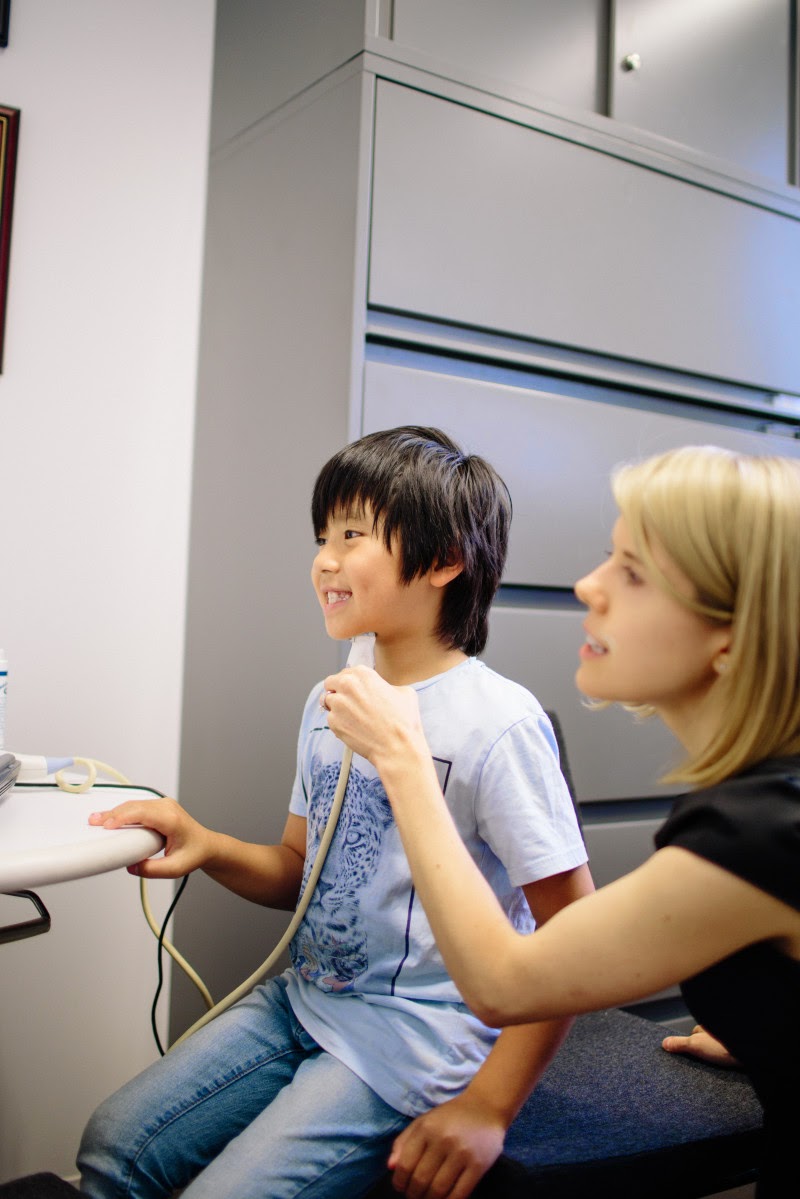
Using ultrasound technology to visualize the tongue's shape and movement can help children with difficulty pronouncing "r" sounds, according to research led by NYU Steinhardt assistant professor Tara McAllister Byun. Credit: Ramsay de Give / NYU Steinhardt
Using ultrasound technology to visualize the tongue's shape and movement can help children with difficulty pronouncing "r" sounds, according to a small study by NYU's Steinhardt School of Culture, Education, and Human Development and Montclair State University.

The ultrasound intervention was effective when individuals were allowed to make different shapes with their tongue in order to produce the "r" sound, rather than being instructed to make a specific shape. The findings appear online in the Journal of Speech, Language, and Hearing Research.

The "r" sound is one of the most frequent speech errors, and can be challenging to correct. For other sounds -- such as "t" or "p" -- speech pathologists can give clear verbal, visual or tactile cues to help children understand how the sound is created. "R" is difficult to show or describe in an easy-to-understand fashion.

In addition, most speech sounds are produced in the same way, but with "r," normal speakers use widely different tongue shapes to create the sound. The two primary strategies to create the "r" sound include a retroflex tongue shape, where the tongue tip is pointed up, and the bunched tongue shape, where the tongue tip is pointed down and body of tongue bunches up toward the top of the mouth.

Up to 10 percent of children have speech sound disorders, according to the National Institutes of Health. Some children respond well to conventional forms of speech therapy, but others have errors that persist despite their therapists' best efforts. A growing body of evidence suggests that treatment incorporating visual biofeedback, which uses various technologies to create a dynamic visual representation of speech, could fill this need.

"The idea that you could get around the challenges with 'r' sounds by showing children their tongues as they are talking is really appealing to clinicians," says Tara McAllister Byun, an assistant professor in NYU Steinhardt's Department of Communicative Sciences and Disorders and the study's lead author. "That's what ultrasound technology lets us do."

Linguists have used ultrasound in the past to study basic functions of speech, and in recent years, speech pathologists have begun exploring using ultrasound to treat children with speech errors. An ultrasound probe -- similar to ones used in cardiac and tissue imaging -- is held under the chin, and sound waves capture real-time images of the tongue. The images provide both the child and speech pathologist with information about the tongue's position and shape.

Using the ultrasound images as a guide, children learn how to manipulate their tongues, and speech pathologists advise them on how to make adjustments to better achieve different sounds.

Several case studies and small studies suggest that ultrasound biofeedback can successfully correct "r" speech errors. Byun and her colleagues set out to gather systematic evidence on the effectiveness of the treatment, studying eight children with difficulty pronouncing "r" sounds. Seven of the eight had previous speech therapy that was unsuccessful.

Four children participated in the initial eight-week study. They were taught to make a bunched tongue shape, guided by ultrasound, in an effort to better pronounce "r." The researchers saw only small improvements among the four participants.

However, while trying to create a bunched tongue, one child stumbled upon a retroflex tongue shape and was able to improve her "r" sound. As a result of her success, the researchers altered their study design to allow participants to choose their own tongue shape, with individualized guidance from speech language pathologists.

A different four children participated in the second study over an eight-week period. Using ultrasound to visualize their tongues, all four participants in the second study showed significant improvement in their "r" sounds.

"Our second study offers evidence that when flexibility is given to choose a tongue shape, rather than a one-size-fits all approach, ultrasound biofeedback treatment can be a highly effective intervention for children with trouble pronouncing 'r' sounds," Byun says.

The researchers noted that the two studies were not a controlled comparison, thus additional systematic research is needed before drawing strong conclusions about the importance of individualized tongue shapes.

 
Support : Creating Website | Johny Template | Mas Template
Copyright © 2011. The planet wall - All Rights Reserved
Template Created by Easy Blogging Published by Mas Template
Proudly powered by Blogger