Latest Post
Showing posts with label MARS EXPLORATION ROVER. Show all posts

Helicopter Could Be 'Scout' for Mars Rovers

Written By Unknown on Saturday, January 31, 2015 | 4:38 PM

Enter the Mars Helicopter, a proposed add-on to Mars rovers of the future that could potentially triple the distance these vehicles currently drive in a Martian day, and deliver a new level of visual information for choosing which sites to explore.

The helicopter would fly ahead of the rover almost every day, checking out various possible points of interest and helping engineers back on Earth plan the best driving route.

Scientists could also use the helicopter images to look for features for the rover to study in further detail. Another part of the helicopter's job would be to check out the best places for the rover to collect key samples and rocks for a cache, which a next-generation rover could pick up later.

The vehicle is envisioned to weigh 2.2 pounds (1 kilogram) and measure 3.6 feet (1.1 meters) across from the tip of one blade to the other. The prototype body looks like a medium-size cubic tissue box.

The current design is a proof-of-concept technology demonstration that has been tested at NASA's Jet Propulsion Laboratory, Pasadena, California.

Source: Nasa

Synthetic biology for space exploration

Written By Unknown on Monday, January 5, 2015 | 8:55 AM

Microbial-based biomanufacturing could be transformative once explorers arrive at an extraterrestrial site. Credit: Image courtesy of Royal Academy Interface
Does synthetic biology hold the key to manned space exploration of the Moon and Mars? Berkeley Lab researchers have used synthetic biology to produce an inexpensive and reliable microbial-based alternative to the world's most effective anti-malaria drug, and to develop clean, green and sustainable alternatives to gasoline, diesel and jet fuels. In the future, synthetic biology could also be used to make manned space missions more practical.

"Not only does synthetic biology promise to make the travel to extraterrestrial locations more practical and bearable, it could also be transformative once explorers arrive at their destination," says Adam Arkin, director of Berkeley Lab's Physical Biosciences Division (PBD) and a leading authority on synthetic and systems biology.

"During flight, the ability to augment fuel and other energy needs, to provide small amounts of needed materials, plus renewable, nutritional and taste-engineered food, and drugs-on-demand can save costs and increase astronaut health and welfare," Arkin says. "At an extraterrestrial base, synthetic biology could make even more effective use of the catalytic activities of diverse organisms."

Arkin is the senior author of a paper in the Journal of the Royal Society Interface that reports on a techno-economic analysis demonstrating "the significant utility of deploying non-traditional biological techniques to harness available volatiles and waste resources on manned long-duration space missions." The paper is titled "Towards Synthetic Biological Approaches to Resource Utilization on Space Missions." The lead and corresponding author is Amor Menezes, a postdoctoral scholar in Arkin's research group at the University of California (UC) Berkeley. Other co-authors are John Cumbers and John Hogan with the NASA Ames Research Center.

One of the biggest challenges to manned space missions is the expense. The NASA rule-of-thumb is that every unit mass of payload launched requires the support of an additional 99 units of mass, with "support" encompassing everything from fuel to oxygen to food and medicine for the astronauts, etc. Most of the current technologies now deployed or under development for providing this support are abiotic, meaning non-biological. Arkin, Menezes and their collaborators have shown that providing this support with technologies based on existing biological processes is a more than viable alternative.

"Because synthetic biology allows us to engineer biological processes to our advantage, we found in our analysis that technologies, when using common space metrics such as mass, power and volume, have the potential to provide substantial cost savings, especially in mass," Menezes says.

In their study, the authors looked at four target areas: fuel generation, food production, biopolymer synthesis, and pharmaceutical manufacture. They showed that for a 916 day manned mission to Mars, the use of microbial biomanufacturing capabilities could reduce the mass of fuel manufacturing by 56-percent, the mass of food-shipments by 38-percent, and the shipped mass to 3D-print a habitat for six by a whopping 85-percent. In addition, microbes could also completely replenish expired or irradiated stocks of pharmaceuticals, which would provide independence from unmanned re-supply spacecraft that take up to 210 days to arrive.

"Space has always provided a wonderful test of whether technology can meet strict engineering standards for both effect and safety," Arkin says. "NASA has worked decades to ensure that the specifications that new technologies must meet are rigorous and realistic, which allowed us to perform up-front techno-economic analysis."

The big advantage biological manufacturing holds over abiotic manufacturing is the remarkable ability of natural and engineered microbes to transform very simple starting substrates, such as carbon dioxide, water biomass or minerals, into materials that astronauts on long-term missions will need. This capability should prove especially useful for future extraterrestrial settlements.

"The mineral and carbon composition of other celestial bodies is different from the bulk of Earth, but the earth is diverse with many extreme environments that have some relationship to those that might be found at possible bases on the Moon or Mars," Arkin says. "Microbes could be used to greatly augment the materials available at a landing site, enable the biomanufacturing of food and pharmaceuticals, and possibly even modify and enrich local soils for agriculture in controlled environments."

The authors acknowledge that much of their analysis is speculative and that their calculations show a number of significant challenges to making biomanufacturing a feasible augmentation and replacement for abiotic technologies. However, they argue that the investment to overcome these barriers offers dramatic potential payoff for future space programs.

"We've got a long way to go since experimental proof-of-concept work in synthetic biology for space applications is just beginning, but long-duration manned missions are also a ways off," says Menezes. "Abiotic technologies were developed for many, many decades before they were successfully utilized in space, so of course biological technologies have some catching-up to do. However, this catching-up may not be that much, and in some cases, the biological technologies may already be superior to their abiotic counterparts."

This research was supported by the National Aeronautics and Space Administration (NASA) and the University of California, Santa Cruz.

NASA's newest Mars mission spacecraft enters orbit around Red Planet

This image shows an artist concept of NASA's Mars Atmosphere and Volatile Evolution (MAVEN) mission. Credit: NASA/Goddard Space Flight Center
NASA's Mars Atmosphere and Volatile Evolution (MAVEN) spacecraft successfully entered Mars' orbit at 7:24 p.m. PDT (10:24 p.m. EDT) Sunday, Sept. 21, where it now will prepare to study the Red Planet's upper atmosphere as never done before. MAVEN is the first spacecraft dedicated to exploring the tenuous upper atmosphere of Mars.

"As the first orbiter dedicated to studying Mars' upper atmosphere, MAVEN will greatly improve our understanding of the history of the Martian atmosphere, how the climate has changed over time, and how that has influenced the evolution of the surface and the potential habitability of the planet," said NASA Administrator Charles Bolden. "It also will better inform a future mission to send humans to the Red Planet in the 2030s."

After a 10-month journey, confirmation of successful orbit insertion was received from MAVEN data observed at the Lockheed Martin operations center in Littleton, Colorado, as well as from tracking data monitored at NASA's Jet Propulsion Laboratory navigation facility in Pasadena, California. The telemetry and tracking data were received by NASA's Deep Space Network antenna station in Canberra, Australia.

"NASA has a long history of scientific discovery at Mars and the safe arrival of MAVEN opens another chapter," said John Grunsfeld, astronaut and associate administrator of the NASA Science Mission Directorate at the agency's Headquarters in Washington. "Maven will complement NASA's other Martian robotic explorers-and those of our partners around the globe-to answer some fundamental questions about Mars and life beyond Earth."

Following orbit insertion, MAVEN will begin a six-week commissioning phase that includes maneuvering into its final science orbit and testing the instruments and
science-mapping commands. MAVEN then will begin its one Earth-year primary mission, taking measurements of the composition, structure and escape of gases in Mars' upper atmosphere and its interaction with the sun and solar wind.

"It's taken 11 years from the original concept for MAVEN to now having a spacecraft in orbit at Mars," said Bruce Jakosky, MAVEN principal investigator with the Laboratory for Atmospheric and Space Physics at the University of Colorado, Boulder (CU/LASP). "I'm delighted to be here safely and successfully, and looking forward to starting our science mission."

The primary mission includes five "deep-dip" campaigns, in which MAVEN's periapsis, or lowest orbit altitude, will be lowered from 93 miles (150 kilometers) to about 77 miles (125 kilometers). These measurements will provide information down to where the upper and lower atmospheres meet, giving scientists a full profile of the upper tier.

"This was a very big day for MAVEN," said David Mitchell, MAVEN project manager from NASA's Goddard Space Flight Center, Greenbelt, Maryland. "We're very excited to join the constellation of spacecraft in orbit at Mars and on the surface of the Red Planet. The commissioning phase will keep the operations team busy for the next six weeks, and then we'll begin, at last, the science phase of the mission. Congratulations to the team for a job well done today."

MAVEN launched Nov. 18, 2013, from Cape Canaveral Air Force Station in Florida, carrying three instrument packages. The Particles and Fields Package, built by the University of California at Berkeley with support from CU/LASP and Goddard, contains six instruments that will characterize the solar wind and the ionosphere of the planet. The Remote Sensing Package, built by CU/LASP, will identify characteristics present throughout the upper atmosphere and ionosphere. The Neutral Gas and Ion Mass Spectrometer, provided by Goddard, will measure the composition and isotopes of atomic particles.

The spacecraft's principal investigator is based at CU/LASP. The university provided two science instruments and leads science operations, as well as education and public outreach, for the mission.

NASA Goddard Space Flight Center manages the project and also provided two science instruments for the mission. Lockheed Martin built the spacecraft and is responsible for mission operations. The Space Sciences Laboratory at the University of California at Berkeley provided four science instruments for MAVEN. JPL provides navigation and Deep Space Network support, and Electra telecommunications relay hardware and operations. JPL, a division of the California Institute of Technology in Pasadena, manages the Mars Exploration Program for NASA.

Source: Nasa

Cassini spacecraft reveals 101 geysers and more on icy Saturn moon

This graphic shows a 3-D model of 98 geysers whose source locations and tilts were found in a Cassini imaging survey of Enceladus' south polar terrain by the method of triangulation.
Credit: NASA/JPL-Caltech/Space Science Institute
Scientists using mission data from NASA's Cassini spacecraft have identified 101 distinct geysers erupting on Saturn's icy moon Enceladus. Their analysis suggests it is possible for liquid water to reach from the moon's underground sea all the way to its surface.

These findings, and clues to what powers the geyser eruptions, are presented in two articles published in the current online edition of the Astronomical Journal.

Over a period of almost seven years, Cassini's cameras surveyed the south polar terrain of the small moon, a unique geological basin renowned for its four prominent "tiger stripe" fractures and the geysers of tiny icy particles and water vapor first sighted there nearly 10 years ago. The result of the survey is a map of 101 geysers, each erupting from one of the tiger stripe fractures, and the discovery that individual geysers are coincident with small hot spots. These relationships pointed the way to the geysers' origin.

After the first sighting of the geysers in 2005, scientists suspected that repeated flexing of Enceladus by Saturn's tides as the moon orbits the planet had something to do with their behavior. One suggestion included the back-and-forth rubbing of opposing walls of the fractures generating frictional heat that turned ice into geyser-forming vapor and liquid.
Alternate views held that the opening and closing of the fractures allowed water vapor from below to reach the surface. Before this new study, it was not clear which process was the dominating influence. Nor was it certain whether excess heat emitted by Enceladus was everywhere correlated with geyser activity.

To determine the surface locations of the geysers, researchers employed the same process of triangulation used historically to survey geological features on Earth, such as mountains. When the researchers compared the geysers' locations with low-resolution maps of thermal emission, it became apparent the greatest geyser activity coincided with the greatest thermal radiation. Comparisons between the geysers and tidal stresses revealed similar connections. However, these correlations alone were insufficient to answer the question, "What produces what?"

The answer to this mystery came from comparison of the survey results with high-resolution data collected in 2010 by Cassini's heat-sensing instruments. Individual geysers were found to coincide with small-scale hot spots, only a few dozen feet (or tens of meters) across, which were too small to be produced by frictional heating, but the right size to be the result of condensation of vapor on the near-surface walls of the fractures. This immediately implicated the hot spots as the signature of the geysering process.

"Once we had these results in hand, we knew right away heat was not causing the geysers, but vice versa," said Carolyn Porco, leader of the Cassini imaging team from the Space Science Institute in Boulder, Colorado, and lead author of the first paper. "It also told us the geysers are not a near-surface phenomenon, but have much deeper roots."

Thanks to recent analysis of Cassini gravity data, the researchers concluded the only plausible source of the material forming the geysers is the sea now known to exist beneath the ice shell. They also found that narrow pathways through the ice shell can remain open from the sea all the way to the surface, if filled with liquid water.

In the companion paper, the authors report the brightness of the plume formed by all the geysers, as seen with Cassini's high-resolution cameras, changes periodically as Enceladus orbits Saturn. Armed with the conclusion that the opening and closing of the fractures modulates the venting, the authors compared the observations with the expected venting schedule due to tides.

They found the simplest model of tidal flexing provides a good match for the brightness variations Cassini observes, but it does not predict the time when the plume begins to brighten. Some other important effect is present and the authors considered several in the course of their work.

The Cassini-Huygens mission is a cooperative project of NASA, the European Space Agency and the Italian Space Agency. The Jet Propulsion Laboratory (JPL) in Pasadena, California, manages the mission for NASA's Science Mission Directorate in Washington. The Cassini orbiter and its two onboard cameras were designed, developed and assembled at JPL. The imaging team consists of scientists from the United States, England, France and Germany. The imaging team is based at the Space Science Institute.

NASA's MAVEN Mars orbiter mission identifies links in chain leading to atmospheric loss

Written By Unknown on Saturday, January 3, 2015 | 3:23 AM

NASA’s MAVEN mission is observing the upper atmosphere of Mars to help understand climate change on the planet. MAVEN entered its science phase on Nov. 16, 2014. Credit: NASA's Goddard Space Flight Center
Early discoveries by NASA's newest Mars orbiter are starting to reveal key features about the loss of the planet's atmosphere to space over time.

The findings are among the first returns from NASA's Mars Atmosphere and Volatile Evolution (MAVEN) mission, which entered its science phase on Nov. 16. The observations reveal a new process by which the solar wind can penetrate deep into a planetary atmosphere. They include the first comprehensive measurements of the composition of Mars' upper atmosphere and electrically charged ionosphere. The results also offer an unprecedented view of ions as they gain the energy that will lead to their to escape from the atmosphere.

"We are beginning to see the links in a chain that begins with solar-driven processes acting on gas in the upper atmosphere and leads to atmospheric loss," said Bruce Jakosky, MAVEN principal investigator with the Laboratory for Atmospheric and Space Physics at the University of Colorado, Boulder. "Over the course of the full mission, we'll be able to fill in this picture and really understand the processes by which the atmosphere changed over time."

On each orbit around Mars, MAVEN dips into the ionosphere -- the layer of ions and electrons extending from about 75 to 300 miles above the surface. This layer serves as a kind of shield around the planet, deflecting the solar wind, an intense stream of hot, high-energy particles from the sun.

Scientists have long thought that measurements of the solar wind could be made only before these particles hit the invisible boundary of the ionosphere. MAVEN's Solar Wind Ion Analyzer, however, has discovered a stream of solar-wind particles that are not deflected but penetrate deep into Mars' upper atmosphere and ionosphere.

Interactions in the upper atmosphere appear to transform this stream of ions into a neutral form that can penetrate to surprisingly low altitudes. Deep in the ionosphere, the stream emerges, almost Houdini-like, in ion form again. The reappearance of these ions, which retain characteristics of the pristine solar wind, provides a new way to track the properties of the solar wind and may make it easier to link drivers of atmospheric loss directly to activity in the upper atmosphere and ionosphere.

MAVEN's Neutral Gas and Ion Mass Spectrometer is exploring the nature of the reservoir from which gases are escaping by conducting the first comprehensive analysis of the composition of the upper atmosphere and ionosphere. These studies will help researchers make connections between the lower atmosphere, which controls climate, and the upper atmosphere, where the loss is occurring.

The instrument has measured the abundances of many gases in ion and neutral forms, revealing well-defined structure in the upper atmosphere and ionosphere, in contrast to the lower atmosphere, where gases are well-mixed. The variations in these abundances over time will provide new insights into the physics and chemistry of this region and have already provided evidence of significant upper-atmospheric "weather" that has not been measured in detail before.

New insight into how gases leave the atmosphere is being provided by the spacecraft's Suprathermal and Thermal Ion Composition (STATIC) instrument. Within hours after being turned on at Mars, STATIC detected the "polar plume" of ions escaping from Mars. This measurement is important in determining the rate of atmospheric loss.

As the satellite dips down into the atmosphere, STATIC identifies the cold ionosphere at closest approach and subsequently measures the heating of this charged gas to escape velocities as MAVEN rises in altitude. The energized ions ultimately break free of the planet's gravity as they move along a plume that extends behind Mars.

The MAVEN spacecraft and its instruments have the full technical capability proposed in 2007 and are on track to carry out the primary science mission. The MAVEN team delivered the spacecraft to Mars on schedule, launching on the very day in 2013 projected by the team 5 years earlier. MAVEN was also delivered well under the confirmed budget established by NASA in 2010.

The team's success can be attributed to a focused science mission that matched the available funding and diligent management of resources. There were also minimal changes in requirements on the hardware or science capabilities that could have driven costs. It also reflects good coordination between the principal investigator; the project management at NASA's Goddard Space Flight Center; the Mars Program Office at NASA's Jet Propulsion Laboratory in Pasadena, California; and the Mars Exploration Program at NASA Headquarters.

The entire project team contributed to MAVEN's success to date, including the management team, the spacecraft and science-instrument institutions, and the launch-services provider.

"The MAVEN spacecraft and its instruments are fully operational and well on their way to carrying out the primary science mission," said Jim Green, director of NASA's Planetary Science Division at NASA Headquarters in Washington. "The management team's outstanding work enabled the project to be delivered on schedule and under budget."

NASA Goddard instrument makes first detection of organic matter on Mars

MSL Curiosity rover at "John Klein" drill site. This self-portrait of NASA's Mars rover Curiosity combines dozens of exposures taken by the rover's Mars Hand Lens Imager on Feb. 3, 2013 plus three exposures taken May 10, 2013 to show two holes (in lower left quadrant) where Curiosity used its drill on the rock target "John Klein". Credit: NASA/JPL-Caltech/MSSS

The team responsible for the Sample Analysis at Mars (SAM) instrument suite on NASA's Curiosity rover has made the first definitive detection of organic molecules at Mars. Organic molecules are the building blocks of all known forms of terrestrial life, and consist of a wide variety of molecules made primarily of carbon, hydrogen, and oxygen atoms. However, organic molecules can also be made by chemical reactions that don't involve life, and there is not enough evidence to tell if the matter found by the team came from ancient Martian life or from a non-biological process. Examples of non-biological sources include chemical reactions in water at ancient Martian hot springs or delivery of organic material to Mars by interplanetary dust or fragments of asteroids and comets.

The surface of Mars is currently inhospitable to life as we know it, but there is evidence that the Red Planet once had a climate that could have supported life billions of years ago. For example, features resembling dry riverbeds and minerals that only form in the presence of liquid water have been discovered on the Martian surface. The Curiosity rover with its suite of instruments including SAM was sent to Mars in 2011 to discover more about the ancient habitable Martian environment by examining clues in the chemistry of rocks and the atmosphere.

The organic molecules found by the team were in a drilled sample of the Sheepbed mudstone in Gale crater, the landing site for the Curiosity rover. Scientists think the crater was once the site of a lake billions of years ago, and rocks like mudstone formed from sediment in the lake. Moreover, this mudstone was found to contain 20 percent smectite clays. On Earth, such clays are known to provide high surface area and optimal interlayer sites for the concentration and preservation of organic compounds when rapidly deposited under reducing chemical conditions.

While the team can't conclude that there was life at Gale crater, the discovery shows that the ancient environment offered a supply of reduced organic molecules for use as building blocks for life and an energy source for life. Curiosity's earlier analysis of this same mudstone revealed that the environment offered water and chemical elements essential for life and a different chemical energy source.

"We think life began on Earth around 3.8 billion years ago, and our result shows that places on Mars had the same conditions at that time -- liquid water, a warm environment, and organic matter," said Caroline Freissinet of NASA's Goddard Space Flight Center in Greenbelt, Maryland. "So if life emerged on Earth in these conditions, why not on Mars as well?" Freissinet is lead author of a paper on this research submitted to the Journal of Geophysical Research-Planets.

The organic molecules found by the team also have chlorine atoms, and include chlorobenzene and several dichloroalkanes, such as dichloroethane, dichloropropane and dichlorobutane. Chlorobenzene is the most abundant with concentrations between 150 and 300 parts-per-billion. Chlorobenzene is not a naturally occurring compound on Earth. It is used in the manufacturing process for pesticides (insecticide DDT), herbicides, adhesives, paints and rubber. Dichloropropane is used as an industrial solvent to make paint strippers, varnishes and furniture finish removers, and is classified as a carcinogen.

It's possible that these chlorine-containing organic molecules were present as such in the mudstone. However, according to the team, it's more likely that a different suite of precursor organic molecules was in the mudstone, and that the chlorinated organics formed from reactions inside the SAM instrument as the sample was heated for analysis. Perchlorates (a chlorine atom bound to four oxygen atoms) are abundant on the surface of Mars. It's possible that as the sample was heated, chlorine from perchlorate combined with fragments from precursor organic molecules in the mudstone to produce the chlorinated organic molecules detected by SAM.

In 1976, the Gas Chromatograph Mass Spectrometer instrument on NASA's Viking landers detected two simple chlorinated hydrocarbons after heating Martian soils for analysis (chloromethane and dichloromethane). However they were not able to rule out that the compounds were derived from the instrument itself, according to the team. While sources within the SAM instrument also produce chlorinated hydrocarbons, they don't make more than 22 parts-per-billion of chlorobenzene, far below the amounts detected in the mudstone sample, giving the team confidence that organic molecules really are present on Mars.
The SAM instrument suite was built at NASA Goddard with significant elements provided by industry, university, and national and international NASA partners.

For this analysis, the Curiosity rover sample acquisition system drilled into a mudstone and filtered fine particles of it through a sieve, then delivered a portion of the sample to the SAM laboratory. SAM detected the compounds using its Evolved Gas Analysis (EGA) mode by heating the sample up to about 875 degrees Celsius (around 1,600 degrees Fahrenheit) and then monitoring the volatiles released from the sample using a quadrupole mass spectrometer, which identifies molecules by their mass using electric fields. SAM also detected and identified the compounds using its Gas Chromatograph Mass Spectrometer (GCMS) mode. In this mode, volatiles are separated by the amount of time they take to travel through a narrow tube (gas chromatography -- certain molecules interact with the sides of the tube more readily and thus travel more slowly) and then identified by their signature mass fragments in the mass spectrometer.

The first evidence for elevated levels of chlorobenzene and dichloroalkanes released from the mudstone was obtained on Curiosity Sol 290 (May 30, 2013) with the third analysis of the Cumberland sample at Sheepbed. The team spent over a year carefully analyzing the result, including conducting laboratory experiments with instruments and methods similar to SAM, to be sure that SAM could not be producing the amount of organic material detected.

"The search for organics on Mars has been extremely challenging for the team," said Daniel Glavin of NASA Goddard, a co-author on the paper. "First, we need to identify environments in Gale crater that would have enabled the concentration of organics in sediments. Then they need to survive the conversion of sediment to rock, where pore fluids and dissolved substances may oxidize and destroy organics. Organics can then be destroyed during exposure of rocks at the surface of Mars to intense ionizing radiation and oxidants. Finally, to identify any organic compounds that have survived, we have to deal with oxychlorine compounds and possibly other strong oxidants in the sample which will react with and combust organic compounds to carbon dioxide and chlorinated hydrocarbons when the samples are heated by SAM."

As part of Curiosity's plan for exploration, an important strategic goal was to sample rocks that represent different combinations of the variables thought to control organic preservation. "The SAM and Mars Science Laboratory teams have worked very hard to achieve this result," said John Grotzinger of Caltech, Mars Science Laboratory's Project Scientist. "Only by drilling additional rock samples in different locations, and representing different geologic histories were we able to tease out this result. At the time we first saw evidence of these organic molecules in the Cumberland sample it was uncertain if they were derived from Mars, however, additional drilling has not produced the same compounds as might be predicted for contamination, indicating that the carbon in the detected organic molecules is very likely of Martian origin."

Source: nasa

Making measurements when a comet passes close to Mars

Comet Siding Spring and Mars. Credit: Artist's impression: NASA
On Sunday 19 October at 20:29 CET a comet will pass close to the planet Mars. At the same time the Swedish instrument ASPERA-3 is on board the European satellite Mars Express orbiting Mars and ready to make measurements.

"No one has before made measurements when a comet passes so close by a planet," says Associate Professor Mats Holmström at the Swedish Institute of Space Physics in Kiruna, Sweden.

The comet Siding Spring will pass by Mars at a distance of only 140,000 km, about a third of the distance from the Earth to the Moon, by way of comparison. The outer parts of the comet's thin atmosphere will collide at high speed (56 km/sec) with the atmosphere of Mars.
"We expect that gas and dust from the comet will impact on the Martian atmosphere, which will be temporarily heated and will expand," says Mats Holmström. "We should be able to see that with our instrument."

The Swedish Institute of Space Physics (IRF) has Principal Investigator responsibility for the satellite instrument ASPERA-3 which is an international collaboration with participants from some 15 research groups from about 10 countries. ASPERA-3 on board the measures how charged particles from the sun, the so-called solar wind, influences the atmosphere of Mars. Mars Express was lauched by the European Space Agency (ESA) and has been orbiting Mars since 2003.

Source: Expertsvar

New method for detecting water on Mars

Washington State University senior Kellie Wall has helped develop a new method for detecting water on Mars. Her findings appear in Nature Communications, one of the most influential general science journals. Credit: Washington State University photo
A Washington State University undergraduate has helped develop a new method for detecting water on Mars.  

Kellie Wall, 21, of Port Orchard, Wash., looked for evidence that water influenced crystal formation in basalt, the dark volcanic rock that covers most of eastern Washington and Oregon. She then compared this with volcanic rock observations made by the rover Curiosity on Mars' Gale Crater.

"This is really cool because it could potentially be useful for not only the study of rocks on Earth but on Mars and other planets," said Wall.

She is the lead author of the article in Nature Communications.  

Co-authors include Michael Rowe, a former WSU research professor now at New Zealand's University of Auckland, and Ben Ellis, a former WSU post-doctoral researcher now at the Institute of Geochemistry and Petrology in Zurich, Switzerland. The other authors are Mariek Schmidt of Brock University in Canada and Jennifer Eccles of the University of Auckland.

Wall was fascinated by volcanoes as a child, touring the Cascade mountain range with her father and marveling at features like the lava tubes under Mount St. Helens.

"I was really excited because I thought that just on the other side of the walls there could be lava," she said.

Still, she started out as a communications major at WSU, choosing a geology class to fulfill a science requirement.

"I loved it so much that I changed my major," she said.

In her sophomore year, Rowe and Ellis asked if she would like to look at the eruption styles of Earth and Mars volcanoes.

"I was really crazy about it -- really intrigued by the buzzword 'Mars,'" she said.

"I've worked with a lot of undergraduate researchers over the years and she's the best that I've come across," said Rowe. "That's why we gave her so much responsibility on this project, because we knew she would do it well."

The researchers established a method to quantify the texture of volcanic rock using an index called "groundmass crystallinity." Wall compares it to the texture of a chocolate chip cookie, which can vary according to how it is cooked and cooled.

"We were interested in the cookie dough part of the cookie," she said.

Liquid volcanic rock cools rapidly as it hits water, flash-freezing to form mostly glass. Without water, it takes longer to cool and forms crystals within the groundmass, the cookie dough part.

Using an x-ray diffraction machine on the WSU campus, home to one of the most sophisticated basalt labs in the world, Wall analyzed rock samples from the Northwest, New Zealand and Italy's Mount Etna and compared them to rocks analyzed by Curiosity's x-ray diffractometer.

"The rocks that erupted and interacted with water, which we call phreatomagmatic, all had a groundmass crystallinity as low as 8 percent and ranging up to about 35 percent," she said. 

"The rocks that erupted without interaction with water had groundmass crystallinities from about 45 percent upwards to almost totally crystalline.

"The analyses we did on the Mars soil samples fell in the range of the magmatic type eruptions, which are the ones erupted without water interaction," she said.

Water is a key indicator for the potential of microbial life on the red planet. While Wall and her colleagues didn't see evidence of it from two sites they studied, their method could look for water elsewhere.

"I think this quantification of volcanic textures is a new facet of the water story that hasn't yet been explored," Wall said. "Most of the studies searching for water have focused on either looking for sedimentary structures -- large- and small-scale -- for evidence of water, or looking for rocks like limestones that actually would have formed in a water-rich environment.

"But being able to determine the environment through the texture of a volcanic rock is something pretty cool and different," she said. "I think it's an interesting avenue for future research."

Source: Washington State University

NASA rover drill pulls first taste from Mars mountain

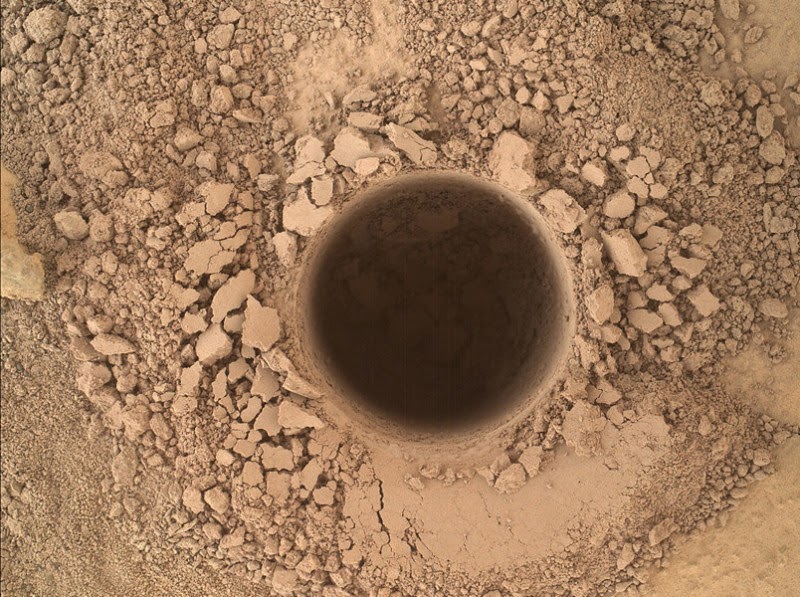
This image from the Mars Hand Lens Imager (MAHLI) camera on NASA's Curiosity Mars rover shows the first sample-collection hole drilled in Mount Sharp, the layered mountain that is the science destination of the rover's extended mission. Credit: NASA/JPL-Caltech/MSSS
NASA's Curiosity Mars rover has collected its first taste of the layered mountain whose scientific allure drew the mission to choose this part of Mars as a landing site.

Late Wednesday, Sept. 24, the rover's hammering drill chewed about 2.6 inches (6.7 centimeters) deep into a basal-layer outcrop on Mount Sharp and collected a powdered-rock sample. Data and images received early Thursday at NASA's Jet Propulsion Laboratory, Pasadena, California, confirmed success of this operation. The powder collected by the drilling is temporarily held within the sample-handling mechanism on the rover's arm.

"This drilling target is at the lowest part of the base layer of the mountain, and from here we plan to examine the higher, younger layers exposed in the nearby hills," said Curiosity Deputy Project Scientist Ashwin Vasavada of JPL. "This first look at rocks we believe to underlie Mount Sharp is exciting because it will begin to form a picture of the environment at the time the mountain formed, and what led to its growth."

After landing on Mars in August 2012 but before beginning the drive toward Mount Sharp, Curiosity spent much of the mission's first year productively studying an area much closer to the landing site, but in the opposite direction. The mission accomplished its science goals in that Yellowknife Bay area. Analysis of drilled rocks there disclosed an ancient lakebed environment that, more than three billion years ago, offered ingredients and a chemical energy gradient favorable for microbes, if any existed there.

From Yellowknife Bay to the base of Mount Sharp, Curiosity drove more than 5 miles (8 kilometers) in about 15 months, with pauses at a few science waypoints. The emphasis in mission operations has now changed from drive, drive, drive to systematic layer-by-layer investigation.

"We're putting on the brakes to study this amazing mountain," said Curiosity Deputy Project Manager Jennifer Trosper of JPL. "Curiosity flew hundreds of millions of miles to do this."

Curiosity arrived Sept. 19 at an outcrop called "Pahrump Hills," which is a section of the mountain's basal geological unit, called the Murray formation. Three days later, the rover completed a "mini-drill" procedure at the selected drilling target, "Confidence Hills," to assess the target rock's suitability for drilling. A mini-drill activity last month determined that a rock slab under consideration then was not stable enough for full drilling, but Confidence Hills passed this test.

The rock is softer than any of the previous three targets where Curiosity has collected a drilled sample for analysis.

Between the mini-drill test and the sample-collection drilling, researchers used tools on Curiosity's mast and robotic arm for close-up inspection of geometrically distinctive features on the nearby surface of the rock.

These features on the Murray formation mudstones are the accumulations of resistant materials. They occur both as discrete clusters and as dendrites, where forms are arranged in tree-like branching. By investigating the shapes and chemical ingredients in these features, the team hopes to gain information about the possible composition of fluids at this Martian location long ago.

The next step will be to deliver the rock-powder sample into a scoop on the rover's arm. In the open scoop, the powder's texture can be observed for an assessment of whether it is safe for further sieving, portioning and delivery into Curiosity's internal laboratory instruments without clogging hardware. The instruments can perform many types of analysis to identify chemistry and mineralogy of the source rock.

NASA's Mars Science Laboratory Project is using Curiosity to assess ancient habitable environments and major changes in Martian environmental conditions. JPL, a division of Caltech, built the rover and manages the project for NASA's Science Mission Directorate in Washington.

Source: NASA/Jet Propulsion Laboratory

Martian meteorite yields more evidence of the possibility of life on Mars

Is there, or was there once, life on Mars? Credit: NASA/JPL/MSSS
A tiny fragment of Martian meteorite 1.3 billion years old is helping to make the case for the possibility of life on Mars, say scientists.

The finding of a 'cell-like' structure, which investigators now know once held water, came about as a result of collaboration between scientists in the UK and Greece. Their findings are published in the latest edition of the journal Astrobiology.

While investigating the Martian meteorite, known as Nakhla, Dr Elias Chatzitheodoridis of the National Technical University of Athens found an unusual feature embedded deep within the rock. In a bid to understand what it might be, he teamed up with long-time friend and collaborator Professor Ian Lyon at the University of Manchester.

Professor Lyon, based in Manchester's School of Earth, Atmospheric and Environmental Sciences explains: "In many ways it resembled a fossilized biological cell from Earth but it was intriguing because it was undoubtedly from Mars. Our research found that it probably wasn't a cell but that it did once hold water, water that had been heated, probably as a result of an asteroid impact."

These findings are significant because they add to increasing evidence that beneath the surface, Mars does provide all the conditions for life to have formed and evolved. It also adds to a body of evidence suggesting that large asteroids hit Mars in the past and produce long-lasting hydrothermal fields that could sustain life on Mars, even in later epochs, if life ever emerged there.

As part of the research, the feature was imaged in unprecedented detail by Dr Sarah Haigh of The University of Manchester whose work usually involves high resolution imaging for next generation electronic devices ,which are made by stacking together single atomic layers of graphene and other materials with the aim of making faster, lighter and bendable mobile phones and tablets. A similar imaging approach was able to reveal the atomic layers of materials inside the meteorite.

Together their combined experimental approach has revealed new insights into the geological origins of this fascinating structure.

Professor Lyon said: "We have been able to show the setting is there to provide life. It's not too cold, it's not too harsh. Life as we know it, in the form of bacteria, for example, could be there, although we haven't found it yet. It's about piecing together the case for life on Mars -- it may have existed and in some form could exist still."

Now, the team is using these and other state-of-the-art techniques to investigate new secondary materials in this meteorite and search for possible bio signatures which provide scientific evidence of life, past or present. Professor Lyon concluded: "Before we return samples from Mars, we must examine them further, but in more delicate ways. We must carefully search for further evidence."

Source: Manchester University

Earth-like soils on Mars? Ancient fossilized soils potentially found deep inside impact crater suggest microbial life

Rover image from Gale Crater reveals soil features similar to paleosols on Earth. Credit: NASA
Soil deep in a crater dating to some 3.7 billion years ago contains evidence that Mars was once much warmer and wetter, saysUniversity of Oregon geologist Gregory Retallack, based on images and data captured by the rover Curiosity.

NASA rovers have shown Martian landscapes littered with loose rocks from impacts or layered by catastrophic floods, rather than the smooth contours of soils that soften landscapes on Earth. However, recent images from Curiosity from the impact Gale Crater, Retallack said, reveal Earth-like soil profiles with cracked surfaces lined with sulfate, ellipsoidal hollows and concentrations of sulfate comparable with soils in Antarctic Dry Valleys and Chile's Atacama Desert.

His analyses appear in a paper placed online this week by the journal Geology in advance of print in the September issue of the world's top-ranked journal in the field. Retallack, the paper's lone author, studied mineral and chemical data published by researchers closely tied with the Curiosity mission. Retallack, professor of geological sciences and co-director of paleontology research at the UO Museum of Natural and Cultural History, is an internationally known expert on the recognition of paleosols -- ancient fossilized soils contained in rocks.

"The pictures were the first clue, but then all the data really nailed it," Retallack said. "The key to this discovery has been the superb chemical and mineral analytical capability of the Curiosity Rover, which is an order of magnitude improvement over earlier generations of rovers. The new data show clear chemical weathering trends, and clay accumulation at the expense of the mineral olivine, as expected in soils on Earth. Phosphorus depletion within the profiles is especially tantalizing, because it attributed to microbial activity on Earth."

The ancient soils, he said, do not prove that Mars once contained life, but they do add to growing evidence that an early wetter and warmer Mars was more habitable than the planet has been in the past 3 billion years.

Curiosity rover is now exploring topographically higher and geologically younger layers within the crater, where the soils appear less conducive to life. For a record of older life and soils on Mars, Retallack said, new missions will be needed to explore older and more clayey terrains.

Surface cracks in the deeply buried soils suggest typical soil clods. Vesicular hollows, or rounded holes, and sulfate concentrations, he said, are both features of desert soils on Earth.

"None of these features is seen in younger surface soils of Mars," Retallack said. "The exploration of Mars, like that of other planetary bodies, commonly turns up unexpected discoveries, but it is equally unexpected to discover such familiar ground."

The newly discovered soils provide more benign and habitable soil conditions than known before on Mars. Their dating to 3.7 billion years ago, he noted, puts them into a time of transition from "an early benign water cycle on Mars to the acidic and arid Mars of today." 

Life on Earth is believed to have emerged and began diversifying about 3.5 billion years ago, but some scientists have theorized that potential evidence that might take life on Earth farther back was destroyed by plate tectonics, which did not occur on Mars.

In an email, Malcolm Walter of the Australian Centre for Astrobiology, who was not involved in the research, said the potential discovery of these fossilized soils in the Gale Crater dramatically increases the possibility that Mars has microbes. "There is a real possibility that there is or was life on Mars," he wrote.

Retallack noted that Steven Benner of the Westheimer Institute of Science and Technology in Florida has speculated that life is more likely to have originated on a soil planet like Mars than a water planet like Earth. In an email, Benner wrote that Retallack's paper "shows not only soils that might be direct products of an early Martian life, but also the wet-dry cycles that many models require for the emergence of life."

Source: University of Oregon

Successful launch of NASA's Orion spacecraft heralds first step on journey to Mars

Written By Unknown on Friday, January 2, 2015 | 5:36 PM

The United Launch Alliance Delta IV Heavy rocket, with NASA's Orion spacecraft mounted atop, lifts off from Cape Canaveral Air Force Station's Space Launch Complex 37 at at 7:05 a.m. EST, Friday, Dec. 5. Credit: NASA/Bill Ingalls
NASA marked a critical step on the journey to Mars with its Orion spacecraft during a roaring liftoff into the dawn sky over eastern Florida on Friday, Dec. 5, 2014, aboard a Delta IV Heavy rocket.

Once on its way, the Orion spacecraft accomplished a series of milestones as it jettisoned a set of fairing panels around the service module before the launch abort system tower pulled itself away from the spacecraft as planned.

The spacecraft and second stage of the Delta IV rocket settled into an initial orbit about 17 minutes after liftoff. Flight controllers put Orion into a slow roll to keep its temperature controlled while the spacecraft flew through a 97-minute coast phase.

The cone-shaped spacecraft did not carry anyone inside its cabin but is designed to take astronauts farther into space than ever before in the future.

Orion's first flight test is expected to be one for the books: the first mission since Apollo to carry a spacecraft built for humans to deep space, the first time NASA's next-generation spacecraft is tested against the challenges of space, and the first operational test of a heat shield strong enough to protect against 4,000-degree temperatures.

From today's launch on a gigantic United Launch Alliance Delta IV Heavy from Florida to the expected splashdown under billowing parachutes, the mission will test many of the riskiest events Orion will see when it sends astronauts to an asteroid and onward toward Mars in the future.

"Orion is the exploration spacecraft for NASA, and paired with the Space Launch System, or SLS, rocket it will allow us to explore the solar system," said Mark Geyer, program manager of Orion, which is based at Johnson Space Center in Houston.

While the Delta IV Heavy will send Orion on its flight test, SLS will launch the spacecraft on future missions.

NASA's Orion program has arrived at a fulcrum point that will tell its designers and builders how it stacks up technically. It also will show that NASA is ready to take the next step on its journey into deep space -- and ultimately to Mars.

So even though Orion is poised for a mere 4 1/2-hour, two-orbit mission without anyone on board, the cone-shaped craft needs to perform its roster of tasks well, including an all-important descent through Earth's atmosphere and splashdown.

"Really, we're going to test the riskiest parts of the mission," Geyer said. "Ascent, entry and things like fairing separations, Launch Abort System jettison, the parachutes plus the navigation and guidance -- all those things are going to be tested. Plus we'll fly into deep 
space and test the radiation effects on those systems."

The flight test began at Space Launch Complex 37 at Cape Canaveral Air Force Station.

The second stage will ignite again about two hours into the flight to send Orion through the Van Allen radiation belts and to a peak altitude of 3,609 miles, some 15 times higher than the International Space Station. This is going to be a key point in the test flight as instruments inside Orion record the radiation doses inside the cabin -- critical data for mission planners considering the best way to safely send astronauts into deep space in the future. Orion's cameras will be turned off during its passes through the belts to protect them.

Three hours, 23 minutes into flight, the Orion crew module will fly on its own following separation from its service module and the Delta IV Heavy second stage. The spacecraft will be aimed at Earth's atmosphere and it will be up to Orion's onboard computers to set the spacecraft in the right position so its base heat shield can bear the brunt of the intense reentry heat.

Hitting the atmosphere at 20,000 mph four hours and 13 minutes after launch, Orion will encounter about 80 percent of the heat it would endure during a return from lunar orbit with astronauts aboard. Ground controllers will lose contact with Orion for 2 1/2 minutes during reentry when the spacecraft is surrounded by plasma. They should regain communications with the craft just before the forward bay cover is jettisoned in a process that will begin the parachute deployment. After about four hours, 23 minutes, Orion will be bobbing in the Pacific Ocean off the coast of Baja California as recovery forces move in.

Teams from NASA's Ground Systems Development and Operations Program based at Kennedy will work with U.S. Navy and Orion prime contractor Lockheed Martin personnel to bring the spacecraft into the well deck of the USS Anchorage, an amphibious ship with a protective enclosure that will allow Orion to basically float onboard without having to be lifted by a crane. A second ship, the USNS Salvor, also will be on hand as a backup.
Many aspects of the mission point to a future as ambitious as any time in NASA's 50-plus-year history.

With lessons learned from Orion's flight test, NASA can improve the spacecraft's design 
while building the first Space Launch System rocket, a heavy booster with enough power to send the next Orion to a distant retrograde orbit around the moon for Exploration Mission-
1. Following that, astronauts are gearing up to fly Orion on the second SLS rocket on a mission that will return astronauts to deep space for the first time in more than 40 years. 

These adventures will set NASA up for future human missions to an asteroid and even on the journey to Mars.

"To be able to even think about going to an asteroid and to be able to think about this kind of exploration, that's very exciting," Kennedy Space Center Director Bob Cabana said. "I think there's a genuine, positive atmosphere, and I don't think it's confined to just Kennedy. You go across all the NASA centers and I think the team is really excited about the future."
And while all that work is happening on the ground, astronauts on the International Space Station will continue the groundbreaking research that is already adding to humanity's understanding of everything from long-duration spaceflight to the continued experimentation on products and processes that improve life on Earth.

None of those plans has caused NASA or Lockheed Martin, which is operating this flight test, to look past the crucial steps needed to make this mission a success.

Lockheed Martin assembled the spacecraft in the high bay at the Operations and Checkout Building at NASA's Kennedy Space Center in Florida, a facility recently named for Neil Armstrong, first man to walk on the moon.

While the mission is expected to make a huge impact on the way the next Orion is built, many lessons from the buildup of this spacecraft are already being incorporated in the planning for the next one, Geyer said.

"This has shown it's a good design, it's a good mission and now it's time to go fly," Geyer said.

Source: NASA

Traces of Martian biological activity could be locked inside a meteorite

Written By Unknown on Sunday, December 21, 2014 | 6:22 PM

Ejected from Mars after an asteroid crashed on its surface, the meteorite, named Tissint, fell on the Moroccan desert on July 18, 2011, in view of several eyewitnesses. Upon examination, the alien rock was found to have small fissures that were filled with carbon-containing matter. Credit: Copyright Alain Herzog/EPFL
Did Mars ever have life? Does it still? A meteorite from Mars has reignited the old debate. An international team that includes scientists from EPFL has published a paper in the scientific journal Meteoritics and Planetary Sciences, showing that martian life is more probable than previously thought.

"So far, there is no other theory that we find more compelling," says Philippe Gillet, director of EPFL's Earth and Planetary Sciences Laboratory. He and his colleagues from China, Japan and Germany performed a detailed analysis of organic carbon traces from a Martian meteorite, and have concluded that they have a very probable biological origin. The scientists argue that carbon could have been deposited into the fissures of the rock when it was still on Mars by the infiltration of fluid that was rich in organic matter.

Ejected from Mars after an asteroid crashed on its surface, the meteorite, named Tissint, fell on the Moroccan desert on July 18, 2011, in view of several eyewitnesses. Upon examination, the alien rock was found to have small fissures that were filled with carbon-containing matter. Several research teams have already shown that this component is organic in nature. But they are still debating where the carbon came from.

Maybe biological, but not from our planet

Chemical, microscopic and isotope analysis of the carbon material led the researchers to several possible explanations of its origin. They established characteristics that unequivocally excluded a terrestrial origin, and showed that the carbon content were deposited in the Tissint's fissures before it left Mars.

The researchers challenged previously described views (Steele et al., Science, 2012) proposing that the carbon traces originated through the high-temperature crystallization of magma. According to the new study, a more likely explanation is that liquids containing organic compounds of biological origin infiltrated Tissint's "mother" rock at low temperatures, near the Martian surface.

These conclusions are supported by several intrinsic properties of the meteorite's carbon, e.g. its ratio of carbon-13 to carbon-12. This was found to be significantly lower than the ratio of carbon-13 in the CO2 of Mars's atmosphere, previously measured by the Phoenix and Curiosity rovers. Moreover, the difference between these ratios corresponds perfectly with what is observed on Earth between a piece of coal -- which is biological in origin -- and the carbon in the atmosphere. The researchers note that this organic matter could also have been brought to Mars when very primitive meteorites -- carbonated chondrites -- fell on it. However, they consider this scenario unlikely because such meteorites contain very low concentrations of organic matter.

"Insisting on certainty is unwise, particularly on such a sensitive topic," warns Gillet. "I'm completely open to the possibility that other studies might contradict our findings. However, our conclusions are such that they will rekindle the debate as to the possible existence of biological activity on Mars -- at least in the past."

WATCH VIDEO

Source: Ecole Polytechnique Fédérale de Lausanne
 
Support : Creating Website | Johny Template | Mas Template
Copyright © 2011. The planet wall - All Rights Reserved
Template Created by Easy Blogging Published by Mas Template
Proudly powered by Blogger