Latest Post
Showing posts with label VEHICLE. Show all posts

Switching to vehicles powered by electricity from renewables could save lives - Video

Written By Unknown on Saturday, January 31, 2015 | 5:20 AM

Use of corn ethanol or electricity from coal worse than gasoline for public health
Driving vehicles that use electricity from renewable energy instead of gasoline could reduce the resulting deaths due to air pollution by 70 percent. This finding comes from a new life cycle analysis of conventional and alternative vehicles and their air pollution-related public health impacts, published Monday, Dec. 15, 2014, in the Proceedings of the National Academy of Sciences.

The study also shows that switching to vehicles powered by electricity made using natural gas yields large health benefits. Conversely, vehicles running on corn ethanol or vehicles powered by coal-based or "grid average" electricity are worse for health; switching from gasoline to those fuels would increase the number of resulting deaths due to air pollution by 80 percent or more.

“These findings demonstrate the importance of clean electricity, such as from natural gas or renewables, in substantially reducing the negative health impacts of transportation,” said Chris Tessum, co-author on the study and a researcher in the Department of Civil, Environmental, and Geo- Engineering in the University of Minnesota’s College of Science and Engineering.

The University of Minnesota team estimated how concentrations of two important pollutants—particulate matter and ground-level ozone—change as a result of using various options for powering vehicles. Air pollution is the largest environmental health hazard in the U.S., in total killing more than 100,000 people per year. Air pollution increases rates of heart attack, stroke, and respiratory disease.

The authors looked at liquid biofuels, diesel, compressed natural gas, and electricity from a range of conventional and renewable sources. Their analysis included not only the pollution from vehicles, but also emissions generated during production of the fuels or electricity that power them. With ethanol, for example, air pollution is released from tractors on farms, from soils after fertilizers are applied, and to supply the energy for fermenting and distilling corn into ethanol.

“Our work highlights the importance of looking at the full life cycle of energy production and use, not just at what comes out of tailpipes,” said Bioproducts and Biosystems Engineering Assistant Professor Jason Hill, co-author of the study. “We greatly underestimate transportation’s impacts on air quality if we ignore the upstream emissions from producing fuels or electricity.”

The researchers also point out that whereas recent studies on life cycle environmental impacts of transportation have focused mainly on greenhouse gas emissions, it is also important to consider air pollution and health. Their study provides a unique look at where life cycle emissions occur, how they move in the environment, and where people breathe that pollution. Their results provide unprecedented detail on the air quality-related health impacts of transportation fuel production and use.
“Air pollution has enormous health impacts, including increasing death rates across the U.S.,” said Civil, Environmental and Geo- Engineering Associate Professor Julian Marshall, co-author on this study. “This study provides valuable new information on how some transportation options would improve or worsen those health impacts.”
The study’s authors are Marshall and Tessum (College of Science and Engineering) and Hill (College of Food, Agricultural and Natural Resource Sciences), at the University of Minnesota. Marshall and Hill are also Resident Fellows of the University’s Institute on the Environment. This research was supported by the University of Minnesota’s Initiative for Renewable Energy and the Environment (IREE), the Office of Energy Efficiency & Renewable Energy of the U.S. Dept. of Energy (EERE/DOE), and the Agricultural and Food Research Initiative of the U.S. Dept. of Agriculture (USDA/AFRI).

WATCH VIDEO


Source: University of Minnesota

VCU researcher receives NSF grant to extend lifespan of Li-ion batteries, make them more environmentally friendly

Written By Unknown on Friday, January 30, 2015 | 4:04 AM

Arunkumar Subramanian, Ph.D., an assistant professor in the Department of Mechanical and Nuclear Engineering in the School of Engineering, will use the grant to deliver technological advances that reduce the cost and carbon footprint of Li-ion batteries by extending their lifespan.
A Virginia Commonwealth University professor has received a five-year, $505,000 award from the National Science Foundation to make lithium-ion batteries — which power electric vehicles and portable electronic devices — far more efficient, sustainable and environmentally friendly.

Arunkumar Subramanian, Ph.D., an assistant professor in the Department of Mechanical and Nuclear Engineering in the School of Engineering, will use the grant to deliver technological advances that reduce the cost and carbon footprint of Li-ion batteries by extending their lifespan. He will simultaneously research alternative battery materials that are both nontoxic and more abundant.

"If you look at electrical energy storage solutions that are used in today's electric vehicles and portable electronic devices, you would find that lithium-ion batteries is the technology of choice," Subramanian said. "But if you want to make this technology truly sustainable and environmentally benign, then we need to be able to reduce its cost, as well as its carbon footprint as compared to energy derived from other sources such as fossil fuels."

Subramanian plans to address these goals by extending the lifespan of Li-ion batteries made from sustainable electrode materials, which are derived from the nontoxic manganese oxide material system.
“This project is likely to result in transformative innovations for the battery industry, which in turn will impact a whole host of consumer devices and cars.”
"This project is likely to result in transformative innovations for the battery industry, which in turn will impact a whole host of consumer devices and cars," said Ram Gupta, Ph.D., a professor and associate dean for research in the School of Engineering.

An overarching goal of the project, "Sustainable Solutions for Li-ion Batteries through Cycle-Life Improvements in Nanostructured, 'Green' Cathodes," is to maximize the environmental benefits of electric cars.

"Electric vehicles are one alternative for reducing fossil fuel consumption and greenhouse gas production for sustainable transportation needs," according to the project's abstract. "Electric vehicles require rechargeable batteries that balance the electrical energy storage and power delivery needs, and these batteries must have a lifespan sufficient to reduce cost and achieve true carbon footprint reduction. Furthermore, batteries should be manufactured from sustainable materials to minimize environmental impact."

The award is from National Science Foundation's Faculty Early Career Development (CAREER) Program, which provides the foundation's most prestigious awards in support of junior faculty who exemplify the role of teacher-scholars through outstanding research, excellent education and the integration of education and research within the context of the mission of their organizations.

A key aspect of Subramanian's project will be to create batteries in which the team will isolate a single manganese oxide nanowire as the battery's functional electrode element. These nanowire materials are synthesized and supplied by Ekaterina Pomerantseva, Ph.D., a research collaborator and materials science professor at Drexel University.

"Now, the reason we want to do this with nanomaterials is because the small form-factors have the potential to facilitate high charge-storage capacities at fast battery charging and discharging rates,” Subramanian said. “The use of a single nanowire battery electrode is motivated by its ability to reveal the electrochemically correlated structure-property-performance relationships in the material system with atomic-to-nanoscale scale resolution, thereby enabling the optimization of the host crystal to lithium intercalation."

The "nanowires" are one-dimensional constructs that have a diameter of roughly 10 nanometers to 20 nanometers. A nanometer is one billionth of a meter.

"If you were to compare these nanowires to, say, a human hair, [the hair would be] about 10,000 times larger than these nanowires in diameter," Subramanian said.
“If you were to compare these nanowires to, say, a human hair, [the hair would be] about 10,000 times larger than these nanowires in diameter.”
These nanowire electrodes will be tested using a co-integrated device created on silicon chips, which includes a lithium cell and a nanoelectromechanical resonator for charge capacity measurements. The functional components of this device are contained within an ultra-small footprint of a square micron, representing the current state-of-the-art for nanosystems made from synthetic constructs.

Much of the testing with the devices is being conducted at Nanomaterials Core Characterization Facility, a research core facility of the VCU Office of Research and located in the Institute for Engineering and Medicine.

As part of the project, Subramanian's team will also develop a "nano energy" workshop for high school teachers taking part in the NanoFellows Institute organized by the MathScience Innovation Center in Richmond.

"We'll have the teachers visit our lab and do hands-on experiments with nano-enabled batteries and then they would take some of these samples for demonstrations in their classrooms during the school year," he said.

The researchers will also implement "nanobot" workshops and summer research internship programs, which are focused on the use of nanorobots inside electron microscopes, targeting Summer Regional Governor’s School student participants at the MathScience Innovation Center.

The researchers will also introduce this "nano energy" module to high school students taking part in the Richmond Area Program for Minorities in Engineering, a nonprofit organization that works to increase diversity in science and engineering.

Source: VCU

Japan tests new satellite on robotic tractors in Riverina

Written By Unknown on Wednesday, January 28, 2015 | 11:32 PM

PHOTO: A drone hovers over the Japanese robotic tractor trialled at Rice Research Australia in south-west NSW. (Laurissa Smith)
How would you feel about leaving a tractor to drive itself in one paddock, while you work in another ?

To the busy farmer, struggling to find local labour, it's an appealing concept.

Around the world, manufacturers, engineers and researchers are now trying to turn that into a reality.

In Japan, they've designed a self-steering robotic tractor which can sow, plough and spray crops.

An advanced positioning signal is transmitted from Japan's Quasi-Zenith Satellite System to control the tractor's movements.

The Japanese Government is funding trials to test the tractor on crops at Rice Research Australia near Jerilderie in south-west New South Wales.

Engineering firm Hitachi Zosen, machine manufacturer Yanmar, Hokkaido University and several other Australian universities are working together on the project.

Phil Collier, research director with Australia's Co-operative Research Centre for Spatial Information, hopes the technology can help farmers run their equipment with more accuracy.

"The satellites in the sky determine the position of the tractor in a global frame of reference," he said.

"The additional information that comes from the QZSS Satellites brings the precision down from several metres to two centimetres.

"The whole objective is to bring down the precision to a reliable level and a consistent level to allow that tractor to navigate its way down the rows of crops so things aren't getting run over."

If the trials prove successful, people in rural and remote Australia will have access to precise positioning, without having to rely on the mobile network.

At the moment, the robotic tractor is being tested on rice crops and paddocks late at night and into the early hours of the morning, when the satellite is passing over Australia.

The boundary of the field, the tractor's path and the start and end point of where it can turn are all programmed on a computer inside its cab.

This is to ensure the tractor doesn't veer off into a fence or an irrigation channel.

The CRC's Phil Collier says the technology's application won't be limited to precision farming.

"From mining to automated guidance of cars, anything where there's a level of machine automation required that's outside, then this technology has got that ability to solve that problem.

"My prediction, if I can be so bold, is that this sort of technology will move from sophisticated installations in machines like this to mobile phones in due course and people will have it in their back pocket."

The Japanese Government intends to deploy another three satellites in the near future, which will give Australia 24 hour coverage of the advanced positioning signals, once the technology is commercialised.

WATCH VIDEO


Source: ABC

Correct seat belt use saves children's lives

Written By Unknown on Friday, January 16, 2015 | 7:39 PM

Nine out of ten children are seriously or fatally injured in traffic accidents because they are incorrectly restrained or because of loose objects in cars. Credit: Marianne Skjerven-Martinsen, NIPH
Nine out of ten children are seriously or fatally injured in traffic accidents because they are incorrectly restrained or because of loose objects in cars. Correct use of safety equipment will save more lives, according to a new study from the Norwegian Institute of Public Health (NIPH).

Why are some children seriously or fatally injured in traffic accidents while other children in the same vehicle walk away without physical injury? This is one of the main questions Dr Marianne Skjerven-Martinsen at the NIPH studied as part of her doctoral dissertation.

The study is part of the research project 'Barn i bil' (Eng: Children in cars), a collaboration between the NIPH and Oslo University Hospital. As part of the project, a roadside study of normal traffic on Norwegian high-speed roads also took place which showed that every third child was incorrectly restrained.

Correct seat belt use is crucial

By investigating traffic accidents in Norway, Skjerven-Martinsen and her colleagues documented that incorrect restraint and loose objects in cars play a significant role in the number of deaths and injuries among children.

The results show that:
  • Accidents where children are seriously injured mainly occur on high speed roads, in weekend traffic and most often follow frontal collisions on roads without crash barriers between carriageways.
  • More than 9 out of 10 children who were seriously or fatally injured in traffic accidents were incorrectly restrained or were hit by loose objects in the car.
  • The most common error is that the seatbelt is misplaced, with the shoulder belt under the arm or behind the back, or the lap belt is placed too high on the abdomen.
  • Loose objects also cause damage to passengers, often indirectly when heavy luggage shifts, displacing the rear seat where the child is sitting.
  • Correctly secured children have a low risk of injury, even in a heavy collision.

Children over 4 years are injured most frequently and the most common injuries are to the head, face, chest and abdomen.

For younger children, the most common errors are loose or misplaced straps.
Learn from experience

"We see that adults want to protect their children but they may lack knowledge of what can happen if the equipment is not used properly. The aim of this study was to evaluate the incorrect usage of child restraint in the vehicle, related to the child's height, age and type of equipment. In this way, we can give advice to parents, authorities and particularly the motor industry," says Skjerven-Martinsen.

In her thesis, she also described how children of different ages should be secured to prevent serious injury in car accidents. The findings provide a scientific basis for targeted prevention.

Source: Norwegian Institute of Public Health

Blazing car murder of 1930 investigated

Written By Unknown on Wednesday, January 14, 2015 | 7:19 AM

Slide with Blazing Car victim's sample on it. Sample taken by Sir Bernard Spilsbury.
Credit: University of Leicester
University of Leicester leads collaboration with Northumbria University, Northamptonshire Police and The Royal London Hospital Museum, in investigation of the Blazing Car Murder of 1930

A forensic team from the University of Leicester and Northumbria University has spearheaded an investigation which has shed new light on a murder case from 1930.

A team from the University of Leicester, led by Dr John Bond OBE from the Department of Chemistry and Dr Lisa Smith from the Department of Criminology worked with colleagues from Northumbria University, Northamptonshire Police and The Royal London Hospital Museum to tackle the riddle of the 'Blazing Car Murder' from over 80 years ago.

The case involved the murder of a male in a car fire in Hardingstone, Northamptonshire, on 6 November 1930. Alfred Rouse was convicted, and later hanged, at Bedford Gaol in March 1931, for murdering his victim who to this day, has not been identified.

At the time, a post mortem examination was carried out in the garage of the local public house by the Home Office-appointed pathologist Sir Bernard Spilsbury, working alongside another local pathologist.

Sir Spilsbury reported that lavender coloured material and light brown hair were found at the scene. It was further documented that the victim's jawbone was removed to assist with possible identification and tissue samples taken for microscopical examination.

Two of these tissue samples are still in existence and archived in The Royal London Hospital Museum: one from the prostate to confirm the sex of the victim, and another from the lung to determine whether or not the victim was already dead before the fire was started.

In recent months, attention has turned to the fact that a man named William Briggs left his family home in London to attend a doctor's appointment at around the same time the crime was committed -- and was never seen or heard of again.

As part of their family ancestry research, the relatives of William Briggs wanted to verify earlier generations' belief that their ancestor may have been Rouse's car murder victim.
Last year, a number of William Briggs's relatives approached Northamptonshire Police in an attempt to put the 83-year-old mystery to rest and finally reveal the identity of the victim.

They met with the Force's curator and archivist Richard Cowley, discussed the story of the murder and were shown artefacts relating to the crime which, at the time received worldwide attention.

With the help of Northamptonshire Police, the family contacted University of Leicester academic Dr John Bond OBE. He and Dr Lisa Smith negotiated with The Royal London Hospital museum to allow one of the remaining tissue samples to be examined.

The slide was released with the approval of Professor Richard Trembath, at Queen Mary College University of London. The slide originates from the old Department of Forensic Medicine which formed part of The London Hospital Medical College. The College was merged with Queen Mary College in 1995.

The University of Leicester team considered whether there might just be enough mitochondrial DNA (mtDNA) left on the slide to get a profile to compare with mtDNA from the family.

Mitochondrial DNA is wholly inherited from the maternal line so it is essential to have an unbroken maternal line of descendants to test.

University of Leicester worked with the Northumbria University Centre for Forensic Science and Dr Eleanor Graham, a former member of staff at the University of Leicester, and Victoria Barlow to carry out DNA analysis on the samples to see if there was a match from the sample and the relatives.

Fortunately, the scientists obtained a full single male mtDNA profile from the slide to compare to the family.

Dr John Bond, from the University of Leicester said: "It's been very interesting and rewarding working on such a famous, local murder case. It was quite a unique investigation to be involved in, as the perpetrator had been identified long ago and brought to justice while the victim's identity remained unknown.

"It was a great example of how the scientific and criminological expertise at the University of Leicester and Northumbria University, working together with the police, could provide answers to this family after 83 years."

Detective Chief Superintendent Paul Phillips from Northamptonshire Police said: "From our perspective this is a closed case, the offender Alfred Rouse was convicted of murder and hanged, but this has been a long-standing mystery in Northamptonshire as the identity of the victim has never been established.

"Our work at Northamptonshire Police is victim focused so I was delighted to learn of new opportunities to establish the identity of the victim through the development of forensic science."

Dr Eleanor Graham from Northumbria University stated: "Projects such as this highlight the fact that forensic DNA analysis is not confined to 'catching criminals'. DNA analysis also has a critical role to play in the identification of those who have been killed during criminal acts, accidents or natural disasters, which have occurred recently, or many years ago."
The result is due to be revealed to the family on the BBC's The One Show on a date to be fixed.

Blazing Car Murder background:
Alfred Rouse sustained a head wound in the First World War, which left him with a personality disorder, to the point that he was described as 'a promiscuous rake with an enormous sexual appetite'.

Rouse was a commercial traveller who went all around the country and his promiscuous lifestyle resulted in him facing severe financial problems.

As a consequence, Rouse devised a plan to murder a homeless tramp who would not be missed by anyone which would enable him to stage his own death in a car accident and then disappear to start a new life free from financial restriction.

To that end, Rouse rendered his victim unconscious, placed him in the driver's seat of his car and set the car alight.

Rouse was making his way from the scene but bumped into two local youths keen to see what was going on and take part in some late Bonfire Night celebrations.

This initial contact eventually led to Rouse's arrest. He was convicted at Northampton Assizes and hanged in Bedford on 10 March 1931.

The local Herald newspaper suggested that the identity of Rouse's victim 'would likely remain a mystery forever.' But will it………..?

Supersonic laser-propelled rockets: Hybrid approach may help power rockets, launch satellites, push future aircraft past Mach 10

The effectiveness of current laser-propulsion techniques is limited by the instability of supersonic gas flow, caused by shock waves that “choke” the inlet of the nozzle, reducing thrust. Those effects can be reduced with the help of laser ablation, redirecting the plasma plume so that it flows close to the interior walls of a supersonic nozzle and significantly improving the overall thrust.
Credit: Y.Rezunkov/IOIE
Scientists and science fiction writers alike have dreamed of aircraft that are propelled by beams of light rather than conventional fuels. Now, a new method for improving the thrust generated by such laser-propulsion systems may bring them one step closer to practical use.

The method, developed by physicists Yuri Rezunkov of the Institute of Optoelectronic Instrument Engineering, Russia and Alexander Schmidt of the Ioffe Physical Technical Institute in Saint Petersburg, Russia is described today in The Optical Society's (OSA) journal Applied Optics.

Currently, the maximum speed of a spacecraft is limited by the amount of solid or liquid fuel that it can carry. Achieving higher speeds means that more fuel must be burned -- fuel that, inconveniently, has to be carried by the craft and hefted into space. These burdensome loads can be reduced, however, if a laser -- one located at a remote location, and not actually on the spacecraft -- were used to provide additional propulsive force.

A number of systems have been proposed that can produce such laser propulsion. One of the most promising involves a process called laser ablation, in which a pulsed laser beam strikes a surface, heats it up, and burns off material to create what is known as a plasma plume -- a column of charged particles that flow off the surface. The outflowing of that plasma plume -- essentially, exhaust -- generates additional thrust to propel the craft.

In their Applied Optics paper, Rezunkov and Schmidt describe a new system that integrates a laser-ablation propulsion system with the gas blasting nozzles of a spacecraft. Combining the two systems, the researchers found, can increase the speed of the gas flow out of the system to supersonic speeds while reducing the amount of burned fuel.

The researchers show that the effectiveness of current laser-propulsion techniques is limited by factors including the instability of supersonic gases as they flow through the gas nozzle, as well as the production of shock waves that "choke" the inlet of the nozzle, reducing thrust. But those effects can be reduced with the help of a laser-ablation plasma plume that is redirected so that it will flow close to the interior walls of the nozzle. Coupling the ablation jet with supersonic gas flow through the nozzle, they find, significantly improves the overall thrust generated by the nozzle.

"Summarizing the data obtained, we can forecast the application of the supersonic laser propulsion techniques not only for launching small satellites to Earth orbits but also for additional acceleration of supersonic aircraft to achieve Mach 10 and more," Rezunkov said.

Smart window that tints and powers itself invented

Written By Unknown on Monday, January 12, 2015 | 6:21 AM

NTU Prof Sun Xiaowei holding his smart window invention that can self-tint and also functions as a battery. Credit: Image courtesy of Nanyang Technological University
Nanyang Technological University (NTU) scientists have developed a smart window which can darken or brighten without the need for an external power source.

This unique self-tinting window requires zero electricity to operate and is also a rechargeable battery. The window's stored energy can be used for other purposes, such as to light up low-powered electronics like a light emitting diode (LED).

Currently, the window solutions in the market are either using permanent tinting which cannot brighten at night or are windows that can change its light transmission properties only with an external power source.

The NTU smart window however can be turned into a cool blue tint in bright daylight, cutting light penetration by about half, and then reverts back to clear glass at night or as required.

This breakthrough research led by NTU Professor Sun Xiaowei, was published recently in Nature Communications.

How it works

The trick to making the self-powered smart window is a new technology developed by Prof Sun's team from NTU's School of Electrical and Electronic Engineering.

"Our new smart electrochromic window is bi-functional; it is also a transparent battery," Prof Sun explained. "It charges up and turns blue when there is oxygen present in the electrolyte -- in other words, it breathes."

The NTU smart window contains liquid electrolyte placed in between two glass sheets coated with indium tin oxide (ITO), commonly used as transparent conductive coatings for television displays. One sheet is coated with an additional layer of a pigment known as Prussian Blue and the other one is attached to a thin strip of aluminium foil. The Prussian Blue gives the glass a blue tint when it is fully charged.

The two glass sheets are connected by typical electrical cables. When the electrical circuit between them is broken, a chemical reaction starts between Prussian Blue and the dissolved oxygen in the electrolyte, turning the glass blue. To turn off the blue tint, the electrical circuit is closed to discharge the battery, turning the Prussian Blue into a colourless Prussian White.

Such an innovative technology can adjust the amount of sunlight coming into buildings in the day, which promises significant savings on cooling and lighting costs.

"Our technology is very attractive as a zero-sum consumption smart window. Buildings owners and even common households can reap energy savings right from the outset and over the long term. Developers who are looking at constructing environmentally-friendly green buildings will find our technology attractive for their building plans," said Prof Sun.
Prof Sun is an electrical engineering expert whose other innovations include various solar technologies, glass-free 3D technologies, next-generation lightings and displays.

The NTU team, consisting of five researchers, is now enhancing their invention and is looking forward to collaborating with industry partners to commercialise their technology.

‘Fury’ tanks in safe hands

Written By Unknown on Sunday, January 11, 2015 | 7:10 PM

Fury Sherman. Credit: Image courtesy of Bournemouth University
BU research engineers have been working on military vehicles that feature in Brad Pitt's new movie.

Set in the Second World War and currently in UK cinemas, 'Fury' sees Pitt's character Wardaddy command a Sherman tank.

Scenes from the movie were filmed at the Tank Museum at Bovington, where the BU research team are investigating how to preserve these historic vehicles.

The team have worked on the Sherman and Tiger 1, which can be seen in the Fury movie trailer (2 minutes 26 seconds in). Researchers Adil Saeed, Dr Zulfiqar Khan, and Professor Mark Hadfield from BU's Sustainable Design Research Centre have published widely on these particular vehicles.

Dr Zulfiqar Khan said, "This movie reflects the importance of the research, which examines how we can preserve these vehicles for the benefit of society for lengths of time that far exceed the basis any normal design intent.

"The centenary of the First World War and the passing of the generation that fought in the Second World War, means the conservation of significantly degraded vehicle collections has taken on a new importance."

The Tank Museum at Bovington is one of the largest military vehicle museums in the world, boasting a collection of over 300 military vehicles with historic significance. Structural deterioration through corrosion, corrosion fatigue, stress corrosion cracking and mechanical failures are a threat to these vehicles in terms of conservation.

The only operational Tiger tank in the world is currently at The Tank Museum at Bovington. This and other vehicles had to be conserved sustainably, while operating modestly for the annual Tank Fest and other events.

Dr Khan concluded, "The opportunity of collaborative research with The Tank Museum at Bovington to develop sustainable methodology of conserving historic military tanks brought us face to face with the history. This research investigated the state of the structural integrity of vehicles used in WW1, WW2 and post war.

"The outcomes of the research informed the current design of control environment in The Tank Museum. In addition a separate research project looked into the cost implications of project management of The Tank Museum.

"This kind of activity is important in engaging new generations with science, technology, maths and mechanical engineering design solutions."

The research has led to further collaborations with Defence Science & Technology Laboratory Ministry of Defence to develop corrosion condition monitoring and predictive modelling techniques.

From video camera to driverless shuttle vehicle

The EZ 10 shuttle vehicle. Credit: © EasyMile
A new type of driverless shuttle vehicle has been developed thanks to innovative computer vision guidance technology that enables the vehicle to locate itself on a roadway reliably and inexpensively. The technology, which is based on the use of simple video cameras, was developed by researchers at Institut Pascal (CNRS/Université Blaise Pascal de Clermont Ferrand/IFMA)[1]. It lies at the heart of the EZ-10 autonomous shuttle vehicle developed by Ligier Group[2], which will be unveiled at the Michelin Challenge Bibendum in Chengdu (China) from 11 to 14 November 2014.

Since the 2000s, a number of companies have sought to make cars autonomous using expensive and sometimes unreliable technologies[3]. In 2003, researchers at Institut Pascal decided to work on automated driving of urban electric vehicles using simple video cameras. 
The technology they developed is based on two stages. The aim of the first stage is to identify all the significant points in the immediate environment of the path followed, in a video recorded during an initial journey in which the vehicle is driven manually. The second stage corresponds to the automatic mode during which the vehicle continuously monitors its path, ensuring that the images provided by the on-board cameras correspond as far as possible to the sequence initially filmed. The initial video thus plays the role of a virtual track that the vehicle must follow when it travels in autonomous mode.

Since 2006, the researchers at Institut Pascal, in collaboration with Ligier Group, have been developing automatic driverless shuttle vehicles that can transport up to 10 people along short routes (in the region of one kilometer), rather like a horizontal elevator. The vehicles, which are designed to be used at specific sites such as industrial sites, airports and amusement parks, are able to deal with obstacles thanks to laser rangefinders fitted on all four sides of the vehicle. The shuttle vehicle can detect the presence of an obstacle at a distance of 50 meters and in this way modify its speed or even stop, depending on the potential danger. The researchers now intend to turn their attention to running a fleet of five vehicles at the Michelin Europe Technology Center at Ladoux. The aim is to deal with multiple and potentially simultaneous requests from call points or smartphones, in real time and on a large industrial site, rather like an automatic taxi service.

The localization technology, which is reliable and inexpensive, will be unveiled at the Michelin Challenge Bibendum in Chengdu (China) from 11 to 14 November 2014. Equipped with an access ramp for people with reduced mobility, the new EZ-10 shuttle vehicle will provide visitors with a completely automated transport service.

[1] Within the framework of the IMobS3 Laboratory of Excellence.

[2] It is marketed by the EasyMile company, a joint venture between Ligier and Robosoft Technology.

[3] For example: differential GPS (which is different from the GPS commonly used in cars) is not always reliable, especially in city centers, where the satellite signals can be reflected off the façades of buildings. This phenomenon can lead to erroneous location calculations.

Source: CNRS

Electric cars without drivers

Autonomous vehicle in the car-sharing operation: After the renter has called for the car, it navigates autonomously to the pick-up area. Credit: © Fraunhofer IPA
E-Mobile will park independently in the future and will also be able to find the next charging station without a driver. Researchers are working on electric cars that can travel short distances autonomously. On the basis of cost-effective sensors, they are developing a dynamic model that perceives the environmental situation.

Whoever got his driver's license twenty years ago and is back in a car for the first time is going to be rubbing his eyes in amazement. Electronic helpers warn of a possible collision when parking and keep the necessary distance to the car ahead during traffic. There are lane departure, crosswind, blind spot and high beam assistants, not to mention the anti-lock system. The car is taking over step by step in the cockpit. Researchers at the Fraunhofer Institute for Manufacturing Engineering and Automation IPA are one step ahead: They are dedicated to automated driving and are working on the vehicles of tomorrow, which can drive through traffic without human assistance. In this process, the Stuttgart engineers are particularly keeping an eye on electric cars.

The specialty of the researchers at the IPA is the development of robots. In the institute building, there is a prototype that independently finds its way on its four wheels through unknown territory. The challenges that are to be mastered are similar to those for automated driving. Here, as well, sensors need to recognize the environment so that the vehicle can navigate around obstacles and find its goal. Why not take advantage of that experience and apply it to the car, say the engineers in Stuttgart. That is why, one and a half years ago, an interdisciplinary team of computer scientists, mathematicians, electrical engineers and mechatronics engineers launched the project Afkar (a German abbreviation for "autonomous driving and intelligent chassis concept for an all-electric vehicle").

In a first step, the electric car is intended to learn to find a parking space and to park without a scratch. The idea behind this is that the car should be able to recharge itself with electricity without human help. This would be particularly important for car-sharing. Imagine the following scenario: The driver easily parks the car in a properly equipped parking garage on any randomly available parking space. The car takes care of everything else itself. It communicates via a wireless interface with the charging station and the parking garage management. In this process, it provides information about its charge level and its location. If the battery is empty and a charging station is free, it maneuvers in the corresponding parking bay and is charged inductively, without a cable. Then it makes room for the next electric car and rolls to a free parking space. In this way, the few existing charging stations can be used effectively.

Necessary technology is available

"The technology needed for this scenario is already available," says Afkar project manager Benjamin Maidel. He is referring to the robots of the institute that find their way easily in a known environment, such as a factory floor. Rebuilding a similar car does not take a lot of effort. Many modern cars already have most of the sensors that are required for this. The data that these devices collect just have to be combined and interpreted accordingly so that they provide a picture of the environment. The Fraunhofer experts are currently developing the necessary technology with the help of complex simulation programs. Soon, they want to test the results in practice on a demonstration vehicle.

It becomes more difficult when a car is intended to move autonomously in traffic. This requires sensors that can look hundreds of meters ahead as well as software that can react to any unforeseen events, whether that's a building site, a thunderstorm or snow. Maidel and his team are focusing on cameras, ultrasound, radar and laser scanners that perceive the surrounding area up to a distance of 200 to 300 meters.

The Afkar group will first go with their test car to a cordoned-off test area. For public roads, a special permit is required. "Whether autonomous driving makes a breakthrough will be decided, along with the right price, by customer acceptance and the legal framework. For example, the liability for accidents has to be re-regulated. The technology will probably conquer the market step by step," says Maidel. The advantages are obvious -- particularly for car-sharing vehicles. Any customer could use his smart phone to call a car, which would then drive to the desired location. Car-sharing companies could utilize their fleets more fully than they do today.

Source: Fraunhofer-Gesellschaft

'Grimsel' electric racing car breaks world record

Written By Unknown on Friday, January 9, 2015 | 7:16 PM

The record journey from the car driver's perspective. Credit: AMZ Racing
The 'grimsel' electric racing car today broke the previous world record for acceleration in electric cars. The vehicle accelerated from 0 to 100 km/h in 1.79 seconds in under 30 metres. The new record was set by students from ETH Zurich and Lucerne University of Applied Sciences and Arts, who also designed and built the vehicle.

The Formula Student team at the Academic Motorsports Club Zurich (AMZ) finally did it: its 'grimsel' electric racing car smashed the previous world record when it accelerated from 0 to 100 km/h in just 1.785 seconds. The previous record of 2.134 seconds was held by an electric car built by Delft University of Technology. The new record was set at the military airfield in Dübendorf, where the vehicle reached a speed of 100 km per hour in less than 30 metres.

The new record-breaking vehicle is a Formula Student electric car that was developed and built in less than a year by 30 students at ETH Zurich and Lucerne University of Applied Sciences and Arts. The 'grimsel' is the fifth AMZ electric car and the result of continuous development. The carbon fibre construction has a total weight of 168 kg and produces about 200 hp. A four-wheel drive is implemented with four specially designed wheel hub motors, which generate a total torque of 1630 Nm at the wheels. By means of traction control, torque distribution is controlled individually for each wheel to maximise vehicle acceleration. No other production vehicle in the world has reached a similarly strong acceleration.

AMZ's most successful car

The 'grimsel' celebrated numerous successes at the Formula Student international competition this summer. With more than 500 teams, Formula Student is the world's biggest competition for engineers and is held annually at various locations around the globe. With three overall wins and an average of 920 points out of a possible 1,000, the 'grimsel' is AMZ's most successful car. And with its victories in Austria and Spain, it achieved the two highest scores in the European history of Formula Student. These further strengthened AMZ's standing at the top of the Formula Student world rankings and demonstrated the potential in electric drive concepts.

Source: ETH Zürich

Law of physics governs airplane 'evolution': Constructal law explains progression of passenger jets, sets guidelines for future aircraft

Written By Unknown on Thursday, January 8, 2015 | 9:55 AM

This graph shows how -- as the years have passed -- bigger and bigger airplanes have joined the ranks of their behemoth brothers. Credit: Adrian Bejan
Researchers believe they now know why the supersonic trans-Atlantic Concorde aircraft went the way of the dodo -- it hit an evolutionary cul-de-sac.

In a new study, Adrian Bejan, professor of mechanical engineering and materials science at Duke University, shows that a law of physics he penned more than two decades ago helps explain the evolution of passenger airplanes from the small, propeller-driven DC-3s of yore to today's behemoth Boeing 787s. The analysis also provides insights into how aerospace companies can develop successful future designs.

The Concorde, alas, was too far from the curve of these good designs, Bejan says. The paper appears online July 22, in the Journal of Applied Physics.

"The evolution of Earth's species occurred on a timescale far too large for humans to witness," said Bejan. "But the evolution of our use of technology and airplanes to transport people and goods has taken place in little more than a single lifetime, making it visible to those who look. Evolution is a universal phenomenon encompassing technology, river basins and animal design alike, and it is rooted in physics as the constructal law."

The constructal law was developed by Bejan in 1996 and states that for a system to survive, it must evolve to increase its access to flow. For example, the human vascular system has evolved to provide blood access to flow through a network of a few large arteries and many small capillaries. River systems, tree branches and modern highway and road networks show the same forces at work, he says.

In the case of commercial aircraft, designs have evolved to allow more people and goods to flow across the face of Earth. Constructal law has also dictated the main design features needed for aircraft to succeed; the engine mass has remained proportional to the body size, the wing size has been tied to the fuselage length, and the fuel load has grown in step with the total weight.

"The same design features can be seen in any large land animal," said Bejan. "Larger animals have longer lifespans and travel farther distances, just as passenger airplanes have been designed to do. For example, the ratio of the engine to aircraft size is analogous to the ratio of a large animal's total body size to its heart, lungs and muscles."

To apply his theories to airplane design, Bejan teamed up with Jordan Charles, a researcher and development engineer, and Sylvie Lorente, a professor of civil engineering at the University of Toulouse, to mine the historical databases of successful commercial aircraft. As they plotted thousands of statistics including year of introduction, size, cruising speed, engine weight, fuel weight, range, wingspan and fuselage length, many patterns began to emerge.

But two in particular stood out.

In one chart, a clear curve tracks the increasing size of commercial airplanes through nearly a century of aviation. As time moves on, new commercial airliners come in all sizes but the biggest are joined by even bigger models. In another chart, the line that best tracks the relationship of body mass to airplane speeds is nearly identical to mass and speed statistics from various mammals, lizards, birds, insects and more. Evolutionary constraints found in nature, in other words, can be seen at work in the airline industry.

There was, however, one outlier on the chart -- the Concorde.

"The Concorde was too far off from the ratios that evolution has produced in passenger jets," explained Bejan, who points out that the doomed aircraft had limited passenger capacity, a low mass-to-velocity ratio, an off-the-charts fuselage-to-wingspan ratio, massive engines and poor fuel economy. "It would have had to adhere to the constructal design rules to succeed."

Bejan said this analysis shows that the aviation industry has done well with its designs over the decades, and that the trends dominating the industry are indeed the most efficient. They also reveal the general design parameters that future passenger aircraft should follow to succeed economically.

"This study gives the rough sketch of what airplane designs will put you in the game," said Bejan. "For design companies, it is money in the bank."

Jose Camberos, research aerospace engineer and lead of design space exploration at the Multidisciplinary Science & Technology Center of the Air Force Research Laboratory at Wright-Patterson Air Force Base in Dayton, Ohio, said that the work will hopefully give the field better insight into where the design of airplanes is going.

"There is definitely an analogy to be understood and articulated to explain why engines and airplanes are sized the way they currently are and how that has evolved," said Camberos, who was not involved with this study. "By looking at the development of aircraft in a larger context in these terms, it may be possible to gain insights into how best to achieve what nature has been able to accomplish already."

Seeking reality in the future of aeronautical simulation

This CFD visualization required a NASA supercomputer to handle the intensive calculations. It shows a mesh adaptation used to simulate a transport aircraft in a high-lift configuration. Credit: NASA / Elizabeth Lee-Rausch, Michael Park
The right tool for the job. It's a platitude that is as true for garage tinkerers as it is for the NASA aeronautical innovators who are helping to design future airliners that will cut fuel consumption, reduce polluting emissions and fly more quietly.

Yet at least in one area -- namely computational fluid dynamics, or CFD -- the design tools that helped give us the modern airliners flying today are not expected to be up to the challenge in the future without some serious upgrades.

This was the finding of a report recently released by NASA called "CFD Vision 2030 Study: A Path to Revolutionary Computational Aerosciences." It came out of a one-year study funded by NASA that included Boeing, Pratt & Whitney, Stanford University, The Massachusetts Institute of Technology, The University of Wyoming and The National Center for Supercomputing Applications.

The dilemma is that today's CFD, which simulates airflow around an airplane and through its jet engines, is largely designed to deal with aircraft with traditional tube and wing configurations that everyone is used to. And even then CFD's full effectiveness through all phases of flight is limited.

But future aircraft designs routinely flying during the 2030's may look very different from today's airliners in order to deliver on the promises of reduced fuel burn, noise and emissions.

Wings may be longer and skinnier and held up, or braced, by trusses. Aircraft hulls may be broader and flatter or have more pointed noses. Jet engines may be mounted on the top of the aircraft. Or the joint between a wing and the body may be blended into a seamless contour.

Understanding the physics behind how all of these new variables will affect airflow during all phases of flight, and then finding a way to model that in a computer simulation and validate the CFD is accurate, are the challenges facing NASA's computer experts right now.

"If we can get more physics into the models we're using with our CFD, we'll have a more general tool that can attack not only off-design conditions of conventional tube and wing aircraft, but it also will do better with the different looking configurations of the future," said Mike Rogers, an aerospace engineer at NASA's Ames Research Center in California.

Data from wind-tunnel testing of these new aircraft designs as they come along will help refine the CFD algorithms. The overarching goal is to improve the entire suite of testing capabilities -simulation, ground and flight test -- to provide a more effective, comprehensive toolbox for designers to use to advance the state of the art more quickly.

"It's an iterative process," Rogers said. "We need to continually assess how well our tools are working so we know whether they are adequate or not."

In the meantime, even as NASA's CFD experts work down a path toward their long-range future goals of 2030 -- advancements made possible only because of vast leaps in computer processing speed and power -- their first step is to meet a set of more immediate technical challenges as soon as 2017.

The first stepping-stone goal is to reduce by 40 percent the error in computing several flow phenomena for which current models fail to make accurate predictions; these flow features are likely to be encountered on some of the new aircraft configurations now being studied.

The report highlighted the need for upgrading not only the CFD algorithms, but also discussed how those new algorithms must be written to take advantage of the ever-increasing speed and complexity of future supercomputers.

Source: nasa

Aircraft wings that change their shape in flight can help to protect the environment

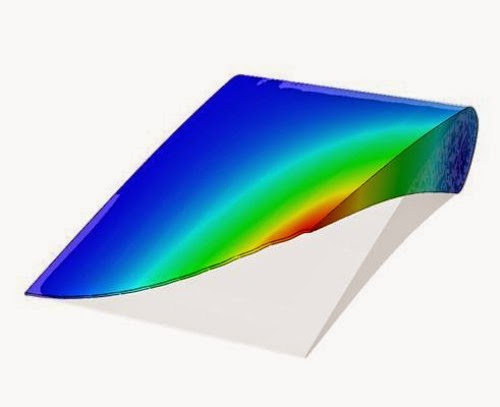
Aircraft wings that change their shape in flight can help to protect the environment. Simulation of a flex module. Credit: © Fraunhofer IFAM
A top priority for any airline is to conserve as much fuel as possible -- and this helps to protect the environment. The EU project SARISTU aims to reduce kerosene consumption by six percent, and integrating flexible landing devices into aircraft wings is one step towards that target. Researchers will be showcasing this concept alongside other prototypes at the ILA Berlin Air Show from May 20-25.

Airport congestion has reached staggering levels as some 2.2 billion people a year take to the skies for business or pleasure. As their numbers grow and more jets add to pollution in the atmosphere, the drawbacks to the popularity of flying become obvious. This has encouraged airlines, aircraft manufacturers and researchers to pull together to reduce airliners' kerosene consumption and contribute to protecting the environment. One effort in this direction is the EU's SARISTU project, short for Smart Intelligent Aircraft Structures.

Landing flaps that change their shape

While birds are able to position their feathers to suit the airflow, aircraft wing components have so far only been rigid. As the name suggests, landing flaps at the trailing edge of the wing are extended for landing. This flap, too, is rigid, its movement being limited to rotation around an axis. This is set to change in the SARISTU project. "Landing flaps should one day be able to adjust to the air flow and so enhance the aerodynamics of the aircraft," explains Martin Schüller, researcher at the Fraunhofer Institute for Electronic Nano Systems ENAS in Chemnitz. A mechanism that alters the landing flap's shape to dynamically accommodate the airflow has already been developed by the consortium partners. Algorithms to control the required shape modifications in flight were programmed by ENAS, in collaboration with colleagues from the Italian Aerospace Research Center (CIRA) and the University of Naples.

The mechanism that allows the landing flap to change shape can only function if the skin of the landing flap can be stretched as it moves, a problem tackled by researchers from the Fraunhofer Institute for Manufacturing Technology and Advanced Materials IFAM in Bremen. "We've come up with a silicon skin with alternate rigid and soft zones," reveals Andreas Lühring from Fraunhofer IFAM. "There are five hard and three soft zones, enclosed within a silicon skin cover extending over the top."

The mechanism sits underneath the soft zones, the areas that are most distended. While the novel design is noteworthy, it is the material itself that stands out, since the flexible parts are made of elastomeric foam that retain their elasticity even at temperatures ranging from minus 55 to 80 degrees Celsius.

Four 90-centimeter-long prototypes -- two of which feature skin segments -- are already undergoing testing. Does the mechanism work? Are the forces being transferred correctly? These are questions for upcoming tests in the wind tunnel. Scientists will be showcasing the prototype at the ILA Berlin Air Show from May 20 -- 25.

Maneuverable wingtips

A single improvement won't be enough to cut kerosene consumption by six percent. Since a variety of measures are needed, scientists from Fraunhofer IFAM are participating in a second subproject focusing on the wingtip. Here the SARISTU consortium has developed a tab that forms part of the wing tip and changes shape during flight to keep air resistance as low as possible. Any gap between the flap and the fixed aircraft wing would cancel out any positive effect. "This led us to develop an elastic connecting element, and this work already covers everything from the chemical makeup to the process technology and manufacture of the component," says Lühring. Like the landing tab, this component retains its elasticity at temperatures ranging from minus 55 to 80 degrees Celsius, and it easily copes with the high wind speeds involved. Researchers will be showcasing the prototype at the ILA Berlin Air Show.

Funding

This project has received funding from the European Union's Seventh Framework Programme for research, technological development and demonstration under grant agreement no 284562.

 
Support : Creating Website | Johny Template | Mas Template
Copyright © 2011. The planet wall - All Rights Reserved
Template Created by Easy Blogging Published by Mas Template
Proudly powered by Blogger