Latest Post
Showing posts with label AERONAUTICAL ENGINEERING. Show all posts

Law of physics governs airplane 'evolution': Constructal law explains progression of passenger jets, sets guidelines for future aircraft

Written By Unknown on Thursday, January 8, 2015 | 9:55 AM

This graph shows how -- as the years have passed -- bigger and bigger airplanes have joined the ranks of their behemoth brothers. Credit: Adrian Bejan
Researchers believe they now know why the supersonic trans-Atlantic Concorde aircraft went the way of the dodo -- it hit an evolutionary cul-de-sac.

In a new study, Adrian Bejan, professor of mechanical engineering and materials science at Duke University, shows that a law of physics he penned more than two decades ago helps explain the evolution of passenger airplanes from the small, propeller-driven DC-3s of yore to today's behemoth Boeing 787s. The analysis also provides insights into how aerospace companies can develop successful future designs.

The Concorde, alas, was too far from the curve of these good designs, Bejan says. The paper appears online July 22, in the Journal of Applied Physics.

"The evolution of Earth's species occurred on a timescale far too large for humans to witness," said Bejan. "But the evolution of our use of technology and airplanes to transport people and goods has taken place in little more than a single lifetime, making it visible to those who look. Evolution is a universal phenomenon encompassing technology, river basins and animal design alike, and it is rooted in physics as the constructal law."

The constructal law was developed by Bejan in 1996 and states that for a system to survive, it must evolve to increase its access to flow. For example, the human vascular system has evolved to provide blood access to flow through a network of a few large arteries and many small capillaries. River systems, tree branches and modern highway and road networks show the same forces at work, he says.

In the case of commercial aircraft, designs have evolved to allow more people and goods to flow across the face of Earth. Constructal law has also dictated the main design features needed for aircraft to succeed; the engine mass has remained proportional to the body size, the wing size has been tied to the fuselage length, and the fuel load has grown in step with the total weight.

"The same design features can be seen in any large land animal," said Bejan. "Larger animals have longer lifespans and travel farther distances, just as passenger airplanes have been designed to do. For example, the ratio of the engine to aircraft size is analogous to the ratio of a large animal's total body size to its heart, lungs and muscles."

To apply his theories to airplane design, Bejan teamed up with Jordan Charles, a researcher and development engineer, and Sylvie Lorente, a professor of civil engineering at the University of Toulouse, to mine the historical databases of successful commercial aircraft. As they plotted thousands of statistics including year of introduction, size, cruising speed, engine weight, fuel weight, range, wingspan and fuselage length, many patterns began to emerge.

But two in particular stood out.

In one chart, a clear curve tracks the increasing size of commercial airplanes through nearly a century of aviation. As time moves on, new commercial airliners come in all sizes but the biggest are joined by even bigger models. In another chart, the line that best tracks the relationship of body mass to airplane speeds is nearly identical to mass and speed statistics from various mammals, lizards, birds, insects and more. Evolutionary constraints found in nature, in other words, can be seen at work in the airline industry.

There was, however, one outlier on the chart -- the Concorde.

"The Concorde was too far off from the ratios that evolution has produced in passenger jets," explained Bejan, who points out that the doomed aircraft had limited passenger capacity, a low mass-to-velocity ratio, an off-the-charts fuselage-to-wingspan ratio, massive engines and poor fuel economy. "It would have had to adhere to the constructal design rules to succeed."

Bejan said this analysis shows that the aviation industry has done well with its designs over the decades, and that the trends dominating the industry are indeed the most efficient. They also reveal the general design parameters that future passenger aircraft should follow to succeed economically.

"This study gives the rough sketch of what airplane designs will put you in the game," said Bejan. "For design companies, it is money in the bank."

Jose Camberos, research aerospace engineer and lead of design space exploration at the Multidisciplinary Science & Technology Center of the Air Force Research Laboratory at Wright-Patterson Air Force Base in Dayton, Ohio, said that the work will hopefully give the field better insight into where the design of airplanes is going.

"There is definitely an analogy to be understood and articulated to explain why engines and airplanes are sized the way they currently are and how that has evolved," said Camberos, who was not involved with this study. "By looking at the development of aircraft in a larger context in these terms, it may be possible to gain insights into how best to achieve what nature has been able to accomplish already."

Seeking reality in the future of aeronautical simulation

This CFD visualization required a NASA supercomputer to handle the intensive calculations. It shows a mesh adaptation used to simulate a transport aircraft in a high-lift configuration. Credit: NASA / Elizabeth Lee-Rausch, Michael Park
The right tool for the job. It's a platitude that is as true for garage tinkerers as it is for the NASA aeronautical innovators who are helping to design future airliners that will cut fuel consumption, reduce polluting emissions and fly more quietly.

Yet at least in one area -- namely computational fluid dynamics, or CFD -- the design tools that helped give us the modern airliners flying today are not expected to be up to the challenge in the future without some serious upgrades.

This was the finding of a report recently released by NASA called "CFD Vision 2030 Study: A Path to Revolutionary Computational Aerosciences." It came out of a one-year study funded by NASA that included Boeing, Pratt & Whitney, Stanford University, The Massachusetts Institute of Technology, The University of Wyoming and The National Center for Supercomputing Applications.

The dilemma is that today's CFD, which simulates airflow around an airplane and through its jet engines, is largely designed to deal with aircraft with traditional tube and wing configurations that everyone is used to. And even then CFD's full effectiveness through all phases of flight is limited.

But future aircraft designs routinely flying during the 2030's may look very different from today's airliners in order to deliver on the promises of reduced fuel burn, noise and emissions.

Wings may be longer and skinnier and held up, or braced, by trusses. Aircraft hulls may be broader and flatter or have more pointed noses. Jet engines may be mounted on the top of the aircraft. Or the joint between a wing and the body may be blended into a seamless contour.

Understanding the physics behind how all of these new variables will affect airflow during all phases of flight, and then finding a way to model that in a computer simulation and validate the CFD is accurate, are the challenges facing NASA's computer experts right now.

"If we can get more physics into the models we're using with our CFD, we'll have a more general tool that can attack not only off-design conditions of conventional tube and wing aircraft, but it also will do better with the different looking configurations of the future," said Mike Rogers, an aerospace engineer at NASA's Ames Research Center in California.

Data from wind-tunnel testing of these new aircraft designs as they come along will help refine the CFD algorithms. The overarching goal is to improve the entire suite of testing capabilities -simulation, ground and flight test -- to provide a more effective, comprehensive toolbox for designers to use to advance the state of the art more quickly.

"It's an iterative process," Rogers said. "We need to continually assess how well our tools are working so we know whether they are adequate or not."

In the meantime, even as NASA's CFD experts work down a path toward their long-range future goals of 2030 -- advancements made possible only because of vast leaps in computer processing speed and power -- their first step is to meet a set of more immediate technical challenges as soon as 2017.

The first stepping-stone goal is to reduce by 40 percent the error in computing several flow phenomena for which current models fail to make accurate predictions; these flow features are likely to be encountered on some of the new aircraft configurations now being studied.

The report highlighted the need for upgrading not only the CFD algorithms, but also discussed how those new algorithms must be written to take advantage of the ever-increasing speed and complexity of future supercomputers.

Source: nasa

Aircraft wings that change their shape in flight can help to protect the environment

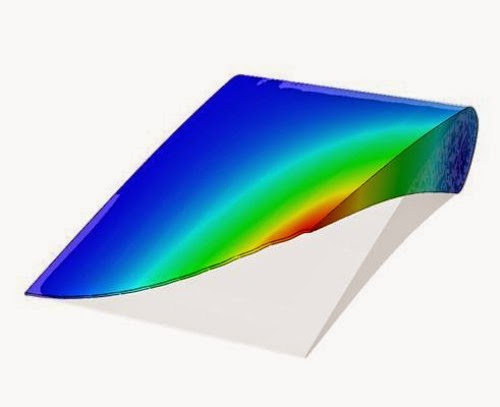
Aircraft wings that change their shape in flight can help to protect the environment. Simulation of a flex module. Credit: © Fraunhofer IFAM
A top priority for any airline is to conserve as much fuel as possible -- and this helps to protect the environment. The EU project SARISTU aims to reduce kerosene consumption by six percent, and integrating flexible landing devices into aircraft wings is one step towards that target. Researchers will be showcasing this concept alongside other prototypes at the ILA Berlin Air Show from May 20-25.

Airport congestion has reached staggering levels as some 2.2 billion people a year take to the skies for business or pleasure. As their numbers grow and more jets add to pollution in the atmosphere, the drawbacks to the popularity of flying become obvious. This has encouraged airlines, aircraft manufacturers and researchers to pull together to reduce airliners' kerosene consumption and contribute to protecting the environment. One effort in this direction is the EU's SARISTU project, short for Smart Intelligent Aircraft Structures.

Landing flaps that change their shape

While birds are able to position their feathers to suit the airflow, aircraft wing components have so far only been rigid. As the name suggests, landing flaps at the trailing edge of the wing are extended for landing. This flap, too, is rigid, its movement being limited to rotation around an axis. This is set to change in the SARISTU project. "Landing flaps should one day be able to adjust to the air flow and so enhance the aerodynamics of the aircraft," explains Martin Schüller, researcher at the Fraunhofer Institute for Electronic Nano Systems ENAS in Chemnitz. A mechanism that alters the landing flap's shape to dynamically accommodate the airflow has already been developed by the consortium partners. Algorithms to control the required shape modifications in flight were programmed by ENAS, in collaboration with colleagues from the Italian Aerospace Research Center (CIRA) and the University of Naples.

The mechanism that allows the landing flap to change shape can only function if the skin of the landing flap can be stretched as it moves, a problem tackled by researchers from the Fraunhofer Institute for Manufacturing Technology and Advanced Materials IFAM in Bremen. "We've come up with a silicon skin with alternate rigid and soft zones," reveals Andreas Lühring from Fraunhofer IFAM. "There are five hard and three soft zones, enclosed within a silicon skin cover extending over the top."

The mechanism sits underneath the soft zones, the areas that are most distended. While the novel design is noteworthy, it is the material itself that stands out, since the flexible parts are made of elastomeric foam that retain their elasticity even at temperatures ranging from minus 55 to 80 degrees Celsius.

Four 90-centimeter-long prototypes -- two of which feature skin segments -- are already undergoing testing. Does the mechanism work? Are the forces being transferred correctly? These are questions for upcoming tests in the wind tunnel. Scientists will be showcasing the prototype at the ILA Berlin Air Show from May 20 -- 25.

Maneuverable wingtips

A single improvement won't be enough to cut kerosene consumption by six percent. Since a variety of measures are needed, scientists from Fraunhofer IFAM are participating in a second subproject focusing on the wingtip. Here the SARISTU consortium has developed a tab that forms part of the wing tip and changes shape during flight to keep air resistance as low as possible. Any gap between the flap and the fixed aircraft wing would cancel out any positive effect. "This led us to develop an elastic connecting element, and this work already covers everything from the chemical makeup to the process technology and manufacture of the component," says Lühring. Like the landing tab, this component retains its elasticity at temperatures ranging from minus 55 to 80 degrees Celsius, and it easily copes with the high wind speeds involved. Researchers will be showcasing the prototype at the ILA Berlin Air Show.

Funding

This project has received funding from the European Union's Seventh Framework Programme for research, technological development and demonstration under grant agreement no 284562.

 
Support : Creating Website | Johny Template | Mas Template
Copyright © 2011. The planet wall - All Rights Reserved
Template Created by Easy Blogging Published by Mas Template
Proudly powered by Blogger