Latest Post
Showing posts with label BUSINESS & INDUSTRY. Show all posts

The University of Rwanda Launch Agribusiness Program in Rwanda

Written By Unknown on Friday, February 6, 2015 | 8:12 PM

Michigan State University and the University of Rwanda recently launched a new Master of Science degree program in agribusiness in Kigali, Rwanda
                                                                   Image Credit: MSU
Michigan State University and the University of Rwanda recently launched a new Master of Science degree program in agribusiness in Kigali, Rwanda.  The gender-sensitive degree program will enroll its first cohort of students in February 2015.

The degree program was jointly developed with funding provided by the U.S. Agency for International Development through the Women’s Leadership Program, implemented globally by Higher Education for Development.

The graduate program prioritizes accessibility to women and midcareer professionals and will incorporate extensive experiential learning opportunities for students. The structure of the program requires all students to partake in an internship, thus better preparing them for leadership and entrepreneurial roles in agriculture in Rwanda. 
“Agriculture is vital to the people and economy of Rwanda, and many of those involved in agriculture are women,” said James McWha, UR professor emeritus and vice chancellor. “Their input to the business of agriculture is essential. It is also important that agriculture adopts a modern business strategy because it is a business and all those involved must learn the relevant skills. This program brings together all the components necessary for a major development of the future of the agriculture and food industries in Rwanda.” 
Using a collaborative approach, the Women’s Leadership Program is designed to support access of women to higher education and advanced degrees, strengthen institutional capacity in research and education on women’s leadership and promote women’s leadership through higher education extension/outreach efforts in underserved communities. 

“The empowerment of women through the expansion of their leadership opportunities and spaces for their voices to be heard is a top priority for USAID globally, including in Rwanda,” said Joseph Lessard, USAID/Rwanda economic growth director. “We really believe this program will give women rich opportunities to share their expertise and play major roles in the country’s economic development. We congratulate the University of Rwanda and Michigan State University on this achievement, and look forward to seeing how it will benefit Rwanda into the future.” 

MSU has a rich history of working collaboratively with the Rwandan government and its institutions of higher education. 

“It has been a great honor to continue the tradition of our two universities working together to advance the agriculture sector in Rwanda,” said Gretchen Neisler, principal investigator on this project from MSU.  “Working collaboratively on the Rwanda Women’s Leadership Program has been very rewarding. I look forward to strengthening our partnership with the UR through the continued development of this degree program.  I am also excited to explore new and innovative ways for our two universities to work together to educate the next generation of thought leaders at both Michigan State University and the University of Rwanda.”

Source: MSU

Study reveals how oxygen is like kryptonite to titanium

UC Berkeley scientists have found the mechanism by which titanium, prized for its high strength-to-weight ratio and natural resistance to corrosion, becomes brittle with just a few extra atoms of oxygen.

WATCH VIDEO and Read Full Artical
Shown is a cross section of grade 3 titanium (containing 0.3 percent oxygen) that has been put under stress and deformed. The defects in the crystal are evident. Oxygen impurities forced the defects to spread onto different planes of the material. (Image by Qian Yu)

The discovery, described in the Feb. 6 issue of the journal Science, has the potential to open the door to more practical, cost-effective uses of titanium in a broader range of applications. The popular silver-gray metal can already be found in high-end bicycles, laptops and human implants, among other products. But high-grade titanium with low levels of oxygen is hard to come by, and the expense of purifying the metal has prevented its wider use in applications for the construction, automotive and aerospace industries.

“If you could process titanium in a way that retained its optimal properties but at a cost comparable to aluminum, you would find uses in cars, trucks, aircraft and ships,” said study senior author Andrew Minor, an associate professor of materials science and engineering and faculty scientist at Lawrence Berkeley National Laboratory. “The high corrosion resistance and excellent specific properties of titanium are very attractive, and reducing the costs to the level of aluminum would make using the material a no-brainer.”

Minor led a research team from the department of materials science and engineering that focused on solving the long-standing mystery in metallurgy of how oxygen causes such a profound change in the characteristics of metals.

“Oxygen is like poison to titanium,” said Minor. “With more oxygen, the material gets harder and more susceptible to cracks, qualities that are not desirable for structural materials.”

A good structural material will have the right balance of ductility — the ability to bend in response to stress — and strength. Minor noted that glass is strong and hard, but not ductile, which is why that material is not used to build vehicles or bridges.
The light blue lines in this schematic illustrate a moving defect, or dislocation, in titanium. The interaction between the dislocation and an oxygen impurity (red atom) leads to the creation of additional dislocations, shown as dark blue lines. (Image by Liang Qi)

Minor added that while many metals have the potential to become brittle with oxygen, titanium is particularly sensitive to even tiny bits of the element. Grade 3 titanium is only 0.3 percent oxygen, yet it is one-third as tough as grade 1 titanium, which is 0.1 percent oxygen. Understanding how oxygen hardens titanium offers a target for research into control of the process, the study authors said.

The researchers subjected various grades of titanium samples to nanocompression tests and examined the resulting impact using advanced transmission electron microscopy techniques and quantum mechanical predictions of defect structures. They found that the interactions between oxygen and the crystalline defects, known as dislocations, that are characteristic of titanium were key to how the material hardened.

The researchers found that oxygen atoms acted like bumps in the road for the corkscrew-shaped dislocations found in titanium. “The mechanical shuffling that occurs as dislocations pop up and over those atomic bumps creates a domino effect of more dislocations,” said study co-author Daryl Chrzan, a professor of materials science and engineering who led the theoretical effort in the project. With increased oxygen, the titanium becomes more difficult to bend and therefore more susceptible to cracking, the researchers found.

A similar effect is seen by bending a paper clip until it breaks. The more the metal bends, the greater the number of dislocations. Dislocations interfere with the motion of other defects, making the paper clip more difficult to bend. Eventually, the number of dislocations is so high that the paper clip can no longer bend, and instead it breaks.

“Now that we know what it is about the oxygen found in inexpensive titanium that causes the material to harden, we can work on figuring out a way to process it to move oxygen atoms to a place where they don’t cause problems,” said study co-author Mark Asta, a professor of materials science and engineering.

Minor noted that this is already done in the semiconductor industry since oxygen and other impurities are also damaging to silicon-based microprocessors.

Other co-authors of the study included researchers from the Berkeley Lab, Japan’s Nuclear Science and Engineering Directorate and Rolls Royce.

The Office of Naval Research helped support this work. Experiments were performed at the National Center for Electron Microscopy in the Molecular Foundry at Berkeley Lab, which is supported by the U.S. Department of Energy.

Source: UC Berekely

UT Institute of Agriculture Launches New Branding Campaign

Written By Unknown on Thursday, February 5, 2015 | 6:42 PM

There’s no mistaking the system colors of the University of Tennessee. Everywhere you look, there’s plenty of orange.

However, the UT Institute of Agriculture (UTIA) is adding new splashes of color to the landscape, along with redesigned logos for the Institute and its four units. All feature the orange “UT” system icon that is so widely recognized. In addition to the new theme colors, UTIA is adopting a new tagline that will serve as its branding promise: Real. Life. Solutions.

“We believe the Institute of Agriculture’s new logo and brand promise best represent our statewide presence in all 95 counties of Tennessee,” says UTIA Chancellor Larry Arrington. “Visual branding is important when telling the story of an organization, and our new look and message will help us better communicate our land-grant mission.”

UTIA’s new logo features the traditional orange with a slate font. UT Extension features a green or “pasture” color. UT AgResearch is represented by a dark blue known as “bluff.” The UT College of Agricultural Sciences and Natural Resources has a blue “azure” color, and the UT College of Veterinary Medicine features a gray “granite” color. The brand promise will be featured prominently on printed and electronic materials, and be a part of apparel and signage around Tennessee. Images of the new logos can be found on the UTIA Marketing website: ag.tennessee.edu/marketing

"Our brand promise speaks to what the faculty, staff, students, alumni and supporters do every day, and that is working to find answers to society's many challenges," says Lisa Stearns, vice chancellor for UTIA Marketing and Communications. "Providing real life solutions that make a positive impact in our state and beyond is our commitment."

The campaign was developed by UTIA’s Marketing and Communications unit over the past year. It included a statewide audit of printed and electronic materials, and consulting an expert to guide a discussion on branding architecture. In addition, the team worked with the UT System Marketing and Communications Office to make sure the direction in which UTIA was moving would help promote the UT brand.

The Institute will begin phasing in the new logos and brand promise immediately, and the goal is to have full implementation by the end of 2015 across Tennessee.

The UT Institute of Agriculture provides instruction, research and outreach through the UT College of Agricultural Sciences and Natural Resources, the UT College of Veterinary Medicine, UT AgResearch, including its system of 10 research and education centers, and UT Extension offices in every county in the state.

Source: UTIA

February 2015 Supermarket Orchid, Mass marketing has hit the orchid world!

The phalaenopsis, or moth orchid, is a favorite gift orchid and is readily available in supermarkets and garden centers. It comes in a variety of colors and exotic patterns, and with care the long-lived blooms can be enjoyed for weeks. Photo by P. McDaniels, courtesy UTIA

Did someone bless you with a beautiful orchid? Mass marketing has hit the orchid world!
Among the most popular orchids for gifting are cattleyas (pronounced “KAT-lee-uh”). Another favorite gift orchid is the genus phalaenopsis (pronounced “fail-en-NOP-sis”).  This orchid is nicknamed the moth orchid because of the shape of its blooms. Both come in a variety of sizes and colors, are readily available in grocery stores and garden centers, and can look just as good in your home as the store.

In spite of the fact that my friends think I can grow anything with little regard for plant rules, I will confess that I managed to kill the first two orchids I was given years ago by simply not consulting the experts. Orchids are epiphytes or air plants that have developed specialized water-storage organs. They like to attach to moist tree bark in a tropical atmosphere. Thus, they have their own set of recommended growing practices. The American Orchid Society (aos.org) gives great advice on keeping your new friend healthy and blooming. 

Both cattleyas and phalaenopsis appreciate a lot of air movement and a long day of filtered, bright light. They don’t appreciate direct sunlight but do thrive in temperatures between 60 and 85 degrees Fahrenheit. Living in an east-facing window usually makes them happiest.

Both orchids should be kept in free-draining growing media. The AOS recommends even moisture, although allowing the media to dry slightly can be beneficial. I recommend you water your orchid once a week, at most. Be sure the water can drain and does not stand in the pot. The pot it came in probably has no drainage, so your job is to not overwater. You can also create drainage holes.

Orchids should be watered in the morning. Because the water should run through the pot, place the plants in the sink. Tepid water is recommended. Also, do not use salt-softened or distilled water. Let the water run through the plant for a minute or so. Be sure to let the plant drain completely. If any water gets trapped in the leaves, use a paper towel to blot. This will help avoid crown rot. If you’ve read that you should just lay some ice cubes around the roots, I have found that generally works, also.

As for fertilizer, there are a number of mixtures and brands, but the AOS recommends that any fertilizer you use should not contain urea. Their website discusses recommended methods. If you want to try a home fertilizer brew, you might try your morning brew. I dump the dregs of my coffee pot into my orchids once a week, all year around.  For an average pot with a 5-inch top measurement, about 1/4 cup of these leavings works best. Doing this will negate the job of occasional fertilizing, as the dregs give your new friend all the encouragement it needs to do its best. I use “high test” (caffeine) coffee leavings, but a friend is using decaf on hers. It will be interesting to see which formula produces the best results. 

When orchids have completed their flowering cycle, it’s time to cut the flower stem to encourage a new bloom on a healthy plant. Again, the AOS has a number of tips about getting your orchid to re-bloom. For phalaenopsis, they recommend cutting the flower stem ½-inch above the first or second node. Be sure your pruners have been disinfected. The plant will most often grow another flower stem and re-bloom.

Repotting may be necessary every one to three years if the plant becomes root-bound or the media needs replenished.  Don’t be tempted to substitute the loose medium that came with your orchid with your favorite soil mix. Orchids like orchid mixes that drain well, otherwise they may decline to the point of no return.

Source: UTIA

Aircraft wings that change their shape in flight can help to protect the environment

Written By Unknown on Thursday, January 8, 2015 | 9:10 AM

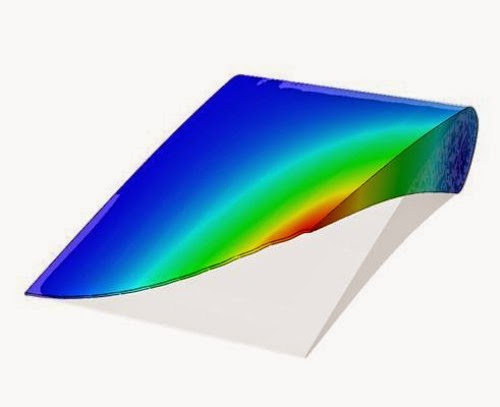
Aircraft wings that change their shape in flight can help to protect the environment. Simulation of a flex module. Credit: © Fraunhofer IFAM
A top priority for any airline is to conserve as much fuel as possible -- and this helps to protect the environment. The EU project SARISTU aims to reduce kerosene consumption by six percent, and integrating flexible landing devices into aircraft wings is one step towards that target. Researchers will be showcasing this concept alongside other prototypes at the ILA Berlin Air Show from May 20-25.

Airport congestion has reached staggering levels as some 2.2 billion people a year take to the skies for business or pleasure. As their numbers grow and more jets add to pollution in the atmosphere, the drawbacks to the popularity of flying become obvious. This has encouraged airlines, aircraft manufacturers and researchers to pull together to reduce airliners' kerosene consumption and contribute to protecting the environment. One effort in this direction is the EU's SARISTU project, short for Smart Intelligent Aircraft Structures.

Landing flaps that change their shape

While birds are able to position their feathers to suit the airflow, aircraft wing components have so far only been rigid. As the name suggests, landing flaps at the trailing edge of the wing are extended for landing. This flap, too, is rigid, its movement being limited to rotation around an axis. This is set to change in the SARISTU project. "Landing flaps should one day be able to adjust to the air flow and so enhance the aerodynamics of the aircraft," explains Martin Schüller, researcher at the Fraunhofer Institute for Electronic Nano Systems ENAS in Chemnitz. A mechanism that alters the landing flap's shape to dynamically accommodate the airflow has already been developed by the consortium partners. Algorithms to control the required shape modifications in flight were programmed by ENAS, in collaboration with colleagues from the Italian Aerospace Research Center (CIRA) and the University of Naples.

The mechanism that allows the landing flap to change shape can only function if the skin of the landing flap can be stretched as it moves, a problem tackled by researchers from the Fraunhofer Institute for Manufacturing Technology and Advanced Materials IFAM in Bremen. "We've come up with a silicon skin with alternate rigid and soft zones," reveals Andreas Lühring from Fraunhofer IFAM. "There are five hard and three soft zones, enclosed within a silicon skin cover extending over the top."

The mechanism sits underneath the soft zones, the areas that are most distended. While the novel design is noteworthy, it is the material itself that stands out, since the flexible parts are made of elastomeric foam that retain their elasticity even at temperatures ranging from minus 55 to 80 degrees Celsius.

Four 90-centimeter-long prototypes -- two of which feature skin segments -- are already undergoing testing. Does the mechanism work? Are the forces being transferred correctly? These are questions for upcoming tests in the wind tunnel. Scientists will be showcasing the prototype at the ILA Berlin Air Show from May 20 -- 25.

Maneuverable wingtips

A single improvement won't be enough to cut kerosene consumption by six percent. Since a variety of measures are needed, scientists from Fraunhofer IFAM are participating in a second subproject focusing on the wingtip. Here the SARISTU consortium has developed a tab that forms part of the wing tip and changes shape during flight to keep air resistance as low as possible. Any gap between the flap and the fixed aircraft wing would cancel out any positive effect. "This led us to develop an elastic connecting element, and this work already covers everything from the chemical makeup to the process technology and manufacture of the component," says Lühring. Like the landing tab, this component retains its elasticity at temperatures ranging from minus 55 to 80 degrees Celsius, and it easily copes with the high wind speeds involved. Researchers will be showcasing the prototype at the ILA Berlin Air Show.

Funding

This project has received funding from the European Union's Seventh Framework Programme for research, technological development and demonstration under grant agreement no 284562.

Revolutionizing genome engineering

Written By Unknown on Thursday, December 25, 2014 | 3:21 AM

Streptococcus pyogenes is one of the bacteria in which the HZI scientists have studied the CRISPR-Cas system. Credit: © HZI / M. Rohde
Genome engineering with the RNA-guided CRISPR-Cas9 system in animals and plants is changing biology. It is easier to use and more efficient than other genetic engineering tools, thus it is already being applied in laboratories all over the world just a few years after its discovery. This rapid adoption and the history of the system are the core topics of a review published in the journal Science. The review was written by the discoverers of the system Prof. Emmanuelle Charpentier, who works at the Helmholtz Centre for Infection Research (HZI) and is also affiliated to the Hannover Medical School and Umeå University, and Prof. Jennifer Doudna from the University of California, Berkeley, USA.

Many diseases result from a change of an individual's DNA -- the letter code that genes consist of. The defined order of the letters within a gene usually codes for a protein. Proteins are the workforce of our body and responsible for almost all processes needed to keep us running. When a gene is altered, its protein product may lose its normal function and disorders can result. "Making site-specific changes to the genome therefore is an interesting approach to preventing or treating those diseases," says Prof Emmanuelle Charpentier, head of the HZI research department "Regulation in Infection Biology." Due to this, ever since the discovery of the DNA structure, researchers have been looking for a way to alternate the genetic code.

First techniques like zinc finger nucleases and synthetic nucleases called TALENs were a starting point but turned out to be expensive and difficult to handle for a beginner. "The existing technologies are dependent on proteins as address labels and customizing new proteins for any new change to introduce in the DNA is a cumbersome process," says Charpentier. In 2012, while working at Umeå University, she described what is now revolutionising genetic engineering: the CRISPR-Cas9 system.

It is based on the immune system of bacteria and archaea but is also of value in the laboratory. CRISPR is short for Clustered Regularly Interspaced Palindromic Repeats, whereas Cas simply stands for the CRISPR-associated protein. "Initially we identified a novel RNA, namely tracrRNA, associated to the CRISPR-Cas9 system, which we published in 2011 in Nature. We were excited when Krzysztof Chylinski from my laboratory subsequently confirmed a long term thinking: Cas9 is an enzyme that functions with two RNAs," says Charpentier.

Together the system has the ability to detect specific sequences of letters within the genetic code and to cut DNA at a specific point. In this process the Cas9 protein functions as the scissors and an RNA snippet as the address label ensuring that the cut happens in the right place. In collaboration with Martin Jinek and Jennifer Doudna, the system could be simplified to use it as a universal technology. Now the user would just have to replace the sequence of this RNA to target virtually any sequence in the genome.

After describing the general abilities of CRISPR-Cas9 in 2012 it was shown in early 2013 that it works as efficiently in human cells as it does in bacteria. Ever since, there has been a real hype around the topic and researchers from all over the world have suggested new areas in which the new tool can be used. The possible applications extend from developing new therapies for genetic disorders caused by gene mutations to changing the pace and course of agricultural research in the future all the way to a possible new method for fighting the AIDS virus HIV.

"The CRISPR-Cas9 system has already breached boundaries and made genetic engineering much more versatile, efficient and easy," Charpentier says. "There really does not seem to be a limit in the applications."

Source: Helmholtz Centre for Infection Research

Can We Offset Global Warming By Geoengineering The Climate With Aerosols?

Written By Unknown on Thursday, December 4, 2014 | 9:38 AM

Volcano eruption on Reunion Island. Should humans deliberately mimic the effect of volcanic aerosols to try to offset global warming? Credit: iStockphoto/Julien Grondin
Concerned that energy system transformations are proceeding too slowly to avoid risks from dangerous human-induced climate change, many scientists are wondering whether geoengineering (the deliberate change of the Earth's climate) may help counteract global warming.

Sulfate aerosols, commonly released by volcanoes, serve to scatter incoming solar energy in the stratosphere, preventing it from reaching the surface. To investigate the feasibility of deliberately mimicking the effect of volcanic aerosols, Rasch et al. explore scenarios in which aerosol properties are varied to assess interactions with the climate system.
Through model simulations, they discover that, because stratosphere-troposphere exchange processes change with increasing levels of aerosols, about 50 percent more aerosols would have to be injected into the atmosphere than in the scenario where such processes stayed constant.
Further, almost double the level of aerosol loading is required to counteract greenhouse warming if aerosol particles are as large as those seen during volcanic eruptions. The authors caution that geoengineering methods to mask global warming may have serious environmental consequences that must be explored before any action is taken.
Journal reference: Exploring the geoengineering of climate using stratospheric sulfate aerosols: The role of particle size. Geophysical Research Letters (GRL) paper 10.1029/2007GL032179, 2008; http://dx.doi.org/10.1029/2007GL032179
Authors: Philip J. Rasch and Danielle B. Coleman: National Center for Atmospheric Research, Boulder Colorado, U.S.A.;Paul J. Crutzen: Max Plank Institute for Chemistry, Mainz, Germany; Also at Scripps Institution of Oceanography, University of California, San Diego, La Jolla, California, U.S.A.

Source: American Geophysical Union.

Geoengineering our climate is not a 'quick fix'

The deliberate, large-scale intervention in the Earth's climate system is not a "quick fix" for global warming, according to the findings of the UK's first publicly funded studies on geoengineering. Credit: University of Leeds
The deliberate, large-scale intervention in the Earth's climate system is not a "quick fix" for global warming, according to the findings of the UK's first publicly funded studies on geoengineering.

The results of three projects -- IAGP, led by the University of Leeds; SPICE, led by the University of Bristol; and CGG, led by the University of Oxford -- are announced at an event held at The Royal Society, London, on 26 November 2014.
Professor Piers Forster, Professor of Physical Climate Change at the University of Leeds, and the principal investigator of the Integrated Assessment of Geoengineering Proposals (IAGP) project, said: "Our research shows that the devil is in the detail. Geoengineering will be much more expensive and challenging than previous estimates suggest and any benefits would be limited.
"For example, when simulating the spraying of sea salt particles into clouds to try to brighten them, we found that only a few clouds were susceptible and that the particles would tend to coagulate and fall out before reaching the cloud base."
In September 2009, The Royal Society published a report, Geoengineering the climate: science, governance and uncertainty. It influenced research worldwide, identified important gaps and called for a major UK funding programme into geoengineering. The IAGP and SPICE projects were funded the next year, and the CGG project followed in 2012.
IAGP is the UK's first interdisciplinary research study into the controversial issue of geoengineering. It has brought together a range of expertise -- climate modelling, philosophy and engineering -- in addition to understanding public perceptions, to assess geoengineering within wider societal values.
"Cleverly designed simulations create less necessity for real-world testing.. My favourite part of the research involved creating a virtual reality in which we tried to rescue Arctic sea ice by dumping sulphur dioxide into the atmosphere from Stratotanker aircraft flying out of Svalbard in Norway," said Professor Forster.
"Issues around monitoring and predicting the effects of our actions led to huge indecision and highlighted how challenging it would be to ever try and deploy these techniques in the real world."
Researchers working on the Stratospheric Particle Injection for Climate Engineering (SPICE) project took a different tack, but came to a similar cautionary conclusion.
Rather than running simulations, SPICE researchers used volcanoes as models to mimic the effect of a solar geoengineering proposal, in which sulphate aerosols are pumped into the atmosphere to reflect more sunlight back into space. This is a process that also naturally occurs due to particles emitted from volcanic eruptions.
Dr Matthew Watson, a reader in natural hazards from the University of Bristol, and principal investigator for the SPICE project, said: "Whilst it is clear that temperatures could be reduced during deployment, the potential for misstep is considerable. By identifying risks, we hope to contribute to the evidence base around geoengineering that will determine whether deployment, in the face of the threat of climate change, has the capacity to do more good than harm."
In addition to the feasibility of deployment, IAGP researchers organised workshops to gauge people's perceptions of geoengineering. Four public workshops were held in Birmingham, Cardiff, Glasgow and Norwich, and two stakeholder workshops in London, with representation from national government departments, civil society groups and industry.
The idea that geoengineering involves "messing with nature" was found to be a central theme in public discussion groups. The workshops also revealed that, of the geoengineering proposals discussed, carbon dioxide removal approaches were favoured over solar geoengineering approaches.
In both the public discussion groups and stakeholder workshops, climate change mitigation strategies, such as improving energy efficiency measures and scaling up renewable technologies, were preferred to geoengineering proposals.
Professor Forster said: "Consulting the public, policymakers and industry from the start told us that we should only consider geoengineering within the wider context of climate change mitigation and adaptation. Geoengineering is not a 'quick fix' alternative."
Dr Watson added: "Full scale deployment of climate engineering technologies will be the clearest indication that we have failed in our role as planetary stewards, but there is a point at which not deploying some technologies would be unethical."
Meanwhile, the Climate Geoengineering Governance (CGG) project is the world's first project to concentrate on the governance and regulatory challenges posed by both research and possible deployment.
The findings of the CGG project include the likelihood that cost estimates for major projects are unrealistic, and that geoengineering must be located firmly in the context of mitigation and adaptation to climate change.
Furthermore, CGG research has also unearthed a paradox: Geoengineering proposals that are technically the easiest to implement and have the quickest impact may be most difficult to govern, while those that are easiest to govern seem likely to be further away from effective large-scale deployment.
Professor Steve Rayner, the James Martin Professor of Science and Civilization at the University of Oxford, and principal investigator for the CGG project, concludes: "Take everything you hear both for and against geoengineering with a large grain of salt. Mostly it is too soon to know what any of these technology ideas would look like in practice or what would be their true cost and benefit.
"But it's almost certain that geoengineering will be neither a magic bullet nor Pandora's Box."

Source: University Of Leeds
 
Support : Creating Website | Johny Template | Mas Template
Copyright © 2011. The planet wall - All Rights Reserved
Template Created by Easy Blogging Published by Mas Template
Proudly powered by Blogger