Latest Post
Showing posts with label TRANSPORTATION SCIENCE. Show all posts

Correct seat belt use saves children's lives

Written By Unknown on Friday, January 16, 2015 | 7:39 PM

Nine out of ten children are seriously or fatally injured in traffic accidents because they are incorrectly restrained or because of loose objects in cars. Credit: Marianne Skjerven-Martinsen, NIPH
Nine out of ten children are seriously or fatally injured in traffic accidents because they are incorrectly restrained or because of loose objects in cars. Correct use of safety equipment will save more lives, according to a new study from the Norwegian Institute of Public Health (NIPH).

Why are some children seriously or fatally injured in traffic accidents while other children in the same vehicle walk away without physical injury? This is one of the main questions Dr Marianne Skjerven-Martinsen at the NIPH studied as part of her doctoral dissertation.

The study is part of the research project 'Barn i bil' (Eng: Children in cars), a collaboration between the NIPH and Oslo University Hospital. As part of the project, a roadside study of normal traffic on Norwegian high-speed roads also took place which showed that every third child was incorrectly restrained.

Correct seat belt use is crucial

By investigating traffic accidents in Norway, Skjerven-Martinsen and her colleagues documented that incorrect restraint and loose objects in cars play a significant role in the number of deaths and injuries among children.

The results show that:
  • Accidents where children are seriously injured mainly occur on high speed roads, in weekend traffic and most often follow frontal collisions on roads without crash barriers between carriageways.
  • More than 9 out of 10 children who were seriously or fatally injured in traffic accidents were incorrectly restrained or were hit by loose objects in the car.
  • The most common error is that the seatbelt is misplaced, with the shoulder belt under the arm or behind the back, or the lap belt is placed too high on the abdomen.
  • Loose objects also cause damage to passengers, often indirectly when heavy luggage shifts, displacing the rear seat where the child is sitting.
  • Correctly secured children have a low risk of injury, even in a heavy collision.

Children over 4 years are injured most frequently and the most common injuries are to the head, face, chest and abdomen.

For younger children, the most common errors are loose or misplaced straps.
Learn from experience

"We see that adults want to protect their children but they may lack knowledge of what can happen if the equipment is not used properly. The aim of this study was to evaluate the incorrect usage of child restraint in the vehicle, related to the child's height, age and type of equipment. In this way, we can give advice to parents, authorities and particularly the motor industry," says Skjerven-Martinsen.

In her thesis, she also described how children of different ages should be secured to prevent serious injury in car accidents. The findings provide a scientific basis for targeted prevention.

Source: Norwegian Institute of Public Health

3-D printed Shelby Cobra

Written By Unknown on Wednesday, January 14, 2015 | 3:55 AM

This Shelby Cobra sports car, 3D-printed at Department of Energy's Manufacturing Demonstration Facility at Oak Ridge National Laboratory, will be on display this week at the Detroit Auto Show Technology Showcase. Credit: Image courtesy of Oak Ridge National Laboratory
With a 3-D printed twist on an automotive icon, the Department of Energy's Oak Ridge National Laboratory is showcasing additive manufacturing research at the 2015 North American International Auto Show in Detroit.

ORNL's newest 3-D printed vehicle pays homage to the classic Shelby Cobra in celebration of the racing car's 50th anniversary. The 3-D printed Shelby will be on display January 12-15 as part of the show's inaugural Technology Showcase.

Researchers printed the Shelby car at DOE's Manufacturing Demonstration Facility at ORNL using the Big Area Additive Manufacturing (BAAM) machine, which can manufacture strong, lightweight composite parts in sizes greater than one cubic meter. The approximately 1400-pound vehicle contains 500 pounds of printed parts made of 20 percent carbon fiber.
Recent improvements to ORNL's BAAM machine include a smaller print bead size, resulting in a smoother surface finish on the printed pieces. Subsequent work by Knoxville-based TruDesign produced a Class A automotive finish on the completed Shelby.

"Our goal is to demonstrate the potential of large-scale additive manufacturing as an innovative and viable manufacturing technology," said Lonnie Love, leader of ORNL's Manufacturing Systems Research group. "We want to improve digital manufacturing solutions for the automotive industry."

The team took six weeks to design, manufacture and assemble the Shelby, including 24 hours of print time. The new BAAM system, jointly developed by ORNL and Cincinnati Incorporated, can print components 500 to 1000 times faster than today's industrial additive machines. ORNL researchers say the speed of next-generation additive manufacturing offers new opportunities for the automotive industry, especially in prototyping vehicles.

"You can print out a working vehicle in a matter of days or weeks," Love said. "You can test it for form, fit and function. Your ability to innovate quickly has radically changed. There's a whole industry that could be built up around rapid innovation in transportation."

The Shelby project builds on the successful completion of the Strati, a fully 3-D printed vehicle created through a collaboration between Local Motors and ORNL.

The lab's manufacturing and transportation researchers plan to use the 3-D printed Shelby as a laboratory on wheels. The car is designed to "plug and play" components such as battery and fuel cell technologies, hybrid system designs, power electronics, and wireless charging systems, allowing researchers to easily and quickly test out new ideas.

Source: Oak Ridge National Laboratory

From video camera to driverless shuttle vehicle

Written By Unknown on Sunday, January 11, 2015 | 7:04 PM

The EZ 10 shuttle vehicle. Credit: © EasyMile
A new type of driverless shuttle vehicle has been developed thanks to innovative computer vision guidance technology that enables the vehicle to locate itself on a roadway reliably and inexpensively. The technology, which is based on the use of simple video cameras, was developed by researchers at Institut Pascal (CNRS/Université Blaise Pascal de Clermont Ferrand/IFMA)[1]. It lies at the heart of the EZ-10 autonomous shuttle vehicle developed by Ligier Group[2], which will be unveiled at the Michelin Challenge Bibendum in Chengdu (China) from 11 to 14 November 2014.

Since the 2000s, a number of companies have sought to make cars autonomous using expensive and sometimes unreliable technologies[3]. In 2003, researchers at Institut Pascal decided to work on automated driving of urban electric vehicles using simple video cameras. 
The technology they developed is based on two stages. The aim of the first stage is to identify all the significant points in the immediate environment of the path followed, in a video recorded during an initial journey in which the vehicle is driven manually. The second stage corresponds to the automatic mode during which the vehicle continuously monitors its path, ensuring that the images provided by the on-board cameras correspond as far as possible to the sequence initially filmed. The initial video thus plays the role of a virtual track that the vehicle must follow when it travels in autonomous mode.

Since 2006, the researchers at Institut Pascal, in collaboration with Ligier Group, have been developing automatic driverless shuttle vehicles that can transport up to 10 people along short routes (in the region of one kilometer), rather like a horizontal elevator. The vehicles, which are designed to be used at specific sites such as industrial sites, airports and amusement parks, are able to deal with obstacles thanks to laser rangefinders fitted on all four sides of the vehicle. The shuttle vehicle can detect the presence of an obstacle at a distance of 50 meters and in this way modify its speed or even stop, depending on the potential danger. The researchers now intend to turn their attention to running a fleet of five vehicles at the Michelin Europe Technology Center at Ladoux. The aim is to deal with multiple and potentially simultaneous requests from call points or smartphones, in real time and on a large industrial site, rather like an automatic taxi service.

The localization technology, which is reliable and inexpensive, will be unveiled at the Michelin Challenge Bibendum in Chengdu (China) from 11 to 14 November 2014. Equipped with an access ramp for people with reduced mobility, the new EZ-10 shuttle vehicle will provide visitors with a completely automated transport service.

[1] Within the framework of the IMobS3 Laboratory of Excellence.

[2] It is marketed by the EasyMile company, a joint venture between Ligier and Robosoft Technology.

[3] For example: differential GPS (which is different from the GPS commonly used in cars) is not always reliable, especially in city centers, where the satellite signals can be reflected off the façades of buildings. This phenomenon can lead to erroneous location calculations.

Source: CNRS

Electric cars without drivers

Autonomous vehicle in the car-sharing operation: After the renter has called for the car, it navigates autonomously to the pick-up area. Credit: © Fraunhofer IPA
E-Mobile will park independently in the future and will also be able to find the next charging station without a driver. Researchers are working on electric cars that can travel short distances autonomously. On the basis of cost-effective sensors, they are developing a dynamic model that perceives the environmental situation.

Whoever got his driver's license twenty years ago and is back in a car for the first time is going to be rubbing his eyes in amazement. Electronic helpers warn of a possible collision when parking and keep the necessary distance to the car ahead during traffic. There are lane departure, crosswind, blind spot and high beam assistants, not to mention the anti-lock system. The car is taking over step by step in the cockpit. Researchers at the Fraunhofer Institute for Manufacturing Engineering and Automation IPA are one step ahead: They are dedicated to automated driving and are working on the vehicles of tomorrow, which can drive through traffic without human assistance. In this process, the Stuttgart engineers are particularly keeping an eye on electric cars.

The specialty of the researchers at the IPA is the development of robots. In the institute building, there is a prototype that independently finds its way on its four wheels through unknown territory. The challenges that are to be mastered are similar to those for automated driving. Here, as well, sensors need to recognize the environment so that the vehicle can navigate around obstacles and find its goal. Why not take advantage of that experience and apply it to the car, say the engineers in Stuttgart. That is why, one and a half years ago, an interdisciplinary team of computer scientists, mathematicians, electrical engineers and mechatronics engineers launched the project Afkar (a German abbreviation for "autonomous driving and intelligent chassis concept for an all-electric vehicle").

In a first step, the electric car is intended to learn to find a parking space and to park without a scratch. The idea behind this is that the car should be able to recharge itself with electricity without human help. This would be particularly important for car-sharing. Imagine the following scenario: The driver easily parks the car in a properly equipped parking garage on any randomly available parking space. The car takes care of everything else itself. It communicates via a wireless interface with the charging station and the parking garage management. In this process, it provides information about its charge level and its location. If the battery is empty and a charging station is free, it maneuvers in the corresponding parking bay and is charged inductively, without a cable. Then it makes room for the next electric car and rolls to a free parking space. In this way, the few existing charging stations can be used effectively.

Necessary technology is available

"The technology needed for this scenario is already available," says Afkar project manager Benjamin Maidel. He is referring to the robots of the institute that find their way easily in a known environment, such as a factory floor. Rebuilding a similar car does not take a lot of effort. Many modern cars already have most of the sensors that are required for this. The data that these devices collect just have to be combined and interpreted accordingly so that they provide a picture of the environment. The Fraunhofer experts are currently developing the necessary technology with the help of complex simulation programs. Soon, they want to test the results in practice on a demonstration vehicle.

It becomes more difficult when a car is intended to move autonomously in traffic. This requires sensors that can look hundreds of meters ahead as well as software that can react to any unforeseen events, whether that's a building site, a thunderstorm or snow. Maidel and his team are focusing on cameras, ultrasound, radar and laser scanners that perceive the surrounding area up to a distance of 200 to 300 meters.

The Afkar group will first go with their test car to a cordoned-off test area. For public roads, a special permit is required. "Whether autonomous driving makes a breakthrough will be decided, along with the right price, by customer acceptance and the legal framework. For example, the liability for accidents has to be re-regulated. The technology will probably conquer the market step by step," says Maidel. The advantages are obvious -- particularly for car-sharing vehicles. Any customer could use his smart phone to call a car, which would then drive to the desired location. Car-sharing companies could utilize their fleets more fully than they do today.

Source: Fraunhofer-Gesellschaft

'Grimsel' electric racing car breaks world record

Written By Unknown on Friday, January 9, 2015 | 7:16 PM

The record journey from the car driver's perspective. Credit: AMZ Racing
The 'grimsel' electric racing car today broke the previous world record for acceleration in electric cars. The vehicle accelerated from 0 to 100 km/h in 1.79 seconds in under 30 metres. The new record was set by students from ETH Zurich and Lucerne University of Applied Sciences and Arts, who also designed and built the vehicle.

The Formula Student team at the Academic Motorsports Club Zurich (AMZ) finally did it: its 'grimsel' electric racing car smashed the previous world record when it accelerated from 0 to 100 km/h in just 1.785 seconds. The previous record of 2.134 seconds was held by an electric car built by Delft University of Technology. The new record was set at the military airfield in Dübendorf, where the vehicle reached a speed of 100 km per hour in less than 30 metres.

The new record-breaking vehicle is a Formula Student electric car that was developed and built in less than a year by 30 students at ETH Zurich and Lucerne University of Applied Sciences and Arts. The 'grimsel' is the fifth AMZ electric car and the result of continuous development. The carbon fibre construction has a total weight of 168 kg and produces about 200 hp. A four-wheel drive is implemented with four specially designed wheel hub motors, which generate a total torque of 1630 Nm at the wheels. By means of traction control, torque distribution is controlled individually for each wheel to maximise vehicle acceleration. No other production vehicle in the world has reached a similarly strong acceleration.

AMZ's most successful car

The 'grimsel' celebrated numerous successes at the Formula Student international competition this summer. With more than 500 teams, Formula Student is the world's biggest competition for engineers and is held annually at various locations around the globe. With three overall wins and an average of 920 points out of a possible 1,000, the 'grimsel' is AMZ's most successful car. And with its victories in Austria and Spain, it achieved the two highest scores in the European history of Formula Student. These further strengthened AMZ's standing at the top of the Formula Student world rankings and demonstrated the potential in electric drive concepts.

Source: ETH Zürich

Aircraft wings that change their shape in flight can help to protect the environment

Written By Unknown on Thursday, January 8, 2015 | 9:10 AM

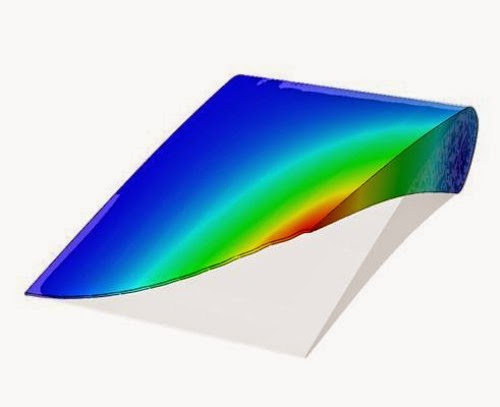
Aircraft wings that change their shape in flight can help to protect the environment. Simulation of a flex module. Credit: © Fraunhofer IFAM
A top priority for any airline is to conserve as much fuel as possible -- and this helps to protect the environment. The EU project SARISTU aims to reduce kerosene consumption by six percent, and integrating flexible landing devices into aircraft wings is one step towards that target. Researchers will be showcasing this concept alongside other prototypes at the ILA Berlin Air Show from May 20-25.

Airport congestion has reached staggering levels as some 2.2 billion people a year take to the skies for business or pleasure. As their numbers grow and more jets add to pollution in the atmosphere, the drawbacks to the popularity of flying become obvious. This has encouraged airlines, aircraft manufacturers and researchers to pull together to reduce airliners' kerosene consumption and contribute to protecting the environment. One effort in this direction is the EU's SARISTU project, short for Smart Intelligent Aircraft Structures.

Landing flaps that change their shape

While birds are able to position their feathers to suit the airflow, aircraft wing components have so far only been rigid. As the name suggests, landing flaps at the trailing edge of the wing are extended for landing. This flap, too, is rigid, its movement being limited to rotation around an axis. This is set to change in the SARISTU project. "Landing flaps should one day be able to adjust to the air flow and so enhance the aerodynamics of the aircraft," explains Martin Schüller, researcher at the Fraunhofer Institute for Electronic Nano Systems ENAS in Chemnitz. A mechanism that alters the landing flap's shape to dynamically accommodate the airflow has already been developed by the consortium partners. Algorithms to control the required shape modifications in flight were programmed by ENAS, in collaboration with colleagues from the Italian Aerospace Research Center (CIRA) and the University of Naples.

The mechanism that allows the landing flap to change shape can only function if the skin of the landing flap can be stretched as it moves, a problem tackled by researchers from the Fraunhofer Institute for Manufacturing Technology and Advanced Materials IFAM in Bremen. "We've come up with a silicon skin with alternate rigid and soft zones," reveals Andreas Lühring from Fraunhofer IFAM. "There are five hard and three soft zones, enclosed within a silicon skin cover extending over the top."

The mechanism sits underneath the soft zones, the areas that are most distended. While the novel design is noteworthy, it is the material itself that stands out, since the flexible parts are made of elastomeric foam that retain their elasticity even at temperatures ranging from minus 55 to 80 degrees Celsius.

Four 90-centimeter-long prototypes -- two of which feature skin segments -- are already undergoing testing. Does the mechanism work? Are the forces being transferred correctly? These are questions for upcoming tests in the wind tunnel. Scientists will be showcasing the prototype at the ILA Berlin Air Show from May 20 -- 25.

Maneuverable wingtips

A single improvement won't be enough to cut kerosene consumption by six percent. Since a variety of measures are needed, scientists from Fraunhofer IFAM are participating in a second subproject focusing on the wingtip. Here the SARISTU consortium has developed a tab that forms part of the wing tip and changes shape during flight to keep air resistance as low as possible. Any gap between the flap and the fixed aircraft wing would cancel out any positive effect. "This led us to develop an elastic connecting element, and this work already covers everything from the chemical makeup to the process technology and manufacture of the component," says Lühring. Like the landing tab, this component retains its elasticity at temperatures ranging from minus 55 to 80 degrees Celsius, and it easily copes with the high wind speeds involved. Researchers will be showcasing the prototype at the ILA Berlin Air Show.

Funding

This project has received funding from the European Union's Seventh Framework Programme for research, technological development and demonstration under grant agreement no 284562.

The Composite plane life cycle assessment shows lighter planes are the future

Written By Unknown on Friday, December 19, 2014 | 12:14 AM

Boeing Dreamliner 787. Credit: Image courtesy of University of Sheffield
A global fleet of composite planes could reduce carbon emissions by up to 15 per cent, but the lighter planes alone will not enable the aviation industry to meet its emissions targets, according to new research.

The study, by the Universities of Sheffield, Cambridge and University College London, is the first to carry out a comprehensive life cycle assessment (LCA) of a composite plane, such as the Boeing Dreamliner 787 or Airbus 350, and extrapolate the results to the global fleet.
The LCA covers manufacture, use and disposal, using publicly available information on the Boeing Dreamliner 787 fuselage and from the supply chain -- such as the energy usage of the robots that construct the planes. The study compares the results to the traditional -- and heavier -- aluminium planes.

Emissions during the manufacture of composite planes are over double those of aluminium planes. But because the lighter aircraft use significantly less fuel, these increased emissions are offset after just a few international flights. Over its lifetime, a composite plane creates up to 20 per cent fewer CO2 emissions than its aluminium equivalent.

Professor in Advanced Materials Technologies at the University of Sheffield, Alma Hodzic, said: "This study shows that the fuel consumption savings with composites far outweigh the increased environmental impact from their manufacture. Despite ongoing debates within the industry, the environmental and financial savings from composites mean that these materials offer a much better solution."

The researchers fed the data from the LCA into a wider transport model to gauge the impact on CO2 emissions as composite planes are introduced into the global fleet over the next 25 years, taking into account other factors including population, economic prosperity, oil prices and speed of adoption of the new technology.

The study -- published in the International Journal of Life Cycle Assessment -- estimated that by 2050, composite planes could reduce emissions from the global fleet by 14-15 per cent relative to a fleet that maintains its existing aluminium-based configuration.

Professor in Energy and Transport at UCL, Andreas Schäfer, explains: "The overall emissions reduction for the global fleet is lower than the reduction for an individual plane, partly, because by 2050, not all the fleet will be of composite construction. New planes entering the fleet before 2020 could still be in use by 2050, but the faster the uptake of this technology, the greater the environmental benefits will be."

Dr Lynette Dray from the University of Cambridge added: "Given that global air traffic is projected to increase four-fold between now and 2050, changing the materials used could avoid 500 million tonnes of CO2 emissions in 2050 alone, a value that roughly corresponds to current emission levels."

Professor Hodzic commented: "The industry target is to halve CO2 emissions for all aircrafts by 2020 and while composites will contribute to this, it cannot be achieved by the introduction of lighter composite planes alone. However, our findings show that composites -- alongside other technology and efficiency measures -- should be part of the picture."

Source: University of Sheffield
 
Support : Creating Website | Johny Template | Mas Template
Copyright © 2011. The planet wall - All Rights Reserved
Template Created by Easy Blogging Published by Mas Template
Proudly powered by Blogger