Latest Post
Showing posts with label ETHANOL FUEL. Show all posts

Switching to vehicles powered by electricity from renewables could save lives

Written By Unknown on Monday, January 12, 2015 | 6:13 AM

Driving vehicles that use electricity from renewable energy instead of gasoline could reduce the resulting deaths due to air pollution by 70 percent. Credit: © Dmitry Vereshchagin / Fotolia
Driving vehicles that use electricity from renewable energy instead of gasoline could reduce the resulting deaths due to air pollution by 70 percent. This finding comes from a new life cycle analysis of conventional and alternative vehicles and their air pollution-related public health impacts, published Monday, Dec. 15, 2014, in the Proceedings of the National Academy of Sciences.

The study also shows that switching to vehicles powered by electricity made using natural gas yields large health benefits. Conversely, vehicles running on corn ethanol or vehicles powered by coal-based or "grid average" electricity are worse for health; switching from gasoline to those fuels would increase the number of resulting deaths due to air pollution by 80 percent or more.

"These findings demonstrate the importance of clean electricity, such as from natural gas or renewables, in substantially reducing the negative health impacts of transportation," said Chris Tessum, co-author on the study and a researcher in the Department of Civil, Environmental, and Geo- Engineering in the University of Minnesota's College of Science and Engineering.

The University of Minnesota team estimated how concentrations of two important pollutants -- particulate matter and ground-level ozone -- change as a result of using various options for powering vehicles. Air pollution is the largest environmental health hazard in the U.S., in total killing more than 100,000 people per year. Air pollution increases rates of heart attack, stroke, and respiratory disease.

The authors looked at liquid biofuels, diesel, compressed natural gas, and electricity from a range of conventional and renewable sources. Their analysis included not only the pollution from vehicles, but also emissions generated during production of the fuels or electricity that power them. With ethanol, for example, air pollution is released from tractors on farms, from soils after fertilizers are applied, and to supply the energy for fermenting and distilling corn into ethanol.

"Our work highlights the importance of looking at the full life cycle of energy production and use, not just at what comes out of tailpipes," said Bioproducts and Biosystems Engineering Assistant Professor Jason Hill, co-author of the study. "We greatly underestimate transportation's impacts on air quality if we ignore the upstream emissions from producing fuels or electricity."

The researchers also point out that whereas recent studies on life cycle environmental impacts of transportation have focused mainly on greenhouse gas emissions, it is also important to consider air pollution and health. Their study provides a unique look at where life cycle emissions occur, how they move in the environment, and where people breathe that pollution. Their results provide unprecedented detail on the air quality-related health impacts of transportation fuel production and use.

"Air pollution has enormous health impacts, including increasing death rates across the U.S.," said Civil, Environmental and Geo- Engineering Associate Professor Julian Marshall, co-author on this study. "This study provides valuable new information on how some transportation options would improve or worsen those health impacts."

Source: University of Minnesota
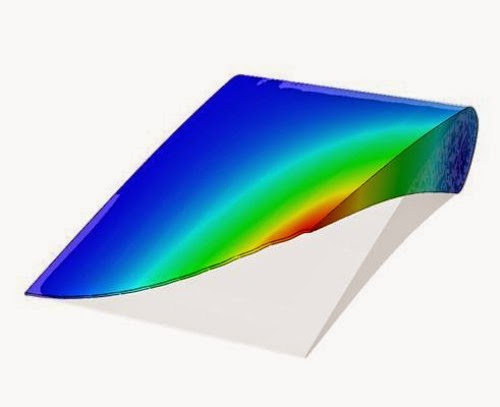
Aircraft wings that change their shape in flight can help to protect the environment

Written By Unknown on Thursday, January 8, 2015 | 9:10 AM

Aircraft wings that change their shape in flight can help to protect the environment. Simulation of a flex module. Credit: © Fraunhofer IFAM
A top priority for any airline is to conserve as much fuel as possible -- and this helps to protect the environment. The EU project SARISTU aims to reduce kerosene consumption by six percent, and integrating flexible landing devices into aircraft wings is one step towards that target. Researchers will be showcasing this concept alongside other prototypes at the ILA Berlin Air Show from May 20-25.

Airport congestion has reached staggering levels as some 2.2 billion people a year take to the skies for business or pleasure. As their numbers grow and more jets add to pollution in the atmosphere, the drawbacks to the popularity of flying become obvious. This has encouraged airlines, aircraft manufacturers and researchers to pull together to reduce airliners' kerosene consumption and contribute to protecting the environment. One effort in this direction is the EU's SARISTU project, short for Smart Intelligent Aircraft Structures.

Landing flaps that change their shape

While birds are able to position their feathers to suit the airflow, aircraft wing components have so far only been rigid. As the name suggests, landing flaps at the trailing edge of the wing are extended for landing. This flap, too, is rigid, its movement being limited to rotation around an axis. This is set to change in the SARISTU project. "Landing flaps should one day be able to adjust to the air flow and so enhance the aerodynamics of the aircraft," explains Martin Schüller, researcher at the Fraunhofer Institute for Electronic Nano Systems ENAS in Chemnitz. A mechanism that alters the landing flap's shape to dynamically accommodate the airflow has already been developed by the consortium partners. Algorithms to control the required shape modifications in flight were programmed by ENAS, in collaboration with colleagues from the Italian Aerospace Research Center (CIRA) and the University of Naples.

The mechanism that allows the landing flap to change shape can only function if the skin of the landing flap can be stretched as it moves, a problem tackled by researchers from the Fraunhofer Institute for Manufacturing Technology and Advanced Materials IFAM in Bremen. "We've come up with a silicon skin with alternate rigid and soft zones," reveals Andreas Lühring from Fraunhofer IFAM. "There are five hard and three soft zones, enclosed within a silicon skin cover extending over the top."

The mechanism sits underneath the soft zones, the areas that are most distended. While the novel design is noteworthy, it is the material itself that stands out, since the flexible parts are made of elastomeric foam that retain their elasticity even at temperatures ranging from minus 55 to 80 degrees Celsius.

Four 90-centimeter-long prototypes -- two of which feature skin segments -- are already undergoing testing. Does the mechanism work? Are the forces being transferred correctly? These are questions for upcoming tests in the wind tunnel. Scientists will be showcasing the prototype at the ILA Berlin Air Show from May 20 -- 25.

Maneuverable wingtips

A single improvement won't be enough to cut kerosene consumption by six percent. Since a variety of measures are needed, scientists from Fraunhofer IFAM are participating in a second subproject focusing on the wingtip. Here the SARISTU consortium has developed a tab that forms part of the wing tip and changes shape during flight to keep air resistance as low as possible. Any gap between the flap and the fixed aircraft wing would cancel out any positive effect. "This led us to develop an elastic connecting element, and this work already covers everything from the chemical makeup to the process technology and manufacture of the component," says Lühring. Like the landing tab, this component retains its elasticity at temperatures ranging from minus 55 to 80 degrees Celsius, and it easily copes with the high wind speeds involved. Researchers will be showcasing the prototype at the ILA Berlin Air Show.

Funding

This project has received funding from the European Union's Seventh Framework Programme for research, technological development and demonstration under grant agreement no 284562.

Switching to vehicles powered by electricity from renewables could save lives

Written By Unknown on Tuesday, December 16, 2014 | 9:48 PM

Driving vehicles that use electricity from renewable energy instead of gasoline could reduce the resulting deaths due to air pollution by 70 percent. Credit: © Dmitry Vereshchagin / Fotolia
Driving vehicles that use electricity from renewable energy instead of gasoline could reduce the resulting deaths due to air pollution by 70 percent. This finding comes from a new life cycle analysis of conventional and alternative vehicles and their air pollution-related public health impacts, published Monday, Dec. 15, 2014, in the Proceedings of the National Academy of Sciences.

The study also shows that switching to vehicles powered by electricity made using natural gas yields large health benefits. Conversely, vehicles running on corn ethanol or vehicles powered by coal-based or "grid average" electricity are worse for health; switching from gasoline to those fuels would increase the number of resulting deaths due to air pollution by 80 percent or more.

"These findings demonstrate the importance of clean electricity, such as from natural gas or renewables, in substantially reducing the negative health impacts of transportation," said Chris Tessum, co-author on the study and a researcher in the Department of Civil, Environmental, and Geo- Engineering in the University of Minnesota's College of Science and Engineering.

The University of Minnesota team estimated how concentrations of two important pollutants -- particulate matter and ground-level ozone -- change as a result of using various options for powering vehicles. Air pollution is the largest environmental health hazard in the U.S., in total killing more than 100,000 people per year. Air pollution increases rates of heart attack, stroke, and respiratory disease.

The authors looked at liquid biofuels, diesel, compressed natural gas, and electricity from a range of conventional and renewable sources. Their analysis included not only the pollution from vehicles, but also emissions generated during production of the fuels or electricity that power them. With ethanol, for example, air pollution is released from tractors on farms, from soils after fertilizers are applied, and to supply the energy for fermenting and distilling corn into ethanol.

"Our work highlights the importance of looking at the full life cycle of energy production and use, not just at what comes out of tailpipes," said Bioproducts and Biosystems Engineering Assistant Professor Jason Hill, co-author of the study. "We greatly underestimate transportation's impacts on air quality if we ignore the upstream emissions from producing fuels or electricity."

The researchers also point out that whereas recent studies on life cycle environmental impacts of transportation have focused mainly on greenhouse gas emissions, it is also important to consider air pollution and health. Their study provides a unique look at where life cycle emissions occur, how they move in the environment, and where people breathe that pollution. Their results provide unprecedented detail on the air quality-related health impacts of transportation fuel production and use.

"Air pollution has enormous health impacts, including increasing death rates across the U.S.," said Civil, Environmental and Geo- Engineering Associate Professor Julian Marshall, co-author on this study. "This study provides valuable new information on how some transportation options would improve or worsen those health impacts."

 
Support : Creating Website | Johny Template | Mas Template
Copyright © 2011. The planet wall - All Rights Reserved
Template Created by Easy Blogging Published by Mas Template
Proudly powered by Blogger