Latest Post
Showing posts with label AIRCRAFT. Show all posts

Meteorology meets metrology: Climate research high up in the clouds

Written By Unknown on Wednesday, January 14, 2015 | 5:11 AM

View along HALO's wing (with the aerosol instruments) above the Amazon rainforest.
Credit: Buchholz/PTB
Barely has the research aircraft HALO entered the kilometre-high clouds towering above the Brazilian rainforest than the researchers find themselves in a complete haze, but they can rely on the measuring instruments that are working at full capacity. HAI -- a new, highly accurate hygrometer of the Physikalisch-Technische Bundesanstalt (PTB) -- is aboard. The shooting star among hygrometers has been developed only recently by metrologists (metrology = the science of measurement) especially for use on board aircraft and in the clouds, but it has already been used in four research campaigns and has already clocked up more than 300 hours of active use. It is the only device worldwide that can determine precisely and simultaneously how much of the water present in the atmosphere is in the form of vapour, condensation, droplets or ice.

These data help us understand natural and anthropogenic cloud formation processes and how they influence the climate. HAI is robust enough for field use at strongly varying temperatures and pressures and it is also coupled to the international humidity scale. Furthermore, it requires no time-consuming calibration. Its unique features combine applied climate research with metrology's most demanding requirements.

HAI is an acronym that stands for Hygrometer for Atmospheric Investigations. Its latest assignment (within the scope of the ACRIDICON-CHUVA mission) took it on a large-scale expedition in which approx. 60 scientists from Germany, Israel and Brazil were involved. On board HALO, one of the most modern measurement aircraft for atmospheric research -- operated by the Deutsches Luft- und Raumfahrtzentrum (DLR -- the national aeronautics and space research centre of the Federal Republic of Germany) -- HAI again and again flew into the clouds rising above the Amazon rainforest to collect samples. The researchers wanted to find out, among other things, which influence air pollution above cities or slash-and-burn areas have on the formation of clouds.

Water is the most important greenhouse gas and plays various roles in climate development. Clouds shade and cool down the surface of Earth; at the same time, they act as an insulation layer, keeping the terrestrial thermal radiation from escaping into space. The total global water cycle is based on the humidity present in the air heating up and cooling down again. 
Furthermore, humidity values serve as a correction coefficient in many other atmospheric measurements. Water is the most influential greenhouse gas, this is a fact. But putting a figure on its influence in order to set up models on climate development is a very difficult task. Depending on how high the clouds are as well as on their exact composition (they can consist of vapour, droplets and ice in varying amounts), they can have very diverse effects. Also, the measurement of the different phases of water is a complex task as its state of matter may already be influenced decisively the moment the sample is taken: for example, water vapour can already condensate to droplets on its way to the measuring instrument due to cooling while the sample is being collected.

Scientists from PTB have solved this problem by means of the HAI multi-phase water sensor. HAI simultaneously determines how much water vapour and how much condensed water is present in the air; a robust, open and aerodynamic measuring cell located outside the aircraft body directly measures the gaseous water vapour content of the air flowing through it. Another two-channel measuring unit is located inside the aircraft, at the end of a heated sample collection tube where two sensors working independently of each other measure the total water content of the sample. The difference between the total water content measured and the result of the measurement carried out in the gaseous phase allow the content of condensed water to be determined simultaneously.

HAI is based on a special variant of TDLAS (Tunable Diode Laser Absorption Spectroscopy) which is self-calibrating. The previously required time-consuming calibration, which was excessively difficult to carry out accurately and frequently enough in the field, has, thus, become obsolete. In addition, HAI, in combination with HALO, is the first airborne fast hygrometer in use that is directly traced back to the metrological humidity scale. Contrary to most other hygrometers, it provides results with low and clearly defined measurement uncertainty, in accordance with strict metrological requirements.
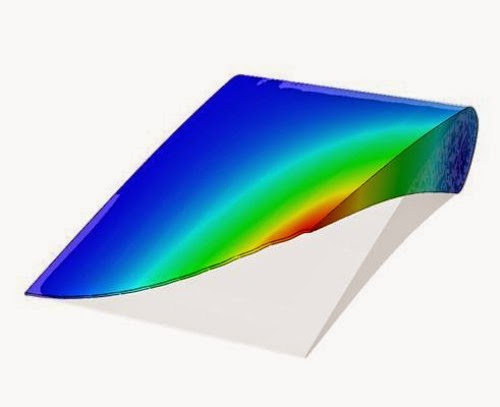
Aircraft wings that change their shape in flight can help to protect the environment

Written By Unknown on Thursday, January 8, 2015 | 9:10 AM

Aircraft wings that change their shape in flight can help to protect the environment. Simulation of a flex module. Credit: © Fraunhofer IFAM
A top priority for any airline is to conserve as much fuel as possible -- and this helps to protect the environment. The EU project SARISTU aims to reduce kerosene consumption by six percent, and integrating flexible landing devices into aircraft wings is one step towards that target. Researchers will be showcasing this concept alongside other prototypes at the ILA Berlin Air Show from May 20-25.

Airport congestion has reached staggering levels as some 2.2 billion people a year take to the skies for business or pleasure. As their numbers grow and more jets add to pollution in the atmosphere, the drawbacks to the popularity of flying become obvious. This has encouraged airlines, aircraft manufacturers and researchers to pull together to reduce airliners' kerosene consumption and contribute to protecting the environment. One effort in this direction is the EU's SARISTU project, short for Smart Intelligent Aircraft Structures.

Landing flaps that change their shape

While birds are able to position their feathers to suit the airflow, aircraft wing components have so far only been rigid. As the name suggests, landing flaps at the trailing edge of the wing are extended for landing. This flap, too, is rigid, its movement being limited to rotation around an axis. This is set to change in the SARISTU project. "Landing flaps should one day be able to adjust to the air flow and so enhance the aerodynamics of the aircraft," explains Martin Schüller, researcher at the Fraunhofer Institute for Electronic Nano Systems ENAS in Chemnitz. A mechanism that alters the landing flap's shape to dynamically accommodate the airflow has already been developed by the consortium partners. Algorithms to control the required shape modifications in flight were programmed by ENAS, in collaboration with colleagues from the Italian Aerospace Research Center (CIRA) and the University of Naples.

The mechanism that allows the landing flap to change shape can only function if the skin of the landing flap can be stretched as it moves, a problem tackled by researchers from the Fraunhofer Institute for Manufacturing Technology and Advanced Materials IFAM in Bremen. "We've come up with a silicon skin with alternate rigid and soft zones," reveals Andreas Lühring from Fraunhofer IFAM. "There are five hard and three soft zones, enclosed within a silicon skin cover extending over the top."

The mechanism sits underneath the soft zones, the areas that are most distended. While the novel design is noteworthy, it is the material itself that stands out, since the flexible parts are made of elastomeric foam that retain their elasticity even at temperatures ranging from minus 55 to 80 degrees Celsius.

Four 90-centimeter-long prototypes -- two of which feature skin segments -- are already undergoing testing. Does the mechanism work? Are the forces being transferred correctly? These are questions for upcoming tests in the wind tunnel. Scientists will be showcasing the prototype at the ILA Berlin Air Show from May 20 -- 25.

Maneuverable wingtips

A single improvement won't be enough to cut kerosene consumption by six percent. Since a variety of measures are needed, scientists from Fraunhofer IFAM are participating in a second subproject focusing on the wingtip. Here the SARISTU consortium has developed a tab that forms part of the wing tip and changes shape during flight to keep air resistance as low as possible. Any gap between the flap and the fixed aircraft wing would cancel out any positive effect. "This led us to develop an elastic connecting element, and this work already covers everything from the chemical makeup to the process technology and manufacture of the component," says Lühring. Like the landing tab, this component retains its elasticity at temperatures ranging from minus 55 to 80 degrees Celsius, and it easily copes with the high wind speeds involved. Researchers will be showcasing the prototype at the ILA Berlin Air Show.

Funding

This project has received funding from the European Union's Seventh Framework Programme for research, technological development and demonstration under grant agreement no 284562.

 
Support : Creating Website | Johny Template | Mas Template
Copyright © 2011. The planet wall - All Rights Reserved
Template Created by Easy Blogging Published by Mas Template
Proudly powered by Blogger