Latest Post
Showing posts with label HYDRPHONICS. Show all posts

Earthworms, ants, termites: The real engineers of the ecosystem

Written By Unknown on Tuesday, December 23, 2014 | 5:45 AM

The contribution of home gardens in the preservation of biodiversity, economics and human health prompted a multidisciplinary group at the South Border College (Ecosur) in Mexico to work on a project in Tabasco, a south state of the country, with the aim to improve the production and environmental management of these plantations. Credit: Image courtesy of Investigación y Desarrollo
The contribution of home gardens in the preservation of biodiversity, economics and human health prompted a multidisciplinary group at the South Border College (Ecosur) in Mexico to work on a project in Tabasco, a south state of the country, with the aim to improve the production and environmental management of these plantations.

Although the research was conducted from different perspectives, head of research Esperanza Huerta Lwanga focused on the study of soil invertebrates because they are indicators of its quality.

"These organisms fulfill various functions,like allowing the soil to absorb processed organic matter such as leaves, wood, trunks and branches and with this nourishing crops; they also maintain an ecological balance capable of preventing the invasion of pests and provide greater fertility without using chemicals. This happens when growing different types of plants, allowing the existence of a wide variety of soil invertebrates" the researcher explains.

The project, which began in 2009 and was funded by the Ministry of Energy, Natural Resources and Environmental Protection (SERNAPAM), arises because home gardens are places where there is a wealth of soil. In total, the research team worked in 50 home gardens located in different physiographic regions of the state: mountains, coast, floodplain and hillocks.

"During the fieldwork I realized that the orchards whose owners had family harmony, were characterized by a rich vegetation and greater diversity of soil invertebrates was found. However, in other orchards we observed garbage instead vegetation and organisms, revealing a gap between people and nature, " relates Huerta Lwanga.

An important finding of this project was when the researcher found a anecic earthworm, initially thought to be a new species, however, it was only a new entry in the state of Tabasco. "Such organism is characterized by its vertical movements, thereby creating tunnels, helping to integrate the organic matter in the soil, aerating it and forming its structure," the researcher says.

Other species were also identified, like earthworms, ants, termites, centipedes, beetles, grasshoppers, cockroaches and woodlice, which may also be called "ecosystem engineers" (specifically earthworms, termites and some ants) because their activities modify the soil, enriching its productivity.

According to the researcher, it is important to note that the presence of such organisms does not mean that the garden is infested with pests. "If you let me live there, they fulfill their tasks and at the same time control their population because the variety of invertebrates generates food chains."

The pest problem, she says, appears when the land is handled as a monoculture. In these cases only one type of organisms thrives and rapidly increases in number and , because nobody eats them, they become a threat to the plantations.

The research results revealed that the coastal region was the one with more garbage, followed by the hillocks. "In the mountains we found healthy vegetation and a great variety of crops, high diversity of invertebrates and greater earthworm biomass, which was estimated at more than 33 grams per square meter," highlights Huerta Lwanga.

That amount is important because according to previous studies it was established that if biomass is equal or greater than 30 grams per square meter germination induction and plant growth are achieved.

Additionally, this project included environmental education, which was given by mini-workshops and training in the production of vermi-compost.

"At Ecosur, we designed a box for composting, which is equiped with a small mill and worms, where we place the fresh waste to be processed. A device like this was given to all farmers, but was only accepted by 47 percent of them," she sadly concludes.

Invasive plant wins competition against its native cousin

Written By Unknown on Saturday, December 20, 2014 | 2:43 AM

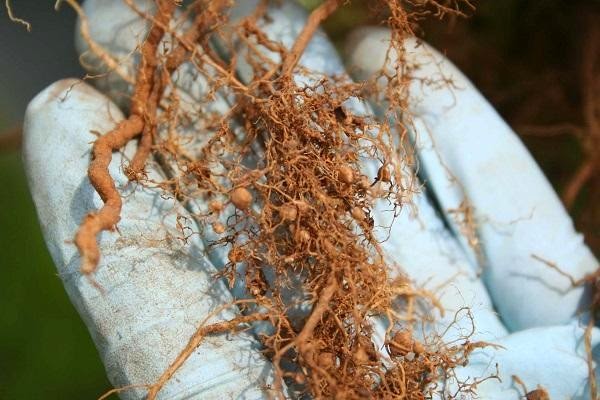
This iamge depicts root nodules. Credit: University of Illinois
Because of its aggressive behavior and its harmful effects, the invasive prairie plant Lespedeza cuneata has been added to several noxious weed lists. Research at the University of Illinois on how soil bacteria interact with the plants' roots to form nodules that fix nitrogen demonstrated that the invasive variety had superior performance when pitted against the native plant variety Lespedeza virginica.

"We expected Lespedeza cuneata to be a strong competitor when up against its native cousin that's planted primarily for prairie restoration," said U of I microbial ecologist Tony Yannarell. "There are a number of studies showing that L. cuneata grows quickly, is able to shade out its competitors, and has a high rate of nitrogen fixation, which allows it to 'self-fertilize' on unproductive soils."
Yannarell explained that Lespedeza plants establish a "partnership" with bacteria in the soil to form nodules that fix nitrogen. "We wanted to demonstrate that the partners in this symbiosis matter," he said.
Because the nitrogen-fixing gene is in the bacteria, the first step in the research was to identify bacteria that have the gene. "We started with isolating a pool of 50 bacteria [from the root nodules of invasive and native Lespedezas] and discovered that some of them weren't traditional nodule-forming bacteria."

Ultimately, seven bacteria were identified and used in a three-month greenhouse experiment in which various combinations of native and invasive varieties of Lespedeza were grown together in pots. Of the seven, five bacteria were found to benefit the invader and two did not benefit either of the plant varieties.

"We were hoping to be able to change the degree of competitiveness by using different varieties of Lespedeza by varying the bacteria," Yannarell said. "It turned out that none of the bacteria seemed to be better for the native plant.

"A really intriguing pattern that we found is that a lot of these strains of bacteria that are good for the invader belong to the Bradyrhizobium genus of bacteria that's been shown in other parts of the world to be good at fixing nitrogen so this was one more confirmation of that information," Yannarell said.

Yannarell said that this study provides yet another piece in the ecological puzzle.

The invasive Lespedeza cuneata was intentionally brought into the United States from Japan near the end of the 1800s. At the time, people liked its nitrogen-fixing capacity and soil fertilization. It was intended to be used to stabilize river banks and rehabilitate poor soil. Yannarell said that it has been recommended as wildlife forage, and some think that it has tannins that can act as a deworming treatment for goats. Now, however, it's considered to be a noxious weed that grows in the South and Midwest. It is commonly called silky bush clover.

Yannarell stressed that there are a lot of different species of Lespedeza that are native to North America and indicative of high-quality prairie. Although Lespedeza cuneata isn't a plant that would be intentionally planted by prairie restorationists, it has been seen in prairie seed mixes.

"Invasive Lespedeza cuneata and native Lespedeza virginica experience asymmetrical benefits from rhizobial symbionts," was published in Plant and Soil and was co-authored by Lingzi Hu, Ryan R. Busby, and Dick L. Gebhart. The work was supported by a grant from the U.S. Army Engineer Research and Development Center and by the Cooperative State Research, Education and Extension Service, U.S. Department of Agriculture.

Source: University of Illinois College of Agricultural, Consumer and Environmental Sciences (ACES)

Impact of climate change on the soil ecosystem

Written By Unknown on Friday, December 19, 2014 | 9:29 PM

The Basque Institute for Agricultural Research and Development NEIKER-Tecnalia has had a Microbial Observatory in the Ordesa and Monte Perdido National Nature Reserve (Huesca Pyrenees) since 2011. Its purpose is to evaluate the impact of climate change on the ecosystems of the soil by monitoring its microbial properties over time. Credit: Image courtesy of Basque Research
The Basque Institute for Agricultural Research and Development NEIKER-Tecnalia has had a Microbial Observatory in the Ordesa and Monte Perdido National Nature Reserve (Huesca Pyrenees) since 2011. Its purpose is to evaluate the impact of climate change on the ecosystems of the soil by monitoring its microbial properties over time. The research areas are located at altitudes of between 1,500 and 2,600 metres, which provides a broad range of different climate conditions and makes it possible to observe how the altitude affects the properties of the soil and the micro-organisms living in it. Preliminary results indicate that microbial properties are highly dependent on the physical and chemical properties of the soil on a small scale and on the environmental conditions existing at the moment when the samples are gathered.

To conduct this research, NEIKER-Tecnalia is using the most advanced techniques in the matter of molecular biology, which have revolutionised microbial ecology. Specifically, massive sequencing analyses are being carried out right now; they allow a large number of genes to be sequenced and identified within a short space of time. The genetic sequencing of the subterranean biosphere is seeking to gain a better understanding of the structure and function of the microbial communities across the altitude gradient.

NEIKER-Tecnalia's Microbial Observatory will contribute towards improving the current understanding of the effects of climate change on soil microbial communities and associated ecological processes. The alpine area where it is located is particularly suitable for a climate change observatory. Firstly, it is a remote spot relatively isolated from direct anthropogenic impacts, which means that global effects like climate change can be clearly perceived without the interference of more local environmental factors. Secondly, the altitude gradients that exist in the mountains in turn create clearly marked climate gradients within short distances; in other words, different climate conditions can be found at different altitudes.

Micro-organisms adapt more quickly than plants and macro-organisms

Micro-organisms adapt more quickly to changes than plants or other macro-organisms, which means they are ideal bioindicators of the impact of sources of environmental stress on the functioning of ecosystems. It is very important to have a record of the alterations gradually occurring in the soil ecosystem as a result of climate change to be able to more accurately predict what future scenarios are going to be in store. It is important to stress that the soil is our most important resource; it is the basis of the terrestrial ecosystem and 95% of our food comes directly or indirectly from it.

The role of micro-organisms in relation to the functioning of the soil ecosystem is fundamental. The soil, which has been traditionally regarded as an inanimate item made up of minerals and chemical substances, contains a myriad of micro-organisms that are responsible for many of its vital functions and, consequently, its health. These functions include the decomposition and recycling of nutrients from dead plant and animal tissue, nitrogen fixing, the maintaining of soil structure and the elimination of contaminants.
It can be predicted that, in the long term, climate change will cause the biota of mountain soil to migrate towards higher altitudes in the quest for the optimum bioclimatic environment. The problem is that this migration has a limit, which is the summit of the mountain, beyond which no migration or escape is possible.

Source:  Basque Research

 
Support : Creating Website | Johny Template | Mas Template
Copyright © 2011. The planet wall - All Rights Reserved
Template Created by Easy Blogging Published by Mas Template
Proudly powered by Blogger