Latest Post
Showing posts with label STD. Show all posts

New recommendation for cervical cancer screening, using HPV test alone

Written By Unknown on Sunday, January 18, 2015 | 3:15 AM

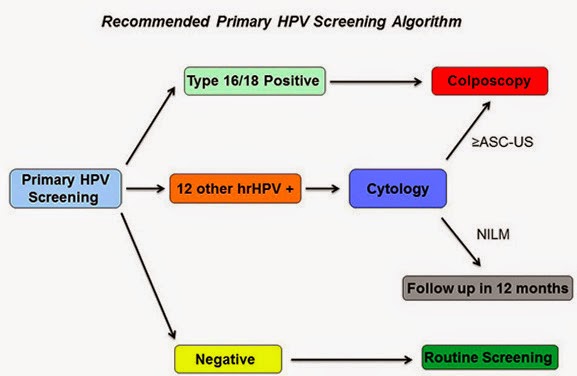
Under the new guidance if HPV test is positive for HPV types 16 or 18, colposcopy is the next step. If the HPV test is positive for one of 12 other HPV types, a Pap smear (cytology) is the next step. Credit: UAB
About 80 million U.S. women ages 25 to 65 should be screened periodically by their health care providers for cervical cancer. At present, the standard way to do that is a Pap smear alone, or co-testing using both a Pap smear and a human papillomavirus (HPV) test.

Today, the clinicians who care for those women are getting new interim guidance about the health advantages of instead using the HPV test alone as the primary screen to find cervical cancer or its precursors. Under the new guidance, the Pap smear, which dates back more than 80 years, would still be used for follow-up tests if an HPV test is positive. The Pap smear will still be used for primary screening of women under age 25.

The need for guidance about using the HPV test was triggered last April when the FDA approved one existing HPV test for use in primary cervical cancer screening. Today's guidance, written by a group of cervical cancer screening experts led by University of Alabama at Birmingham gynecologic oncologist Warner Huh, M.D., is being published simultaneously in the journals Gynecologic Oncology, Obstetrics & Gynecology, and the Journal of Lower Genital Tract Disease under the title "Use of Primary High Risk Human Papillomavirus Testing for Cervical Cancer Screening: Interim Clinical Guidance." Also published today in Gynecologic Oncology is the end-of-trial data of the Roche Diagnostics ATHENA HPV trial that enrolled more than 47,000 women in a longitudinal, three-year study of Roche's HPV test.

"Although FDA approval is critically important for introducing a new screening test or algorithm, providers ultimately rely on guidance or guidelines to help them make the best decisions for their patients and want to understand advantages, disadvantages and unknowns associated with a new screening approach," said Huh, who is a senior scientist for the UAB Comprehensive Cancer Center, Director of the UAB Division of Gynecologic Oncology, and is also a board member for both the American Society for Colposcopy and Cervical Pathology and the Society of Gynecologic Oncology.

Major conclusions The two major conclusions of the interim guidance panel are:

• "Because of equivalent or superior effectiveness," the paper says, "primary HPV screening can be considered as an alternative to current U.S. cytology-based (i.e., Pap smears) cervical cancer screening methods."

The authors note that the existing, previously published guidelines still recommend Pap smears alone, or co-testing with a Pap smear and an HPV test, for cervical cancer screening. However, those guidelines from 2011 predate more recent clinical studies of HPV testing that were analyzed in today's paper.

• Women who have a negative HPV test result from their primary screening have a greater reassurance of a very low risk for a future cervical cancer precursor lesion, as compared to women who have a negative Pap smear test in their primary screening. This lower rate of false negative results is a key benefit of the HPV screening. Overall, the panel said, "While there continue to be numerous practical and research questions, primary HPV testing has the potential to further reduce morbidity and mortality of cervical cancer in the U.S. 
However, what is most important is that women need to be screened with any strategy, as many women in the U.S. with cervical cancer are either unscreened or underscreened."

"The scientific evidence clearly demonstrates that primary HPV testing outperforms cytology or Pap as a screening test," said Huh. "This has been confirmed from numerous European and Canadian studies as well as the ATHENA trial. There are going to be fewer false negatives with HPV, and arguably, we have been using a less sensitive test for screening for a while now."

Huh added, "Pap smears miss a fair number of adenocarcinomas. "We don't want a test that will miss disease."

From the patient's point of view, the experience of getting an HPV test will be the same as getting a Pap smear. The difference is how the sample is then screened: Instead of a technician looking for abnormal cells (Pap), the HPV sample is put into an automated machine to detect HPV DNA.

Other questions The guidance also addresses four other questions that clinicians may have. 
1. How should one manage a positive HPV result? While data are still limited, the study group suggested a flowchart algorithm, as follows. If a woman is positive for HPV genotypes 16 or 18, which convey the greatest risk of developing cervical cancer precursor lesions in the next three years, she should be referred for a colposcopy (an illuminated, magnified examination of the cervix and other genital tissue for premalignant or malignant lesions). If a woman is positive for the 12 other lower-risk HPV genotypes, she should get a Pap smear; and if that Pap smear is also positive, she should then get a colposcopy. If her follow-up Pap smear is negative, she should be retested with another Pap smear in 12 months. This algorithm "achieves a reasonable balance of disease detection with the number of screening tests and colposcopies required to achieve that detection," the panel wrote.

2. What is the optimal interval for primary HPV screening?
Data are limited for determining the optimal screening interval, but the interval should be no sooner than every three years. There is no need to screen more frequently than every three years, since the cumulative occurrence of a cervical cancer precursor lesion called a CIN3+ during the three years after a negative HPV test was less than 1 percent.

3. At what age should one initiate primary HPV screening?
It should not begin before age 25. The study panel noted that about 30 percent of the CIN3+ cervical cancer precursor lesions in the ATHENA study occurred in women ages 25 to 29. A majority of women ages 25 to 29 who have CIN3+ have normal Pap smears. Another 37 percent of the CIN3+ lesions in the ATHENA study were found in women 30 to 39 years old. 
The panel did have some concerns that starting at age 25 -- even though it increases detection of disease -- would lead to too many colposcopies in women whose progression to cancer is uncommon.

4. How does primary HPV screening performance compare with co-testing?
The panel said that most of the reassurance of safety provided by a co-test (a Pap smear together with an HPV test) derives from the HPV test. Analysis of about 1 million women screened at Kaiser Permanente Northern California suggests that HPV screening with a three-year interval between negative tests is at least as effective as co-testing every five years. However, co-testing is still an appropriate and recommended screening strategy, Huh noted.

The future As the new advance of primary HPV screening enters into clinical practice, there will be a number of additional questions and concerns, the panel said. First, clinicians need to be aware that false negative tests will still occur -- that is, some women will still develop invasive cancer, even though their HPV tests were negative.

Second, at present there are four commercially available, FDA-approved HPV tests; but only one of them is FDA-approved for primary screening. While the panel hopes that there will be other tests that will be rigorously validated and approved for primary screening sometime in the near future, clinicians should not use a test that lacks a specific primary HPV screening indication.

Third, the panel noted a need for comparative effectiveness studies "that consider projected lifetime number of screening tests, colposcopies and follow-up visits," as well as direct cost comparisons between primary HPV testing vs. Pap smears and co-testing. Further information is also needed about the cancer risks if the interval between HPV tests is extended from three years to five years.

While today's guidance applies to women who receive regular screening for cervical cancer, 
the panel also noted the continuing need to identify women who are still unscreened or underscreened.

"One major aspect of cervical cancer prevention that needs to be discussed in light of screening is HPV vaccination," said Huh. "Particularly with the recent FDA approval of the new 9-valent HPV vaccine and evidence that the vaccine decreases HPV and disease prevalence, I have concerns that this will put an additional strain on the performance of cytology (i.e., Pap smear). We will need to look at other tests like HPV as a more appropriate screening test as disease rates decrease over time."

Long-acting drug effectively prevents HIV-like infection in monkeys

Written By Unknown on Friday, January 16, 2015 | 3:26 AM

The new drug cabotegravir (in vials above) has been shown to protect monkeys from infection by an HIV-like virus, and a clinical trial testing cabotegravir's safety and acceptability has begun. Unlike other preventive treatments, it would require only one injection every three months.
Credit: Zach Veilleux / The Rockefeller University
A regime of anti-HIV drugs -- components of regimens to treat established HIV infection -- has the potential to protect against infection in the first place. But real life can interfere; the effectiveness of this prophylactic approach declines if the medications aren't taken as prescribed.

HIV researchers hope a new compound, known as cabotegravir, could make dosing easier for some because the drug would be administered by injection once every three months. A clinical trial testing long-acting cabotegravir's safety and acceptability has already begun at multiple U.S. sites including The Rockefeller University Hospital. Meanwhile two new studies, including one conducted by researchers at the Aaron Diamond AIDS Research Center (ADARC) and Rockefeller University, published today (January 15) in Science Translational Medicine, show that long-acting cabotegravir injections are highly protective in a monkey model of vaginal transmission of a virus similar to HIV.

"Clinical trial results have demonstrated that the effectiveness of preventive oral medications can range with results as high as 75 percent effective to as low as ineffective, and a lot of that variability appears to hinge on the patient's ability to take the pills as prescribed," says study researcher Martin Markowitz, a professor at Rockefeller University and ADARC. "Long acting cabotegravir has the potential to create an option that could improve adherence by making it possible to receive the drug by injection once every three months."

Developed by ViiV Healthcare and GlaxoSmithKline, and previously known as GSK744 LA, cabotegravir is an antiretroviral drug. Antiretrovirals interfere with HIV's ability to replicate itself using a host cell and they are used to treat an HIV infection or to prevent those at high risk from acquiring it in the first place.

Cabotegravir belongs to a group of antiretrovirals that target integrase, an enzyme the virus uses to integrate itself into the cell's genome. This compound is a relative of an already FDA-approved integrase inhibitor, dolutegravir, but with chemical properties that allow it to be formulated into a long-acting suspension for injection.

A previous study by the ADARC and Rockefeller team in collaboration with ViiV Healthcare and GSK found long-acting cabotegravir could protect male rhesus macaque monkeys from exposure to a virus related to HIV. Following up on these results, a phase 2 clinical trial is now underway in a group of 120 men at low risk of infection. Before cabotegravir's effectiveness in high risk individuals can be tested, trials must show that study participants tolerate the drug well and find the quarterly injections, which are a novel approach to HIV prevention, acceptable.

Both new animal studies were conducted with women in mind; in 2013 women accounted for 47 percent of new HIV infections worldwide according to the Joint United Nations Programme on HIV and AIDS. Working separately, two teams tested the drug's ability to block vaginal transmission in two species of monkeys with different breeding cycles and susceptibility to infection.

First author Chasity Andrews, a postdoctoral fellow at ADARC and Rockefeller, and colleagues at ADARC, the Tulane Regional Primate Center and ViiV/GSK, studied female rhesus macaques treated with progesterone to increase their susceptibility to the virus. They found injections of long acting cabotegravir were 90 percent effective at protecting the monkeys from repeated high-dose exposures to the virus.

Meanwhile, the complementary study conducted by researchers at the CDC and ViiV/GSK found female pigtail macaques injected with cabotegravir were completely protected against multiple exposures to the virus.

"While we are still a long way off from showing that this drug works for HIV prevention in humans, our hope is that it may one day offer high risk women, as well as men, an additional option for HIV prevention," Markowitz says. "One of the lessons we have learned from contraception is the more options available, the better. We are hoping for the same in HIV prevention -- more options and better results."

Source: Rockefeller University

Role of microbes, effect on infectious disease dynamics

Written By Unknown on Wednesday, December 24, 2014 | 7:24 PM

In the field, UCSB graduate student Andrea Jani uses a sterile swab to sample mucus on the skin of a frog. Frogs are released unharmed after sampling. Credit: Abby Mayer
The adult human body is made up of about 37 trillion cells. Microbes, mainly bacteria, outnumber body cells by 10 to 1. Increasingly, scientists recognize that this huge community of microbes, called the microbiome, affects the health, development and evolution of all multicellular organisms, including humans.

Studies show symbiotic microbes can help prevent infection by disease-causing pathogens. But sometimes the interaction goes the other way, with a pathogen or disease disrupting the normal community of symbiotic bacteria. In a new study, a team of scientists from UC Santa Barbara demonstrates that a fungal pathogen of amphibians does just that. The findings appear today in the Early Edition of the Proceedings of the National Academy of Science.

Landmark experiments with model organisms such as mice have shown that infectious pathogens can disrupt the "normal" microbiome, but the extent to which this process shapes symbiotic microbial communities during disease outbreaks in nature is largely unknown. This new work, conducted by Andrea Jani, a UCSB graduate student in Cherie Briggs' lab in the Department of Ecology, Evolution and Marine Biology (EEMB), addresses a fundamental gap in disease ecology and microbiome research.

Co-authors Jani and Briggs -- also affiliated with UCSB's Biomolecular Science and Engineering program -- found that the chytrid fungus Batrachochytrium dendrobatidis (Bd) appears to drive dramatic changes in symbiotic bacterial communities during natural disease episodes in four populations of the endangered Sierra Nevada yellow-legged frog (Rana sierrae). Chytridiomycosis, an emerging infectious disease of amphibian skin caused by the Bd pathogen, is a leading cause of amphibian biodiversity loss worldwide.

"In the California Sierra Nevada, this disease has led to the rapid extirpation of frogs from hundreds of high-elevation lakes; however, in other lakes, infected frogs of the same species are surviving and persisting with the fungus," explained Briggs, who is the Duncan and Suzanne Mellichamp Chair in Systems Biology. "Given that amphibian skin is the organ infected by Bd, there has been a lot of interest in how antifungal properties of some skin-associated bacteria may protect frogs against this fungal pathogen. In this study we focused on the flip side of this interaction -- that is, how infection with Bd can disrupt the skin microbial community."

"We used next-generation DNA sequencing to document significant shifts in skin-associated bacterial communities of the Sierra Nevada yellow-legged frog during natural Bd outbreaks," Jani explained. "We paired these field surveys with a laboratory infection experiment, demonstrating a causal relationship in which Bd alters the Rana sierrae microbiome."

The researchers found a remarkable consistency in the response of the microbiome to Bd infection among field populations and between the field and laboratory. Several key taxa -- a group of one or more populations of an organism or organisms -- consistently responded in the same direction to Bd infection, suggesting some predictability in the effect of Bd on the microbiome.

"What we found was that the severity of infection with Bd is strongly correlated with the composition of bacterial communities on the skin of frogs," Jani continued. "What was surprising was that across the different frog populations there was pretty striking consistency in this correlation with Bd. One of the frog populations crashed due to Bd infection; the other three populations seemed to tolerate Bd infections. So there are different disease dynamics going on, yet they have a similar relationship between the microbiome and Bd."

Still, the underlying mechanism for Bd-induced changes in the microbiome is not clear. The researchers hypothesize that the pathogen might compete directly with certain bacteria for space or resources or release compounds that negatively or positively affect certain bacterial species. Alternatively, they say, some pathogens could control immune responses of the host to favor their own growth and disrupt the normal symbiotic bacterial community.

Jani noted that some promise exists for probiotic treatments as a tool to fight the decline of frogs due to Bd, but she was careful to qualify that statement by saying that there is still a lot that scientists do not understand about either the environmental impact that might have or what the interactions are between the natural bacteria that exist on frogs and the pathogen. "We find that some taxa previously identified as having anti-Bd properties are driven to low abundances by Bd infection, which may limit their effectiveness as probiotic agents," she said.

"This study shows the importance of knowing how the many benign microbes living on and in our bodies interact with those that cause disease," said Sam Scheiner, National Science Foundation (NSF) director for the joint NSF/National Institutes of Health/United States Department of Agriculture Ecology and Evolution of Infectious Disease Program, which funded the research. "The results are important for developing responses to a disease causing amphibians to go extinct worldwide and also have implications for future studies of human health.

Source:  University of California - Santa Barbara
 
Support : Creating Website | Johny Template | Mas Template
Copyright © 2011. The planet wall - All Rights Reserved
Template Created by Easy Blogging Published by Mas Template
Proudly powered by Blogger