Latest Post
Showing posts with label AMAZON. Show all posts

Stanford scientists team with indigenous people to produce detailed carbon calculations of Amazon rainforest

Written By Unknown on Wednesday, January 28, 2015 | 6:51 AM

The late Dr. Kye Epps teaches Wapichana field researchers how to measure tree diameter, information that can then be used to calculate a tree's biomass and carbon storage.
When it comes to measuring the carbon storage potential of the Amazon forest, indigenous people might outperform sophisticated satellites.

The results from a long-term collaboration between Stanford scientists and indigenous people in Guyana suggests that traditional remote sensing techniques might be undervaluing the region's carbon storage potential by as much as 40 percent. The work could influence how indigenous people in Guyana and elsewhere manage their forests and lead to greater opportunities for these communities to engage in carbon offset programs.

The project, led by Jose Fragoso, a senior scientist in the Department of Biology at Stanford, grew out of his earlier efforts to engage indigenous peoples to gain a better understanding of ecosystems relatively undisturbed by modern civilization.

What is carbon?

The first challenge was teaching people with little to no exposure to the outside world just what carbon is. Co-author Kimberly "Kye" Epps, a postdoctoral scholar in Stanford School of Earth Sciences (who passed away during the project,) developed lesson plans for explaining that all life is based on carbon.

Epps pointed out that the black charcoal from a burnt twig is primarily carbon, and how the carbon-laden smoke enters the atmosphere and ultimately affects the global climate. The plants and trees suck carbon from the atmosphere, she explained, and store it in their trunks and leaves.

"Kye's innovative lessons helped get them to where they not only understand what carbon is, but also understand its global implications and how much they actually hold themselves on their land," said Fragoso, the senior author on the paper. "When they realized its importance, they became very invested in the work."

Next came lessons on establishing survey plots, cataloging plant species and learning how to measure plant trunk circumferences, which is a standard measurement used to calculate biomass and thus how much carbon is contained in the plot.

"The people know the trails really well, and some of them will walk two days to get to their plot and make measurements," Fragoso said. "They can make really good measurements in really isolated areas, where government workers would never get to. Generally, professional scientists will not travel these distances on foot to verify carbon estimates."

Biomass specifics

Whereas satellite observations would most likely have identified each of these plots as "forest" and assigned them a standardized value for carbon storage, Fragoso said that the field workers identified 11 habitat types with trees, each of which requires a different set of calculations for determining its carbon storage potential. Because the researchers could be more specific about the biomass of each vegetation type making up a plot, they were able to calculate that forests in Guyana contain 20 to 40 percent more carbon than previously estimated.

This difference can affect a number of different areas. For one, it means that climate models that include blanket estimations of carbon storage in lands governed by indigenous people might be missing significant data – indigenous people govern about half of all remaining undeveloped land on the planet.

Indigenous lands probably play a much larger role in the global climate than previously assumed, Fragoso said, and indigenous people need to be better represented at global climate talks. These land-owners have more carbon storage at their disposal to sell as carbon credits to governments and corporations looking to offset their greenhouse gas-producing activities.

"Having a good measurement of carbon storage really helps them to enter into discussions with the national government and surrounding communities," Fragoso said. "This helps them to both prevent global climate change while also benefiting, and that is something that the people we worked with were very interested in."

This is the first model for turning indigenous people into field researchers capable of producing scientifically rigorous calculations for carbon, said Fragoso, who is now planning to share the concept with other indigenous nations around the world.

The paper was published recently in the journal Forest Ecology and Management. The work was co-authored by Nathalie Butt of the University of Queensland, Australia, who completed Epps' work; Stanford postdoctoral fellow Takuya Iwamura; and Han Overman, a postdoc at State University of New York. While not official co-authors, Stanford professors Peter Vitousek and Pamela Matson were instrumental in providing guidance for Epps' work.

Source: Stanford

Study shows Brazil’s Soy Moratorium still needed to preserve Amazon

Written By Unknown on Tuesday, January 27, 2015 | 7:35 PM

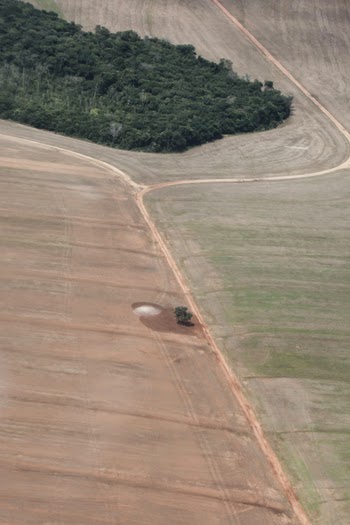
Soybeans grow near a forested area in the Brazilian state of Mato Grosso. Under the Soy Moratorium, major trading companies do not purchase soybeans produced in the Brazilian Amazon on recently deforested areas. Credit: Lisa Rausch
Today, fewer chicken nuggets can trace their roots to cleared Amazon rain forest.

In 2006, following a report from Greenpeace and under pressure from consumers, large companies like McDonald's and Wal-Mart decided to stop using soy grown on cleared forestland in the Brazilian Amazon. This put pressure on commodity traders, such as Cargill, who in turn agreed to no longer purchase soy from farmers who cleared rain forest to expand soy fields.

The private sector agreement, a type of supply chain governance, is called the Soy Moratorium and it was intended to address the deforestation caused by soy production in the Amazon. In a new study to evaluate the agreement, published today (Jan. 22, 2015) in Science, the University of Wisconsin-Madison's Holly Gibbs and colleagues across the U.S. and Brazil show that the moratorium helped to drastically reduce the amount of deforestation linked to soy production in the region and was much better at curbing it than governmental policy alone.
Holly Gibbs

"What we found is that before the moratorium, 30 percent of soy expansion occurred through deforestation, and after the moratorium, almost none did; only about 1 percent of the new soy expansion came at the expense of forest," says Gibbs, a professor of environmental studies and geography in the UW-Madison Nelson Institute's Center for Sustainability and the Global Environment (SAGE).

Between 2001 and 2006, prior to the moratorium, soybean fields in the Brazilian Amazon expanded by 1 million hectares, or nearly 4,000 square miles, contributing to record deforestation rates. By 2014, after eight years of the moratorium, almost no additional forest was cleared to grow new soy, even though soy production area had expanded another 1.3 million hectares. Farmers were planting on already cleared land.

The findings are intended to help policy makers and industry leaders make informed decisions going forward.

"We really wanted to understand if the Soy Moratorium mattered," says Gibbs. "There was a lot of discussion about ending the moratorium in 2014 and we wanted to know what the agreement meant on the ground and how it compared with governmental policy, which is the proposed replacement."

Brazil, Gibbs says, has some of the world's most stringent environmental legislation. Public policies, including increased enforcement of state and federal laws, have gone a long way to slow the destruction of rain forest. Yet, the study shows that "government policy alone is simply not enough," Gibbs says. At least, not yet.
Photo: Brazilian farmers examine their soybean crop Brazilian farmers examine their soybean crop. Credit: Lisa Rausch
Using 15 years (2000-2014) of satellite-based imagery covering the Brazilian Amazon forest and the Cerrado, another large tropical biome in Brazil comprising woodlands and scrublands, the researchers assessed how much land had been cleared to grow soy. They examined land use on thousands of individual farms and identified substantial large-scale deforestations not penalized by Brazilian authorities.

The team also mapped already-cleared areas suitable for soy production to assess the potential for future expansion under the Soy Moratorium and determined how much illegal deforestation was still occurring for purposes other than soy and in direct violation of Brazil Forest Code laws.

What the team found was surprising.

"Only 115 people out of several thousand soy farmers have violated the Soy Moratorium since 2006, but over 600 of them have violated the Forest Code," Gibbs says. "So, this same group of farmers is five times more likely to violate the governmental policy than they are to violate the private sector agreement."

For instance, the Forest Code dictates that 80 percent of Amazon rain forest on a person's property must be held in reserve; they can only clear 20 percent. Yet, just 2 percent of soy farmers have maintained their legal reserve and even farmers abiding by the moratorium were still illegally clearing forest on their properties, just not for growing soy.
A provision in the Forest Code also requires that property owners register their land, after which their name and a clear map of their property becomes publicly available. While the researchers say this is a huge step forward, the study found that property registration alone does not safeguard forests. For example, nearly a quarter of the illegal deforestation that occurred over the last year in the state of Mato Grosso, the Amazon's "soy capital," happened on these registered properties.
An island of forest in a sea of soy agriculture in Mato Grosso. Credit: Rhett Butler
Additionally, the researchers found that while soy-linked deforestation diminished in the Amazon biome, 20 percent of new soy areas created in the Cerrado over the study period directly led to deforestation. Expanding the moratorium to the Cerrado would reduce this conversion.

"It reinforces the idea that private sector interventions will be needed in the long term to maintain the deforestation-free production of soy," says Gibbs, who notes that soy is Brazil's most profitable crop and that most goes to feed animals produced for food. "Without the moratorium, chicken nuggets would once again contribute to rain forest destruction."

Implementing environmental laws across the Brazilian Amazon, an area more than six times the size of Texas, is a huge challenge, and Gibbs points out that enforcement has significantly ramped up in recent years. Despite this, the study found that government enforcement efforts capture only between 15 and 50 percent of illegal, large-scale deforestation. Even then, many factors make execution of fines and other penalties difficult.

Meanwhile, the study shows that a small number of soy traders, like Cargill, ADM and Bunge, have "a lot of power and control to influence land management decisions on the ground," says Gibbs.

The study also found there is enough already-cleared, suitable land in the Amazon to allow soy production area to expand by 600 percent. Presently, the area of land used to grow soy in the Amazon is comparable to the size of Vermont. Brazil rivals only the U.S. in terms of soy production and trade.

The team continues to use satellite data and field surveys to better understand deforestation dynamics and land use decisions in the Brazilian Amazon and Cerrado, the most active land use frontiers in the world. Gibbs and colleagues are also conducting econometric analysis to evaluate the interplay between deforestation and the Soy Moratorium, one of the first voluntary zero-deforestation agreements in the world.

Ensuring this reduced deforestation continues is a priority for those involved, and Gibbs says new approaches to the policy — that combine elements from public and private strategies — are being considered.

"We work closely with policymakers, the agricultural industry and nongovernmental organizations, and aim to use our rigorous scientific analysis to help inform decisions going forward," Gibbs says.

The study was funded by the Gordon and Betty Moore Foundation, the Norwegian Agency for Development Cooperation's Department for Civil Society, NASA and several Brazilian agencies. Co-authors include researchers from NASA; the University of Maryland, College Park; the National Wildlife Federation; Universidade Federal de Minas Gerais, Belo Horizonte; IMAZON Institute of People and the Environment; and Instituto Centro de Vida.

Material Source: UW
Source: Center for Sustainability and the Global Environment(SAGE).

Home on the range: Cattle ranching in the Amazon

Written By Unknown on Friday, December 19, 2014 | 4:05 AM

Rubber tapper children ride their steer home from school in the Brazilian state of Acre.
Credit: Image courtesy of University of California - Santa Barbara
In a paper published in the current issue of the journal Human Organization, UC Santa Barbara anthropologist Jeffrey Hoelle takes a look at the rise of cattle ranching in the Brazilian state of Acre and the processes that brought it to one of the greenest corners of western Amazonia.

According to Hoelle, an assistant professor of anthropology, the Amazonian research on cattle usually falls into one of two camps: documentation of the environmental consequences of cattle raising -- the leading driver of Amazonian deforestation -- or analysis of the ways that policies and markets interact to make cattle and pasture more profitable than the standing forest. His article aims to expand the study of Amazonian cattle raising to include "cattle culture," the positive cultural constructions associated with a cattle-raising lifestyle that contribute to its appeal over other ways of using the land.

In Acre, Hoelle writes, "the rubber tapper movement protested the arrival of cattle ranching in the 1980s, capturing worldwide attention with a message of sustainable forest-based development. Across Amazonia, groups who once opposed or were displaced by cattle are now adopting it, including Acrean rubber tappers and colonists."

Using primary data he collected among rural and urban groups in Acre, Hoelle demonstrates, through a discussion of two processes that result in very different types of cultural expression, how cattle culture emerged in this unlikely place.

On the one hand, he notes, the subsistence uses of cattle led to cultural beliefs that were based on interdependence and resembled cattle complexes from other parts of the world. Yet local economic relationships with cattle could not explain the explosion of a "cauboi" (cowboy) model in which human control of cattle and nature was celebrated by men and women with shiny belt buckles, tight jeans, boots and a love of rodeos and "sertananeja" or "contri" (country) music.

Rubber tapper Jatobá Rocha was hesitant about cattle when Hoelle first met him in 2007. A year later, however, he bought a young bull named Tchoa, who quickly became a member of the family, pulling his own weight -- literally, with an oxcart -- and serving as a means of transportation for the Rochas.

Hoelle explained that people raise cattle all over the world in different ways, from subsistence pastoralism in East Africa to large-scale capitalist ranching in the Americas, with smallholders who fall somewhere in between these economic and ecological systems. In traditional nomadic pastoralism, humans regarded their cattle as individuals -- as the Rochas do Tchoa -- and develop an emotional connection with them. With large-scale ranching, cattle are a nameless commodity.

"For the cowboys and ranchers, the objective is to raise cattle as if they were a crop to be harvested at the right time," Hoelle said. "You don't want to hurt the herd to the extent that you'll jeopardize your investment, but you do need to dominate it." This economic relationship is recreated symbolically in rituals such as rodeos, he noted.
"If, however, you're relying on a cow for its milk, or if you're going to ride it to the store, you have to establish a relationship with the animal," he continued. Deep cultural connections form from that relationship, such as India's "sacred cow" or the cattle complex in East Africa. Hoelle argued the same thing happens deep in the heart of capitalist ranching in the Amazon.

He emphasized that it isn't necessarily ranching/pastoralism or capitalism/subsistence that explains the type of cattle culture that emerges, but rather the type of relationship that humans have with animals to secure products or services from them. "This really became apparent when I stopped looking at the ways that cowboys roughed up the cattle and focused instead on the affection they showed their horses," Hoelle continued. "They'd name their horses, hug them around the neck and nudge them playfully, and probably punch you if you asked about eating their beloved equine."

For the cowboys, horses were essential economic tools for securing the production of cattle; whereas for smallholders, the cattle served a similar function in terms of daily reliance. In both cases, cultural beliefs develop to protect vital resources.

Since the arrival of cattle in Acre, Hoelle said, these animals have been surrounded by violence, deforestation and displacement. "It is surprising that cattle raising and cattle culture have expanded across Amazonia, and especially in Acre," he commented. "It is also troubling for those of us concerned with sustainable alternatives to cattle raising. My point is that you have to put that aside for the moment and attempt to understand why it makes sense for those adopting it."

Understanding the appeal of the cowboy in the Amazon rainforest is critical to understanding the appeal of cattle raising, he noted. "The cowboy persona is something people strive for. It's very strong there, and really important in terms of the way people interact with nature," Hoelle said. "Being the strong manly type who can face the forest and transform it into this nice uniform pasture full of big domesticated animals is very powerful in the way it communicates ideals of masculinity, modernity and development."

From a distance of thousands of miles, it's easy for us here in the U.S. to decry the Acreans' decimation of the rainforest to expand cattle-grazing land. Our instinct is to preserve the rainforest because of its vital contribution to the world. "But those who are living it see themselves in the same way pioneers and settlers have throughout history. There is a drive to tame the frontier -- to control or cultivate nature," Hoelle explained. While this tendency has declined in the U.S., it remains front and center for those attempting to make a living in a place where people really do feel that they are under constant assault from the forest, he noted. In this context, the cowboy is an appealing figure, while here it might be more common to romanticize the Indians.

Hoelle, the author of the forthcoming book, "Rainforest Cowboys: The Rise of Ranching and Cattle Culture in Western Amazonia," emphasized that crafting appropriate policy solutions requires an understanding of the interlinked political, economic and cultural features of Amazonian cattle raising.

Source: University of California - Santa Barbara

NASA study shows 13-year record of drying Amazon caused vegetation declines

Written By Unknown on Sunday, December 14, 2014 | 11:11 PM

Change in Amazon greenness from 2000 to 2012, measured as Normalized Difference Vegetation Index (NDVI). Greener colors represent increased greenness, gray is no change, and yellow represents decreased greenness over the 13-year record.
Credit: Hilker et al.
13-year decline in vegetation in the eastern and southeastern Amazon has been linked to a decade-long rainfall decline in the region, a new NASA-funded study finds.

With global climate models projecting further drying over the Amazon in the future, the potential loss of vegetation and the associated loss of carbon storage may speed up global climate change.

The study was based on a new way to measure the "greenness" of plants and trees using satellites. While one NASA satellite measured up to 25 percent decline in rainfall across two thirds of the Amazon from 2000 to 2012, a set of different satellite instruments observed a 0.8 percent decline in greenness over the Amazon. The study was published on Nov. 11 in Proceedings of the National Academy of Sciences.

While the decline of green vegetation was small, the area affected was not: 2.1 million square miles (5.4 million square kilometers), equivalent to over half the area of the continental United States. The Amazon's tropical forests are one of the largest sinks for atmospheric carbon dioxide on the planet.

"In other words, if greenness declines, this is an indication that less carbon will be removed from the atmosphere. The carbon storage of the Amazon basin is huge, and losing the ability to take up as much carbon could have global implications for climate change," said lead author Thomas Hilker, remote sensing specialist at Oregon State University in Corvallis, Oregon.

Plants absorb carbon dioxide as part of photosynthesis, the process by which green plants harvest sunlight. The healthier the plants, the greener the forest.

The Amazon basin stores an estimated 120 billion tons of Earth's carbon -- that's about 3 times more carbon than humans release into the atmosphere each year. If vegetation becomes less green, it would absorb less of that carbon dioxide. As a result, more of human emissions would remain in the atmosphere, increasing the greenhouse effect that contributes to global warming and alters Earth's climate.

Can't See the Forest for the Clouds
Teasing out changes in vegetation greenness over the Amazon is one of the most challenging problems for satellite remote sensors because there's no tougher place on Earth to observe the surface.

"The wet season has typically 85 to over 95 percent cloudiness from late morning to early afternoon, when NASA satellites make measurements," said co-author and remote sensing specialist Alexei Lyapustin of NASA's Goddard Space Flight Center in Greenbelt, Maryland. "Even during the dry season the average cloudiness can be on the order of 50 to 70 percent." Add other atmospheric effects, soot and other particles released from fires during the dryer months, and it's very difficult for the satellite to pick up a clear signal of the surface, Lyapustin added.

Using the Moderate Resolution Imaging Spectroradiometer, or MODIS, instruments aboard NASA's Terra and Aqua satellites, Hilker, Lyapustin and their colleagues developed a new method to detect and remove clouds and other sources of error in the data. It looks at the same location on Earth's surface day after day over time and analysts pick out a pattern that is stable in contrast to the ever-changing clouds and aerosols. This knowledge of what the surface should look like from earlier observations is used later to detect and remove the atmospheric noise caused by clouds and aerosols. It's as if the signal from the ground were a song on a static-y radio station, and by listening to it over and over again for long enough, the new method detects and removes the static. By reducing those errors, they increased the accuracy of the greenness measurements over the Amazon.

"We're much more confident that this is a gap between clouds where we can measure greenness, but standard algorithms would call it a cloud," said Lyapustin. "We can get more data about the surface, and we can start seeing more subtle changes."

One of the subtle changes visible in the new data-set is how the Amazon's greenness corresponds to one of the long-known causes of rainfall or drought to the Amazon basin: changes in sea surface temperatures in the eastern Pacific Ocean, called the El Nino Southern Oscillation. During warmer and dryer El Nino years, the Amazon appears browner. During cooler La Nina wet years, the Amazon appears greener.

In the past, with greenness data, "it's been hard to tell an El Nino year from a non-El Nino year," said Lyapustin.

The effects of large and more frequent droughts may have lasting impacts that contribute to the long-term decline in vegetation, especially in an increasingly water stressed ecosystem. Many climate models project that in the future, El Nino and La Nina events will become more intense. They also project a northward shift of the main rain belt that provides 
moisture to the Amazon rainforest, which could further reduce rainfall to the region.
"Our observations are too short to link drying to human causes," Hilker said. "But if, as global circulation models suggest, drying continues, our results provide evidence that this could degrade the Amazonian forest canopies, which would have cascading effects on global carbon and climate dynamics."

Limits of Light vs. Water

The researchers found another subtlety in the Amazon's response to rainfall, which has led to new insights on a question under debate: Are seasonal changes in plant growth more limited by lack of sunlight or lack of water?

The Amazon basin, which consists of grasslands, evergreen forest, and deciduous forest where trees lose their leaves annually, has a wet season and a dry season. Past measurements from satellites have shown either no changes in greening between seasons or increased greening through the end of the dry season, attributed to fewer clouds blocking sunlight from reaching the ground. Measurements from a handful of field stations across the basin, however, indicated the vegetation greenness due to increased sunlight in the dry season would decline once the water in the soils was used up -- especially in drought years.
"Our study has helped confirm field-based results across large areas from space," Hilker said. "With our work, we have shown that there is a dry season greening but that under extended drought we get a decline in vegetation greenness."

During the dry season of an average year, the evergreen plants tap into groundwater, bask in the sunlight, and become greener.

"They're deeply rooted so they have plenty of water and they have lots of leaves," said Compton Tucker, a senior research scientist at Goddard who also contributed to the paper. "However, when you come up to one of these really dry periods, [like the drought of 2005 or 2010], then there isn't enough water to take advantage of all the light during the dry season." Water becomes the limiting factor whose effects can carry over from one year into the next if trees and vegetation die off.

 
Support : Creating Website | Johny Template | Mas Template
Copyright © 2011. The planet wall - All Rights Reserved
Template Created by Easy Blogging Published by Mas Template
Proudly powered by Blogger