Latest Post
Showing posts with label MALARIA. Show all posts

New Molecular Target Identified for Treating Cerebral Malaria

Written By Unknown on Thursday, February 5, 2015 | 5:16 AM

Mosquito Anopheles
                                                             Mosquito Anopheles

A drug already approved for treating other diseases may be useful as a treatment for cerebral malaria, according to researchers at Harvard T. H. Chan School of Public Health. They discovered a novel link between food intake during the early stages of infection and the outcome of the disease, identifying two molecular pathways that could serve as new targets for treatment.

“We have known for a long time that nutrition can affect the course of infectious disease, but we were surprised at how rapidly a mild reduction in food intake could improve outcome in a mouse malaria model,” said senior author James Mitchell, associate professor of genetics and complex diseases. “However, the real importance of this work is the identification of unexpected molecular pathways underlying cerebral malaria that we can now target with existing drugs.”

The study appears online January 30, 2015 in Nature Communications.

Cerebral malaria — a severe form of the disease — is the most serious consequence of infection by the parasite Plasmodium falciparum, resulting in seizures, coma, and death. Currently there is a lack of safe treatment options for cerebral malaria, particularly for use in children, who represent the majority of cases. Even patients who receive early treatment with standard antimalarial chemotherapeutic agents run a high risk of dying, despite clearance of the parasite. Moreover, around 25% of survivors develop neurological complications and cognitive impairment.

Lead authors Pedro Mejia and J. Humberto Treviño-Villarreal, both researchers at Harvard T.H. Chan School of Public Health, found that leptin—a hormone secreted from fat tissue with roles in suppressing appetite, but also in activating adaptive immune and inflammatory responses—is increased upon infection in a mouse model of cerebral malaria, and turns out to be a major bad actor in promoting neurological symptoms and death. Remarkably, Mejia, Treviño-Villarreal and colleagues showed that reducing leptin using a variety of means, either genetically, pharmacologically, or nutritionally by reducing food intake during the first two days of infection, protected against cerebral malaria.

The researchers also found that leptin acted primarily on cytotoxic T cells by turning on the well-studied mTOR protein, for which pharmacologic inhibitors are readily available. In their animal model, treating mice with the mTOR inhibitor rapamycin protected them against the neurological complications of cerebral malaria. Protection was due in part to a preservation of the blood brain barrier, which prevented the entry of blood cells carrying the parasites into the brain. As rapamycin is already FDA-approved for use in humans, trials in humans for cerebral malaria treatment with this drug may be possible, according to the researchers.

This study was the result of an ongoing collaboration between the Mitchell lab in the Department of Genetics and Complex Diseases and the labs of Manoj Duraisingh and Dyann Wirth in the Department of Immunology and Infectious Diseases. Other Harvard T.H. Chan School of Public Health authors included  Christopher Hine, Eylul Harputlugil, Samantha Lang, Ediz Calay and Rick Rogers.

This study was supported in part by grants from NIH (DK090629 and AG036712) and the Glenn Foundation for Medical Research to J.R.M.; a Harvard T.H. Chan School of Public Health Yerby postdoctoral fellowship to Mejia, and financial support from the Universidad Auto´noma de Nuevo Leo´n to Treviño-Villarreal.

Source: Harvard

Cheap malaria drug could treat colorectal cancer effectively too, say experts

Written By Unknown on Sunday, January 18, 2015 | 4:34 PM

Artemisinin is isolated from the plant Artemisia annua also known as sweet wormwood. Credit: Image courtesy of University of St George's London
Medical experts say a common malaria drug could have a significant impact on colorectal cancer providing a cheap adjunct to current expensive chemotherapy.

A pilot study by researchers at St George's, University of London, has found the drug artesunate, which is a widely used anti-malaria medicine, had a promising effect on reducing the multiplication of tumour cells in colorectal cancer patients who were already going to have their cancer surgically removed.

Colorectal cancer (CRC) makes up about 10 percent of the annual 746,000 global cancer cases in men and 614,000 cases in women.

In the UK, 110 new cases are diagnosed daily, with older patients particularly at risk of death. Prognosis even with the best available treatments does not increase disease free or overall survival beyond 60 percent, five years after diagnosis.

Professor Sanjeev Krishna, an infectious disease expert at St George's who jointly-led the study, said: "There is therefore a continuing and urgent need to develop new, cheap, orally effective and safe colorectal cancer treatments.

"Our approach in this study was to take a close look at an existing drug that already had some anticancer properties in experimental settings, and to assess its safety and efficacy in patients.

"The results have been more than encouraging and can offer hopes of finding effective treatment options that are cheaper in the future."

"Larger clinical studies with artesunate that aim to provide well tolerated and convenient anticancer regimens should be implemented with urgency, and may provide an intervention where none is currently available, as well as synergistic benefits with current treatment regimens," added Professor Devinder Kumar, a leading expert in colorectal cancer at St George's and joint-lead of this study.

For most patients globally, access to advanced treatments is difficult as they are too expensive to be widely available, or associated with significant morbidity thereby further compromising their survival.

"In the St George's study, patients were examined and then were given either the anti-malaria drug artesunate or a placebo. After 42 months following surgery, there were six recurrences of cancer in the placebo group (of 12 patients) and one recurrence in an artesunate recipient (of 10 patients).The survival beyond two years in the artesunate group was estimated at 91% whilst surviving the first recurrence of cancer in the placebo group was only 57%.

This is the first randomized, double blind study to test the anti-CRC properties of oral artesunate. The anticancer properties of artemisinins have been seen in the laboratory previously but this is the first time their effect has been seen in patients in a rigorously designed study.

Anemia: One-minute point-of-care test shows promise in new study

Written By Unknown on Friday, January 16, 2015 | 7:20 AM

Erika Tyburski is shown with a prototype device for point-of-care testing of anemia. The device could enable more rapid diagnosis of the common blood disorder and allow inexpensive at-home self-monitoring of persons with chronic forms of the disease. Credit: Gary Meek
A simple point-of-care testing device for anemia could provide more rapid diagnosis of the common blood disorder and allow inexpensive at-home self-monitoring of persons with chronic forms of the disease.

The disposable self-testing device analyzes a single droplet of blood using a chemical reagent that produces visible color changes corresponding to different levels of anemia. The basic test produces results in about 60 seconds and requires no electrical power. A companion smartphone application can automatically correlate the visual results to specific blood hemoglobin levels.

By allowing rapid diagnosis and more convenient monitoring of patients with chronic anemia, the device could help patients receive treatment before the disease becomes severe, potentially heading off emergency room visits and hospitalizations. Anemia, which affects two billion people worldwide, is now diagnosed and monitored using blood tests done with costly test equipment maintained in hospitals, clinics or commercial laboratories.

Because of its simplicity and ability to deliver results without electricity, the device could also be used in resource-poor nations.

A paper describing the device and comparing its sensitivity to gold-standard anemia testing was published August 30 in The Journal of Clinical Investigation. Development of the test has been supported by the FDA-funded Atlantic Pediatric Device Consortium, the Georgia Research Alliance, Children's Healthcare of Atlanta, the Georgia Center of Innovation for Manufacturing and the Global Center for Medical Innovation.

"Our goal is to get this device into patients' hands so they can diagnose and monitor anemia themselves," said Dr. Wilbur Lam, senior author of the paper and a physician in the Aflac Cancer and Blood Disorders Center at Children's Healthcare of Atlanta and the Department of Pediatrics at the Emory University School of Medicine. "Patients could use this device in a way that's very similar to how diabetics use glucose-monitoring devices, but this will be even simpler because this is a visual-based test that doesn't require an additional electrical device to analyze the results."

The test device was developed in a collaboration of Emory University, Children's Healthcare of Atlanta and the Georgia Institute of Technology -- all based in Atlanta. It grew out of a 2011 undergraduate senior design project in the Wallace H. Coulter Department of Biomedical Engineering at Georgia Tech and Emory University. In 2013, it was among the winners of Georgia Tech's InVenture Prize, an innovation competition for undergraduate students, and won first place in the Ideas to SERVE Competition in Georgia Tech's Scheller College of Business.

Using a two-piece prototype device, the test works this way: A patient sticks a finger with a lance similar to those used by diabetics to produce a droplet of blood. The device's cap, a small vial, is then touched to the droplet, drawing in a precise amount of blood using capillary action. The cap containing the blood sample is then placed onto the body of the clear plastic test kit, which contains the chemical reagent. After the cap is closed, the device is briefly shaken to mix the blood and reagent.

"When the capillary is filled, we have a very precise volume of blood, about five microliters, which is less than a droplet -- much less than what is required by other anemia tests," explained Erika Tyburski, the paper's first author and leader of the undergraduate team that developed the device.

Blood hemoglobin then serves as a catalyst for a reduction-oxidation reaction that takes place in the device. After about 45 seconds, the reaction is complete and the patient sees a color ranging from green-blue to red, indicating the degree of anemia.

A label on the device helps with interpretation of the color, or the device could be photographed with a smartphone running an application written by Georgia Tech undergraduate student Alex Weiss and graduate student William Stoy. The app automatically correlates the color to a specific hemoglobin level, and could one day be used to report the data to a physician.

To evaluate sensitivity and specificity of the device, Tyburski studied blood taken from 238 patients, some of them children at Children's Healthcare of Atlanta and the others adults at Emory University's Winship Cancer Institute. Each blood sample was tested four times using the device, and the results were compared to reports provided by conventional hematology analyzers.

The work showed that the results of the one-minute test were consistent with those of the conventional analysis. The smartphone app produced the best results for measuring severe anemia.

"The test doesn't require a skilled technician or a draw of venous blood and you see the results immediately," said Lam, who is also an assistant professor in the Coulter Department of Biomedical Engineering. "We think this is an empowering system, both for the general public and for our patients."

Tyburski and Lam have teamed up with two other partners and worked with Emory's Office of Technology Transfer to launch a startup company, Sanguina, to commercialize the test, which will be known as AnemoCheck™. The test ultimately will require approval from the FDA. The team also plans to study how the test may be applied to specific diseases, such as sickle cell anemia -- which is common in Georgia.

The device could be on pharmacy shelves sometime in 2016, where it might help people like Tyburski, who has suffered mild anemia most of her life. "If I'd had this when I was kid, I could have avoided some trips to the emergency room when I passed out in gym class," she said.

About a third of the population is at risk for anemia, which can cause neurocognitive deficits in children, organ failure and less serious effects such as chronic fatigue. Women, children, the elderly and those with chronic conditions such as kidney disease are more likely to suffer from anemia.

Source: Georgia Institute of Technology

Computational model: Ebola could infect more than 1.4 million people by end of January 2015

Written By Unknown on Wednesday, January 7, 2015 | 7:21 AM

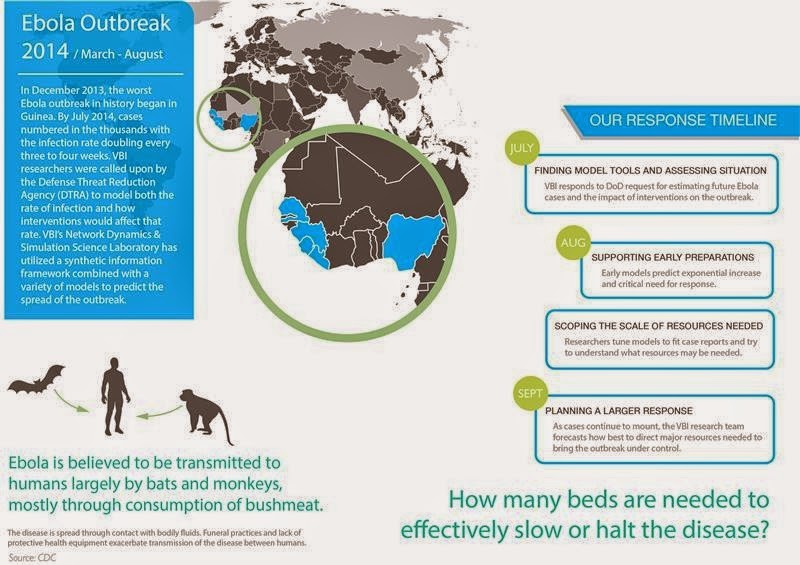
The Network Dynamics and Simulation Science Laboratory at the Virginia Bioinformatics Institute modeled the rate of infections and how interventions would affect the rate.
Credit: Source: CDC / Image courtesy of Virginia Tech
The Ebola epidemic could claim hundreds of thousands of lives and infect more than 1.4 million people by the end of January, according to a statistical forecast released this week by the U.S. Centers for Disease Control and Prevention.

The CDC forecast supports the drastically higher projections released earlier by a group of scientists, including epidemiologists with the Virginia Bioinformatics Institute, who modeled the Ebola spread as part of a National Institutes of Health-sponsored project called Midas, short for Models of Infectious Disease Agent Study.

The effort is also supported by the federal Defense Threat Reduction Agency.
Before the scientists released results, the outbreak in West Africa was expected to be under control in nine months with only about 20,000 total cases. But modeling showed 20,000 people could be infected in just a single month.

The predictions could change dramatically if public health efforts become effective, but based on the virus's current uncontrolled spread, numbers of people infected could skyrocket.

"If the disease keeps spreading as it has been we estimate there could be hundreds of thousands of cases by the end of the year in Liberia alone," said Bryan Lewis, a computational epidemiologist with the Network Dynamics and Simulation Science Laboratory at the Virginia Bioinformatics Institute.

Lewis and his fellow researchers use a combination of models to predict outcomes of the epidemic.

The agent-based models are adaptive, evolving as more information is fed into them to provide an accurate forecast.

Pharmaceutical intervention, which is still on the horizon, is proving less effective in the models than supportive care and personal protection equipment for health care workers.

"The work with Ebola is not an isolated event," said Christopher Barrett, the executive director of the institute. "This research is part of a decades-long effort largely funded by the Defense Threat Reduction Agency to build a global synthetic population that will allow us to ask questions about our world and ourselves that we have never been able to ask before, and to use those answers to prevent or quickly intervene during a crisis."

Barrett and other institute leaders updated U.S. Sen. Tim Kaine and Virginia Tech President Timothy Sands about the Network Dynamics and Simulation Science Lab's role in analyzing the Ebola outbreak at the Virginia Tech Research Center in Arlington on Tuesday morning. That afternoon in Blacksburg they briefed staff members from U.S. Sen. Mark Warner's office.

A university-level Research Institute of Virginia Tech, the Virginia Bioinformatics Institute was established in 2000 with an emphasis on informatics of complex interacting systems scaling the microbiome to the entire globe. It helps solve challenges posed to human health, security, and sustainability. Headquartered at the Blacksburg campus, the institute occupies 154,600 square feet in research facilities, including state-of-the-art core laboratory and high-performance computing facilities, as well as research offices in the Virginia Tech Research Center in Arlington, Virginia.

Source: Virginia Tech

Parasites and the evolution of primate culture

Written By Unknown on Tuesday, December 23, 2014 | 7:21 PM

Chimpanzees (stock image). A new study examines the ‘costs’ of innovation, and learning from others. Credit: © shiruikage / Fotolia
Learning from others and innovation have undoubtedly helped advance civilization. But these behaviours can carry costs as well as benefits. And a new study by an international team of evolutionary biologists sheds light on how one particular cost -- increased exposure to parasites -- may affect cultural evolution in non-human primates.

The results, published Dec. 3, 2014 in the journal Proceedings of the Royal Society B, suggest that species with members that learn from others suffer from a wider variety of socially transmitted parasites, while innovative, exploratory species suffer from a wider variety of parasites transmitted through the environment, such as in the soil or water.

"We tend to focus on innovation and learning from others as a good thing, but their costs have received relatively little attention," says McGill University biologist Simon Reader, co-author of the study. "Here, we uncover evidence that socially transmitted pathogen burdens rise with learning from others -- perhaps because close interaction is needed for such learning -- and environmentally transmitted pathogen burdens rise with exploratory behaviour such as innovation and extractive foraging."

Chimpanzees, for example, live in groups and have a wide range of such behaviours, such as digging for food underground or eating new kinds of insects.. Previously, studies have not been able to determine whether costly parasites force primates to engage in more exploratory behaviour -- by diversifying food sources, for example -- or whether exploratory behaviour leads to their having more parasites, Reader notes. "Our results support the idea that exploratory and social behaviours expose primates to specific kinds of parasites."

"The findings also lead to questions about how people and other primates have developed solutions to minimize these parasite costs -- such as eating medicinal plants -- and may help us better understand how the processes underlying human culture arose," Reader says.
The research team, led by Collin McCabe of Harvard University and Charles Nunn of Duke University, based their analyses on databases obtained by surveying thousands of articles on primate behaviour and parasites.

Funding for the research was provided by the National Science Foundation, the Natural Sciences and Engineering Research Council of Canada, and the Netherlands Organisation for Scientific Research.

Source: McGill University

New molecules to burst malaria's bubble

Dr Natalie Spillman. Credit: Alex Maier
Scientists have released details of a raft of new chemicals with potent anti-malarial properties which could open the way to new drugs to fight the disease.

A new paper in PNAS is the third published recently by a group at the Australian National University (ANU). The group has collaborated with scientists from around the globe to uncover potential ammunition in the fight against malaria.

Over 200 million people contract malaria each year, and the parasite that causes the disease has become resistant to most of the drugs currently available.

"The series of papers shows that the malaria parasite has a real Achilles heel, and describe a range of new ways to attack it," said Professor Kiaran Kirk, Dean of the College of Medicine, 
Biology and Environment and one of the scientists involved in the project.

Dr Natalie Spillman, from the Research School of Biology at ANU studied the mechanism by which the parasites are killed.

"The new molecules block a molecular salt pump at the surface of the parasite, causing it to fill up with salt," Dr Spillman said

"This has the effect of drawing water into the parasite, causing it to swell uncontrollably and burst."

Although the process of developing the new compounds into clinical drugs is complex and lengthy, Professor Kirk is optimistic the findings will lead to new treatments.

"It's very early days, but these pump-blocking compounds have some of the most promising anti-malarial potential we've seen," he says.

Aspects of the work were carried out with groups at Griffith University, Monash University and the Menzies School of Health Research in Darwin.

"This is a good example of a long-term, international drug development program in which Australian groups have played a key role," he said.

Source: Australian National University

Nanotechnology against malaria parasites

After maturation, malaria parasites (yellow) are leaving an infected red blood cell and are efficiently blocked by nanomimics (blue). Credit: Fig: modified by University of Basel with permission from ACS
Malaria parasites invade human red blood cells, they then disrupt them and infect others. Researchers at the University of Basel and the Swiss Tropical and Public Health Institute have now developed so-called nanomimics of host cell membranes that trick the parasites. This could lead to novel treatment and vaccination strategies in the fight against malaria and other infectious diseases. Their research results have been published in the scientific journal ACS Nano.

For many infectious diseases no vaccine currently exists. In addition, resistance against currently used drugs is spreading rapidly. To fight these diseases, innovative strategies using new mechanisms of action are needed. The malaria parasite Plasmodium falciparum that is transmitted by the Anopheles mosquito is such an example. Malaria is still responsible for more than 600,000 deaths annually, especially affecting children in Africa (WHO, 2012).
Artificial bubbles with receptors

Malaria parasites normally invade human red blood cells in which they hide and reproduce. They then make the host cell burst and infect new cells. Using nanomimics, this cycle can now be effectively disrupted: The egressing parasites now bind to the nanomimics instead of the red blood cells.

Researchers of groups led by Prof. Wolfgang Meier, Prof. Cornelia Palivan (both at the University of Basel) and Prof. Hans-Peter Beck (Swiss TPH) have successfully designed and tested host cell nanomimics. For this, they developed a simple procedure to produce polymer vesicles -- small artificial bubbles -- with host cell receptors on the surface. The preparation of such polymer vesicles with water-soluble host receptors was done by using a mixture of two different block copolymers. In aqueous solution, the nanomimics spontaneously form by self-assembly.

Blocking parasites efficiently

Usually, the malaria parasites destroy their host cells after 48 hours and then infect new red blood cells. At this stage, they have to bind specific host cell receptors. Nanomimics are now able to bind the egressing parasites, thus blocking the invasion of new cells. The parasites are no longer able to invade host cells, however, they are fully accessible to the immune system.

The researchers examined the interaction of nanomimics with malaria parasites in detail by using fluorescence and electron microscopy. A large number of nanomimics were able to bind to the parasites and the reduction of infection through the nanomimics was 100-fold higher when compared to a soluble form of the host cell receptors. In other words: In order to block all parasites, a 100 times higher concentration of soluble host cell receptors is needed, than when the receptors are presented on the surface of nanomimics.

"Our results could lead to new alternative treatment and vaccines strategies in the future," says Adrian Najer first-author of the study. Since many other pathogens use the same host cell receptor for invasion, the nanomimics might also be used against other infectious diseases. The research project was funded by the Swiss National Science Foundation and the NCCR "Molecular Systems Engineering."

Source: University of Basel

Promising compound rapidly eliminates malaria parasite

A new report says that the rapid action of (+)-SJ733 will likely slow malaria drug resistance. Credit: Peter Barta, St. Jude Children's Research Hospital
An international research collaborative has determined that a promising anti-malarial compound tricks the immune system to rapidly destroy red blood cells infected with the malaria parasite but leave healthy cells unharmed. St. Jude Children's Research Hospital scientists led the study, which appears in the current online early edition of the Proceedings of the National Academy of Sciences (PNAS).

The compound, (+)-SJ733, was developed from a molecule identified in a previous St. Jude-led study that helped to jumpstart worldwide anti-malarial drug development efforts. Malaria is caused by a parasite spread through the bite of an infected mosquito. The disease remains a major health threat to more than half the world's population, particularly children. The World Health Organization estimates that in Africa a child dies of malaria every minute.

In this study, researchers determined that (+)-SJ733 uses a novel mechanism to kill the parasite by recruiting the immune system to eliminate malaria-infected red blood cells. In a mouse model of malaria, a single dose of (+)-SJ733 killed 80 percent of malaria parasites within 24 hours. After 48 hours the parasite was undetectable.

Planning has begun for safety trials of the compound in healthy adults.

Laboratory evidence suggests that the compound's speed and mode of action work together to slow and suppress development of drug-resistant parasites. Drug resistance has long undermined efforts to treat and block malaria transmission.

"Our goal is to develop an affordable, fast-acting combination therapy that cures malaria with a single dose," said corresponding author R. Kiplin Guy, Ph.D., chair of the St. Jude Department of Chemical Biology and Therapeutics. "These results indicate that SJ733 and other compounds that act in a similar fashion are highly attractive additions to the global malaria eradication campaign, which would mean so much for the world's children, who are central to the mission of St. Jude."

Whole genome sequencing of the Plasmodium falciparum, the deadliest of the malaria parasites, revealed that (+)-SJ733 disrupted activity of the ATP4 protein in the parasites. The protein functions as a pump that the parasites depend on to maintain the proper sodium balance by removing excess sodium.

The sequencing effort was led by co-author Joseph DeRisi, Ph.D., a Howard Hughes Medical Institute investigator and chair of the University of California, San Francisco Department of Biochemistry and Biophysics. Investigators used the laboratory technique to determine the makeup of the DNA molecule in different strains of the malaria parasite.

Researchers showed that inhibiting ATP4 triggered a series of changes in malaria-infected red blood cells that marked them for destruction by the immune system. The infected cells changed shape and shrank in size. They also became more rigid and exhibited other alterations typical of aging red blood cells. The immune system responded using the same mechanism the body relies on to rid itself of aging red blood cells.

Another promising class of antimalarial compounds triggered the same changes in red blood cells infected with the malaria parasite, researchers reported. The drugs, called spiroindolones, also target the ATP4 protein. The drugs include NITD246, which is already in clinical trials for treatment of malaria. Those trials involve investigators at other institutions.

"The data suggest that compounds targeting ATP4 induce physical changes in the infected red blood cells that allow the immune system or erythrocyte quality control mechanisms to recognize and rapidly eliminate infected cells," DeRisi said. "This rapid clearance response depends on the presence of both the parasite and the investigational drug. That is important because it leaves uninfected red blood cells, also known as erythrocytes, unharmed."

Laboratory evidence also suggests that the mechanism will slow and suppress development of drug-resistant strains of the parasite, researchers said.

Planning has begun to move (+)-SJ733 from the laboratory into the clinic beginning with a safety study of the drug in healthy adults. The drug development effort is being led by a consortium that includes scientists at St. Jude, the Swiss-based non-profit Medicines for Malaria Venture and Eisai Co., a Japanese pharmaceutical company.

Source: St. Jude Children's Research Hospital
 
Support : Creating Website | Johny Template | Mas Template
Copyright © 2011. The planet wall - All Rights Reserved
Template Created by Easy Blogging Published by Mas Template
Proudly powered by Blogger