Latest Post
Showing posts with label PRIONS. Show all posts

Computational model: Ebola could infect more than 1.4 million people by end of January 2015

Written By Unknown on Wednesday, January 7, 2015 | 7:21 AM

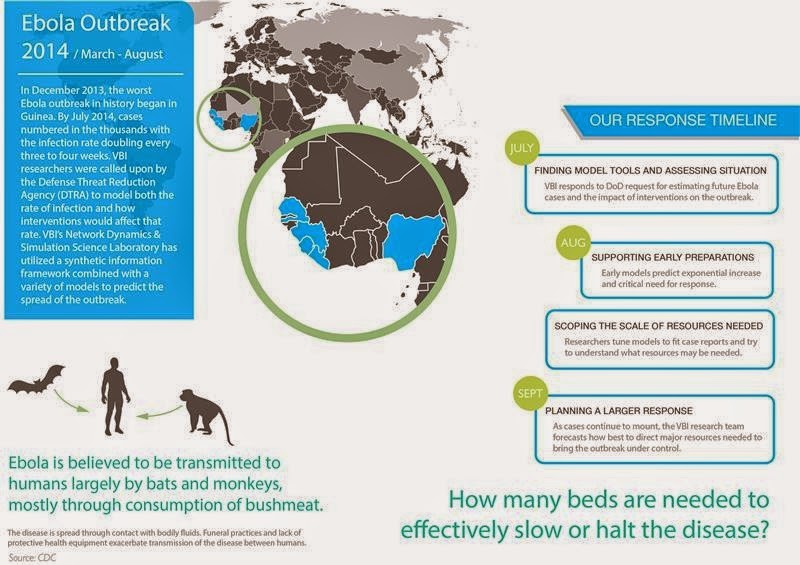
The Network Dynamics and Simulation Science Laboratory at the Virginia Bioinformatics Institute modeled the rate of infections and how interventions would affect the rate.
Credit: Source: CDC / Image courtesy of Virginia Tech
The Ebola epidemic could claim hundreds of thousands of lives and infect more than 1.4 million people by the end of January, according to a statistical forecast released this week by the U.S. Centers for Disease Control and Prevention.

The CDC forecast supports the drastically higher projections released earlier by a group of scientists, including epidemiologists with the Virginia Bioinformatics Institute, who modeled the Ebola spread as part of a National Institutes of Health-sponsored project called Midas, short for Models of Infectious Disease Agent Study.

The effort is also supported by the federal Defense Threat Reduction Agency.
Before the scientists released results, the outbreak in West Africa was expected to be under control in nine months with only about 20,000 total cases. But modeling showed 20,000 people could be infected in just a single month.

The predictions could change dramatically if public health efforts become effective, but based on the virus's current uncontrolled spread, numbers of people infected could skyrocket.

"If the disease keeps spreading as it has been we estimate there could be hundreds of thousands of cases by the end of the year in Liberia alone," said Bryan Lewis, a computational epidemiologist with the Network Dynamics and Simulation Science Laboratory at the Virginia Bioinformatics Institute.

Lewis and his fellow researchers use a combination of models to predict outcomes of the epidemic.

The agent-based models are adaptive, evolving as more information is fed into them to provide an accurate forecast.

Pharmaceutical intervention, which is still on the horizon, is proving less effective in the models than supportive care and personal protection equipment for health care workers.

"The work with Ebola is not an isolated event," said Christopher Barrett, the executive director of the institute. "This research is part of a decades-long effort largely funded by the Defense Threat Reduction Agency to build a global synthetic population that will allow us to ask questions about our world and ourselves that we have never been able to ask before, and to use those answers to prevent or quickly intervene during a crisis."

Barrett and other institute leaders updated U.S. Sen. Tim Kaine and Virginia Tech President Timothy Sands about the Network Dynamics and Simulation Science Lab's role in analyzing the Ebola outbreak at the Virginia Tech Research Center in Arlington on Tuesday morning. That afternoon in Blacksburg they briefed staff members from U.S. Sen. Mark Warner's office.

A university-level Research Institute of Virginia Tech, the Virginia Bioinformatics Institute was established in 2000 with an emphasis on informatics of complex interacting systems scaling the microbiome to the entire globe. It helps solve challenges posed to human health, security, and sustainability. Headquartered at the Blacksburg campus, the institute occupies 154,600 square feet in research facilities, including state-of-the-art core laboratory and high-performance computing facilities, as well as research offices in the Virginia Tech Research Center in Arlington, Virginia.

Source: Virginia Tech

Infectious prion protein discovered in urine of patients with variant Creutzfeldt-Jakob disease

Written By Unknown on Sunday, December 28, 2014 | 7:08 PM

Claudio Soto, Ph.D., in one of his labs at The University of Texas Health Science Center at Houston (UTHealth). Credit: Image courtesy of University of Texas Health Science Center at Houston
The misfolded and infectious prion protein that is a marker for variant Creutzfeldt-Jakob disease – linked to the consumption of infected cattle meat – has been detected in the urine of patients with the disease by researchers at The University of Texas Health Science Center at Houston (UTHealth) Medical School.

The results of the international study, led by Claudio Soto, Ph.D., professor of neurology at the UTHealth Medical School, will be published in the Aug. 7 issue of the New England Journal of Medicine.

Variant Creutzfeldt-Jakob disease in humans and bovine spongiform encephalopathy in animals – also known as Mad Cow disease – are fatal neurodegenerative disorders. There are currently no noninvasive tools available to diagnose the disease and there are no treatments.

Sporadic Creutzfeldt-Jakob disease occurs worldwide at a rate of around 1 new case per million people per year. The variant form is a new disease occurring in people who either ate the beef of cows with bovine spongiform encephalopathy or, in the case of three patients in the United Kingdom, received blood transfusions from asymptomatic infected donors.

The international team of researchers analyzed urine samples from 68 patients with sporadic Creutzfeldt-Jakob disease, 14 patients with variant Creutzfeldt-Jakob disease, four patients with genetic prion diseases, 50 patients with other neurodegenerative diseases, 50 patients with nondegenerative neurologic diseases and 52 healthy persons.

Soto’s laboratory used a protein misfolding cyclic amplification assay, invented in the lab, which mimics the prion replication process in vitro that occurs in prion disease. The misfolded prion proteins were detected in the urine of 13 of 14 patients with variant Creutzfeldt-Jakob disease. The single patient whose urine was negative had been receiving an experimental treatment of pentosan polysulfate directly into the brain. No misfolded prion proteins were detected in the urine of any the other study subjects, including the patients who had sporadic Creutzfeldt-Jakob disease.

“What could be less invasive than detecting this disease in urine? The fact that we were able to detect just the variant Creutzfeldt-Jakob disease form in the urine is very important. This could lead to the development of commercial technology for diagnosis as well as to determine the safety of donated blood and urinary products,” said Soto, who is the director of The George and Cynthia Mitchell Center for Research in Alzheimer’s disease and Related Brain Disorders, and founder of Amprion Inc, a biotech company developing the cyclic amplification technology for commercial application.

According to the World Health Organization (WHO), variant Creutzfeldt-Jakob disease affects younger patients, who have a median age of 28 at death, compared to sporadic Creutzfeldt-Jakob disease with a median age of 68. Most patients, after diagnosis of either form, live less than a year before death.

As of June 2, 2014, 177 of 229 people in the world with Creutzfeldt-Jakob disease were from the United Kingdom. A 2013 study published in the British Medical Journal has estimated that approximately 30,000 people in the United Kingdom might be carriers of the variant form of the disease.

“This study reports, for the first time, the detection of the abnormal prion protein in the urine from patients with variant Creutzfeldt-Jakob disease using the protein misfolding amplification technique pioneered by Dr. Claudio Soto,” said co-author James W. Ironside, FMedSci, FRSE, professor of clinical neuropathology at the National CJD Research and Surveillance Unit at the University of Edinburgh. “This has great potential to allow the development of a highly sensitive and specific non-invasive test that can be used for the diagnosis of variant Creutzfeldt-Jakob disease, and potentially as a screening tool for variant Creutzfeldt-Jakob disease infection in asymptomatic individuals, which is a topic of current interest in the United Kingdom.”

Source: University of Texas Health Science Center at Houston

What bank voles can teach us about prion disease transmission and neurodegeneration

This image shows accumulation of misfolded, toxic prion protein (brown staining) in the brain of a transgenic mouse expressing bank vole PrP and challenged with human variant Creutzfeldt-Jakob disease (vCJD) prions. Credit: Image courtesy of Dr. Joel Watts
When cannibals ate brains of people who died from prion disease, many of them fell ill with the fatal neurodegenerative disease as well. Likewise, when cows were fed protein contaminated with bovine prions, many of them developed mad cow disease. On the other hand, transmission of prions between species, for example from cows, sheep, or deer to humans, is -- fortunately -- inefficient, and only a small proportion of exposed recipients become sick within their lifetimes.

A study published on April 3rd in PLOS Pathogens takes a close look at one exception to this rule: bank voles appear to lack a species barrier for prion transmission, and their universal susceptibility turns out to be both informative and useful for the development of strategies to prevent prion transmission.
Prions are misfolded, toxic versions of a protein called PrP, which in its normal form is present in all mammalian species that have been examined. Toxic prions are "infectious"; they can induce existing, properly folded PrP proteins to convert into the disease-associated prion form. Prion diseases are rare, but they share features with more common neurodegenerative diseases like Alzheimer's disease.

Trying to understand the unusual susceptibility of bank voles to prions from other species, Stanley Prusiner, Joel Watts, Kurt Giles and colleagues, from the University of California in San Francisco, USA, first tested whether the susceptibility is an intrinsic property of the voles' PrP, or whether other factors present in these rodents make them vulnerable.

The scientists introduced into mice the gene that codes for the normal bank vole prion protein, thereby generating mice that express bank vole PrP, but not mouse PrP. When these mice get older, some of them spontaneously develop neurologic illness, but in the younger ones the bank vole PrP is in its normal, benign folded state. The scientists then exposed young mice to toxic misfolded prions from 8 different species, including human, cattle, elk, sheep, and hamster.

They found that all of these foreign-species prions can cause prion disease in the transgenic mice, and that the disease develops often more rapidly than it does in bank voles. The latter is likely because the transgenic mice express higher levels of bank vole PrP than are naturally present in the voles.

The results show that the universal susceptibility of bank voles to cross-species prion transmission is an intrinsic property of bank vole PrP. Because the transgenic mice develop prion disease rapidly, the scientists propose that the mice will be useful tools in studying the processes by which toxic prions "convert" healthy PrP and thereby destroy the brain. And because that process is similar across many neurodegenerative diseases, better understanding prion disease development might have broader implications.

Source:  PLOS

The shape of infectious prions

Structural changes were located in the prion protein N-terminus, where a novel reorganization of the beta sheet (in yellow) was observed. In the background, the X-ray diffraction pattern of the crystal composed by the complex prion protein-Nanoboy.
Prions are unique infective agents -- unlike viruses, bacteria, fungi and other parasites, prions do not contain either DNA or RNA. Despite their seemingly simple structure, they can propagate their pathological effects like wildfire, by "infecting" normal proteins. PrPSc (the pathological form of the prion protein) can induce normal prion proteins (PrPC) to acquire the wrong conformation and convert into further disease-causing agents.

"When they are healthy, they look like tiny spheres; when they are malignant, they appear as cubes" stated Giuseppe Legname, principal investigator of the Prion Biology Laboratory at the Scuola Internazionale Superiore di Studi Avanzati (SISSA) in Trieste, when describing prion proteins. Prions are "misfolded" proteins that cause a group of incurable neurodegenerative diseases, including spongiform encephalopathies (for example, mad cow diseases) and Creutzfeldt-Jakob disease. Legname and coworkers have recently published a detailed analysis of the early mechanisms of misfolding. Their research has just been published in the Journal of the American Chemical Society, the most authoritative scientific journal in the field.

"For the first time, our experimental study has investigated the structural elements leading to the disease-causing conversion" explains Legname. "With the help of X-rays, we observed some synthetic prion proteins engineered in our lab by applying a new approach -- we used nanobodies, i.e. small proteins that act as a scaffolding and induce prions to stabilize their structure." Legname and colleagues reported that misfolding originates in a specific part of the protein named "N-terminal." "The prion protein consists of two subunits. The C-terminal has a clearly defined and well-known structure, whereas the unstructured N-terminal is disordered, and still largely unknown. This is the very area where the early prion pathological misfolding occurs" adds Legname. "The looser conformation of the N-terminal likely determines a dynamic structure, which can thus change the protein shape."

"Works like ours are the first, important steps to understand the mechanisms underlying the pathogenic effect of prions" concludes Legname. "Elucidating the misfolding process is essential to the future development of drugs and therapeutic strategies against incurable neurodegenerative diseases."

Source: Sissa Medialab

Targeted culling of deer controls disease with little effect on hunting

A new study found that the targeted culling of deer prevents the rampant spread of chronic wasting disease to healthy deer.
Chronic wasting disease, the deer-equivalent of mad cow disease, has crept across the U.S. landscape from west to east. It appeared first in captive mule deer in Colorado in the late 1960s. By 1981, it had escaped to the wild. It reached the Midwest by 2002. Little is known about its potential to infect humans.

The effort to keep chronic wasting disease in check in Illinois is a success, report researchers Nohra Mateus-Pinilla, left, a wildlife veterinary epidemiologist with the Illinois Natural History Survey; U. of I. animal sciences professor Jan Novakofski; and postdoctoral researcher Michelle Green.

Now researchers at the University of Illinois offer a first look at the long-term effectiveness of the practice of culling deer in areas affected by CWD to keep the disease in check. Their study appears in the journal Preventive Veterinary Medicine.

Each year, the Illinois Department of Natural Resources tests 7,000 (hunted, culled or incidentally killed) deer for CWD infection, conducts aerial surveillance to see where deer congregate and sends in sharpshooters to cull deer at the sites with disease, said Jan Novakofski, a professor of animal sciences at the University of Illinois and an author of the study.

"We know a lot about how far deer typically move," he said. "If they're sick, they're going to spread the disease that far. So if you find a deer that's sick, you draw that small circle and you shoot there."

Novakofski called this approach "a textbook scientific strategy for control. You reduce contact and you reduce the spread of infection with the smallest overall impact on healthy deer."

He and his colleagues at the Illinois Natural History Survey (part of the Prairie Research Institute at the U. of I.) found that the strategy worked: The prevalence of CWD in tested Illinois deer remained at about 1 percent from 2002 to 2012.

The team also found that hunters were killing more deer each year in each region of the state (north, central and south) regardless of CWD and CWD management. Statewide, the number of deer killed by hunters went from 147,830 in 2001, before the appearance of CWD, to 181,451 in 2012. The only exception: Two counties out of 10 with cases of CWD saw a reduction in hunter harvest over the same period.

"We wanted to know whether Illinois hunters have fewer deer to hunt now than they did before CWD," said Nohra Mateus-Pinilla, a wildlife veterinary epidemiologist at the INHS who led the study with postdoctoral researcher Mary Beth Manjerovic. "We found that hunter harvest has increased, and the prevalence of CWD has been maintained at low levels for 10 years in Illinois."

This finding answers a long-time complaint by some hunters that the culling of deer makes it harder for them to find deer to shoot, Novakofski said.
"Since 2001, hunter harvest of deer has increased similarly in the northern region of Illinois, where CWD occurs, and the rest of the state, where there is no disease or sharpshooting," he said.

In the two Illinois counties with fewer deer, "the reductions were 11 to 20 percent," Manjerovic said.

The team compared the Illinois experience with that of Wisconsin, which changed its CWD-management strategy from one that relied on culling to one that consisted primarily of allowing hunters to thin deer herds, the researchers said. Wisconsin saw a striking increase of infection in CWD-tested deer after it did that, the team found.

"In the early years in Wisconsin, (CWD prevalence) was still about 1 percent, just as it was in Illinois," Manjerovic said. "Then the strategy changed. Since 2007, CWD prevalence has increased to about 5 percent."

"We can't find an environmental or other variable that explains the increase in prevalence except a change in management," Novakofski said.

The numbers may not seem alarming to some, said postdoctoral researcher and co-author Michelle Green. But the trend is of concern, she said.

"CWD is a prion disease (like mad cow disease) and it's 100 percent fatal. 
There's no current way that we can actually make the deer better, so it's important that we keep it from spreading too far throughout the population," she said. "And then there's also the connection to mad cow disease. We don't have enough information yet to really understand what the impact to human health could be."

"We all hope that there is never a case of chronic wasting disease in humans. We all hope that it never spreads to people or agricultural animals," Novakofski said. "If it ever does, the investment in maintaining prevalence at a low level in Illinois will be repaid a thousand-fold."

Source: University of Illinois at Urbana-Champaign

Scrapie could breach the species barrier

Written By Unknown on Thursday, December 25, 2014 | 3:05 AM

Scrapie is a neurodegenerative disease that has been known for centuries and which affects sheep and goats. Credit: INRA/Florent Giffard
INRA scientists have shown for the first time that the pathogens responsible for scrapie in small ruminants (prions) have the potential to convert the human prion protein from a healthy state to a pathological state. In mice models reproducing the human species barrier, this prion induces a disease similar to Creutzfeldt-Jakob disease. These primary results published in Nature Communications on 16 December 2014, stress the necessity to reassess the transmission of this disease to humans.

Scrapie is a neurodegenerative disease that has been known for centuries and which affects sheep and goats. Similar to Bovine Spongiform Encephalopathy (BSE) or mad cow disease, scrapie is caused by a transmissible pathogen protein called prion.

However, and contrary to BSE[1], epidemiological studies have never been able to establish a link between this disease and the occurrence of prion diseases in humans. "Risks of transmitting scrapie to humans (zoonose) were hitherto considered negligible because of the species barrier that naturally prevents prion propagation between species," said Olivier 
Andreoletti, INRA scientist who led the present study.

Researchers at INRA studied the permeability of the human transmission barrier to pathogens responsible for scrapie, using animal models specifically developed for this purpose. This approach previously allowed the confirmation of the zoonotic nature of prions responsible for BSE in cows and of the variant of Creutzfeldt-Jakob disease in humans (vCJD).

Unexpectedly, in these rodent models, certain pathogens responsible for scrapie were able to cross the transmission barrier. Moreover, the pathogens that propagated through this barrier were undistinguishable from the prions causing the sporadic form of Creutzfeldt-Jakob disease (sCJD). This data suggest a potential link between the occurrence of certain sCJD and these animal prions.

"Since CJD is scarce, about 1 case per million and per year, and incubation periods are usually long -several decades- it is extremely difficult for epidemiological studies to try and make this link," explains Olivier Andreoletti.

In their conclusions, the authors stress the fact that CJD cases are rare though scrapie has been circulating for centuries in small ruminants for which we eat the meat. Even if in future studies scrapie is finally confirmed to have a zoonotic potential, the authors consider that this disease does not constitute a new major risk for public health.

Source: INRA-France
 
Support : Creating Website | Johny Template | Mas Template
Copyright © 2011. The planet wall - All Rights Reserved
Template Created by Easy Blogging Published by Mas Template
Proudly powered by Blogger