Latest Post
Showing posts with label COMPUTATIONAL BIOLOGY. Show all posts

EGFR-Mediated Beclin 1 Phosphorylation in Autophagy Suppression, Tumor Progression, and Tumor Chemoresistance

Written By Unknown on Tuesday, February 3, 2015 | 5:58 PM

EGFR negatively regulates autophagy by binding to Beclin 1.
Active EGFR phosphorylates Beclin 1 and alters its interactome.
EGFR suppression of Beclin 1 may contribute to tumor progression in lung cancer.

Lung cancer responses to EGFR inhibitors may involve activation of Beclin 1. Image Credit: Cell Press

Summary
Cell surface growth factor receptors couple environmental cues to the regulation of cytoplasmic homeostatic processes, including autophagy, and aberrant activation of such receptors is a common feature of human malignancies. Here, we defined the molecular basis by which the epidermal growth factor receptor (EGFR) tyrosine kinase regulates autophagy. Active EGFR binds the autophagy protein Beclin 1, leading to its multisite tyrosine phosphorylation, enhanced binding to inhibitors, and decreased Beclin 1-associated VPS34 kinase activity. EGFR tyrosine kinase inhibitor (TKI) therapy disrupts Beclin 1 tyrosine phosphorylation and binding to its inhibitors and restores autophagy in non-small-cell lung carcinoma (NSCLC) cells with a TKI-sensitive EGFR mutation. In NSCLC tumor xenografts, the expression of a tyrosine phosphomimetic Beclin 1 mutant leads to reduced autophagy, enhanced tumor growth, tumor dedifferentiation, and resistance to TKI therapy. Thus, oncogenic receptor tyrosine kinases directly regulate the core autophagy machinery, which may contribute to tumor progression and chemoresistance.

Introduction
Epidermal growth factor receptor (EGFR), an oncogenic receptor tyrosine kinase, links extracellular signals to cellular homeostasis. In normal cells, EGFR signaling is triggered by the binding of growth factors, such as epidermal growth factor (EGF), leading to homodimerization or heterodimerization with other EGFR family members (such as HER2/neu) and autophosphorylation of the intracellular domain (Lemmon and Schlessinger, 2010). The phosphotyrosines formed serve as a docking site for adaptor molecules, which results in the activation of signaling pathways including the Ras/MAPK pathway, the PI3K/Akt pathway, and STAT signaling pathways. In tumor cells, the tyrosine kinase activity of EGFR may be dysregulated by EGFR gene mutation, increased EGFR gene copy number, or EGFR protein overexpression, leading to aberrant EGFR signaling and increased tumor cell survival, proliferation, invasion, and metastasis ( Ciardiello and Tortora, 2008). EGFR signaling is deregulated in many human cancers, including those of the lung, head and neck, colon, pancreas, and brain.

The deregulation of EGFR in human cancers has led to the development of anticancer agents that target EGFR, including: (1) anti-EGFR antibodies that inhibit ligand binding and (2) small-molecule receptor tyrosine kinase inhibitors (TKIs), erlotinib and gefitinib, that block EGFR intracellular tyrosine kinase activity. Although the EGFR TKIs have shown limited clinical benefit in the majority of solid tumors, they are effective in non-small-cell lung carcinomas (NSCLCs) that harbor specific mutations in the tyrosine kinase domain of EGFR (most commonly, in-frame deletion in exon 19 around codons 746–750 or single-base substitution, L858R, in exon 21) (Ciardiello and Tortora, 2008, Lynch et al., 2004 and Pao and Chmielecki, 2010). Most patients with NSCLCs with EGFR mutations initially respond favorably to erlotinib or gefitinib, suggesting these mutations drive tumorigenesis. However, among tumors that initially respond to EGFR TKIs, most eventually acquire resistance, often due to the emergence of a secondary mutation, T790M, in the kinase domain of EGFR (Pao and Chmielecki, 2010).

Several studies have shown that EGFR signaling regulates autophagy, a lysosomal degradation pathway that functions in cellular homeostasis and protection against a variety of diseases, including cancer (Levine and Kroemer, 2008). The downstream targets of EGFR—PI3K, Akt, and mammalian target of rapamycin (mTOR)—are well-established negative regulators of autophagy (Botti et al., 2006). Moreover, EGFR inhibitors induce autophagy in NSCLCs (Gorzalczany et al., 2011 and Han et al., 2011) and other cancer cells (Fung et al., 2012). However, the links between EGFR signaling and autophagy remain poorly understood, particularly (1) the molecular mechanisms by which EGFR signaling suppresses autophagy, (2) the role of EGFR suppression of autophagy in lung cancer pathogenesis, and (3) the role of autophagy induction in the response to TKI therapy. EGFR inhibitor-induced autophagy in lung cancer cells has been postulated to exert either cytoprotective (Han et al., 2011) or cytotoxic (Gorzalczany et al., 2011) effects.

Conflicting results regarding the role of autophagy in the response or resistance to EGFR TKI treatment reflects broader uncertainties in the role of autophagy in cancer therapy (Rubinsztein et al., 2012). It is not understood in what contexts autophagy induction contributes to tumor progression or suppression and to tumor chemoresistance or chemosensitivity. There is a general consensus that autophagy prevents tumor initiation, as loss-of-function mutations of several different autophagy genes results in spontaneous tumorigenesis (beclin 1, Atg5, and Atg7) and/or increased chemical-induced tumorigenesis (Atg4C) in mice ( Rubinsztein et al., 2012). Despite this inhibitory role in tumor initiation, it has been proposed that autophagy may promote the growth of established tumors and contribute to chemoresistance, principally through its actions to prolong the survival of metabolically stressed neoplastic cells ( Rubinsztein et al., 2012).

To understand the relationship between oncogenic signaling, autophagy, and distinct stages of tumorigenesis, it is important to define the molecular mechanisms by which oncogenic signaling regulates autophagy. We recently showed that the oncogene Akt inhibits autophagy independently of mTOR signaling via serine phosphorylation of the essential autophagy protein, Beclin 1 (Wang et al., 2012), a haploinsufficient tumor suppressor protein frequently monoallelically deleted in human breast and ovarian cancer (Levine and Kroemer, 2008). Moreover, Akt-mediated phosphorylation of Beclin 1 contributes to Akt-dependent fibroblast transformation, supporting the concept that inactivation of Beclin 1-dependent autophagy plays a role in tumor initiation. However, it is not known whether oncogenic inactivation of Beclin 1 (or other autophagy proteins) influences progression of established tumors and/or their response to therapy.


Here, we identify the molecular basis by which EGFR tyrosine kinase activity regulates autophagy. We show that active EGFR binds to Beclin 1, leading to its tyrosine phosphorylation, alteration of its interactome, and inhibition of its autophagy function. A mutant of Beclin 1 containing phosphomimetic mutations in the EGFR-dependent tyrosine phosphorylation sites enhances autophagy suppression in EGFR-mutated NSCLC cells, resulting in enhanced tumor progression, altered tumor cell differentiation, and partial tumor resistance to EGFR TKI therapy. These findings demonstrate a heretofore unknown link between oncogenic receptor tyrosine kinases and the autophagy machinery, which may contribute to tumor progression and resistance to targeted therapy.

Source: Full Artical At - CELL PRESS

On the ups and downs of the seemingly idle brain

Written By Unknown on Friday, January 30, 2015 | 5:46 AM

Cortical colors Inhibitory cells abound in the barrel cortex of the mouse, where three main types were labeled to fluoresce in different colors: PV (red), SOM (blue), and 5HT3aR, which includes VIP and NPY, (green). Image: Connors lab/Brown University
Even when it seems not to be doing much, the brain maintains a baseline of activity in the form of up and down states of bustle and quiet. To accomplish this seemingly simple cycle, it maintains a complex balance between the activity of many excitatory and inhibitory cells, Brown University scientists report in the Journal of Neuroscience.

PROVIDENCE, R.I. [Brown University] — Even in its quietest moments, the brain is never “off.” Instead, while under anesthesia, during slow-wave sleep, or even amid calm wakefulness, the brain’s cortex maintains a cycle of activity and quiet called “up” and “down” states. A new study by Brown University neuroscientists probed deep into this somewhat mysterious cycle in mice, to learn more about how the mammalian brain accomplishes it.

In addition to an apparent role in maintaining a baseline of brain activity, the up and down cycling serves as a model for other ways in which activity across the cortex is modulated, said Garrett Neske, graduate student and lead author. To study how the brain maintains this cycling, he found, is to learn how the brain walks a healthy line between excitement and inhibition as it strives to be idle but ready, a bit like a car at a stoplight.
Garrett Neske To study how the brain maintains up and down cycles is to learn how the brain strives to be idle but ready, a bit like a car at a stoplight. Photo: David Orenstein/Brown University
“It is very important to regulate that balance of excitation and inhibition,” said senior author Barry Connors, professor and chair of neuroscience at Brown. “Too much excitation relative to inhibition you get a seizure, too little you become comatose. So whether you are awake and active and processing information or whether you are in some kind of idling state of the brain, you need to maintain that balance.”

The cycling may seem simple, but what Neske and Connors found in their investigation, published in the Journal of Neuroscience, is that it involves a good deal of complexity. They focused on five different types of cells in a particular area of the mouse cortex and found that all five appear to contribute uniquely to the ups and downs.

Cells in a barrel

Specifically the researchers, including Saundra Patrick, neuroscience research associate and second author, looked at the activity of excitatory pyramidal cells and four kinds of inhibitory interneurons (PV, SOM, VIP and NPY) in different layers of the barrel cortex. That part of the cortex is responsible for processing sensations on the face, including the whiskers.

Neske induced up and down cycles in slices of tissue from the barrel cortex and recorded each cell type’s electrical properties and behaviors, such as its firing rate and the amounts of excitation and inhibition they received from other neurons.

The picture that emerged is that all types of interneurons were active. This included the most abundant interneuron subtype (the fast-spiking PV cell), and the various more slowly spiking subtypes (SOM, VIP, NPY). In fact, Connors said, the latter cells were active at levels similar to or higher than neighboring excitatory cells, contributing strong inhibition during the up state.

One way such findings are important is in how they complement recent ones by another research group at Yale University. In that study scientists looked at a different part of the cortex called the entorhinal cortex. There they found that only one inhibitory neuron, PV, seemed to be doing anything in the up state to balance out the excitement of the pyramidal neurons. The other inhibitory neurons stayed virtually silent. In his study, Neske replicated those results.

Taken together, the studies indicate that even though up and down cycles occur throughout the cortex, they may be regulated differently in different parts.

“It suggests that inhibition plays different roles in persistent activity in these two regions of cortex and it calls for more comparative work to be done among cortical areas,” Neske said. “You can’t just use one cortical region as the model for all inhibitory interneuron function.”

From observation to manipulation

Since observing the different behaviors of the neuron types, Neske has moved on to manipulating them to see what role each of them plays. Using the technique of optogenetics, in which the firing of different neuron types can be activated or suppressed with pulses of colored light, Neske is experimenting with squelching different interneurons to see how their enforced abstention affects the up and down cycle.

When the work is done, he should emerge with an even clearer idea of the brain’s intricate and diligent efforts to remain balanced between excitation and inhibition.

The National Institutes of Health (grants NS-050434, MH-086400, and T32NS062443) and the Defense Advanced Research Projects Agency (grant DARPA-BAA-09-27) supported the research.

Source: Brown University

Computational model: Ebola could infect more than 1.4 million people by end of January 2015

Written By Unknown on Wednesday, January 7, 2015 | 7:21 AM

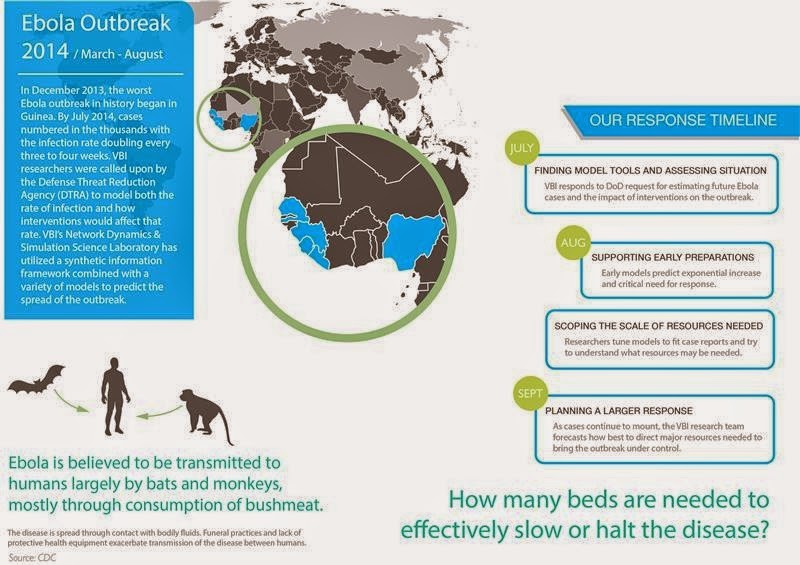
The Network Dynamics and Simulation Science Laboratory at the Virginia Bioinformatics Institute modeled the rate of infections and how interventions would affect the rate.
Credit: Source: CDC / Image courtesy of Virginia Tech
The Ebola epidemic could claim hundreds of thousands of lives and infect more than 1.4 million people by the end of January, according to a statistical forecast released this week by the U.S. Centers for Disease Control and Prevention.

The CDC forecast supports the drastically higher projections released earlier by a group of scientists, including epidemiologists with the Virginia Bioinformatics Institute, who modeled the Ebola spread as part of a National Institutes of Health-sponsored project called Midas, short for Models of Infectious Disease Agent Study.

The effort is also supported by the federal Defense Threat Reduction Agency.
Before the scientists released results, the outbreak in West Africa was expected to be under control in nine months with only about 20,000 total cases. But modeling showed 20,000 people could be infected in just a single month.

The predictions could change dramatically if public health efforts become effective, but based on the virus's current uncontrolled spread, numbers of people infected could skyrocket.

"If the disease keeps spreading as it has been we estimate there could be hundreds of thousands of cases by the end of the year in Liberia alone," said Bryan Lewis, a computational epidemiologist with the Network Dynamics and Simulation Science Laboratory at the Virginia Bioinformatics Institute.

Lewis and his fellow researchers use a combination of models to predict outcomes of the epidemic.

The agent-based models are adaptive, evolving as more information is fed into them to provide an accurate forecast.

Pharmaceutical intervention, which is still on the horizon, is proving less effective in the models than supportive care and personal protection equipment for health care workers.

"The work with Ebola is not an isolated event," said Christopher Barrett, the executive director of the institute. "This research is part of a decades-long effort largely funded by the Defense Threat Reduction Agency to build a global synthetic population that will allow us to ask questions about our world and ourselves that we have never been able to ask before, and to use those answers to prevent or quickly intervene during a crisis."

Barrett and other institute leaders updated U.S. Sen. Tim Kaine and Virginia Tech President Timothy Sands about the Network Dynamics and Simulation Science Lab's role in analyzing the Ebola outbreak at the Virginia Tech Research Center in Arlington on Tuesday morning. That afternoon in Blacksburg they briefed staff members from U.S. Sen. Mark Warner's office.

A university-level Research Institute of Virginia Tech, the Virginia Bioinformatics Institute was established in 2000 with an emphasis on informatics of complex interacting systems scaling the microbiome to the entire globe. It helps solve challenges posed to human health, security, and sustainability. Headquartered at the Blacksburg campus, the institute occupies 154,600 square feet in research facilities, including state-of-the-art core laboratory and high-performance computing facilities, as well as research offices in the Virginia Tech Research Center in Arlington, Virginia.

Source: Virginia Tech

Together, humans and computers can figure out plant world

A Web-based system was built for palynologists to interact with stored data and search for pollen images. This screen shows search capabilities by morphology semantics. From Han et al., part of the special issue 'Bioinformatic and Biometric Methods in Plant Morphology' in Applications in Plant Sciences. Credit: Image credit Han et al. Han, J. G., H. Cao, A. Barb, S. W. Punyasena, C. Jaramillo, and C.-R. Shyu. 2014. A neotropical Miocene pollen database employing image-based search and semantic modeling. Applications in Plant Sciences 2(8): 1400030. doi:10.3732/apps.1400030.
As technology advances, science has become increasingly about data -- how to gather it, organize it, and analyze it. The creation of key databases to analyze and share data lies at the heart of bioinformatics, or the collection, classification, storage, and analysis of biochemical and biological information using computers and software. The tools and methods used in bioinformatics have been instrumental in the development of fields such as molecular genetics and genomics. But, in the plant sciences, bioinformatics and biometrics are employed in all fields -- not just genomics -- to enable researchers to grapple with the rich and varied data sources at their disposal.

In July 2013, Surangi Punyasena of the University of Illinois at Urbana-Champaign and Selena Smith of the University of Michigan organized a special session at Botany 2013, the annual meeting of the Botanical Society of America in New Orleans, Louisiana. They invited plant morphologists, systematists, and paleobotanists, as well as computer scientists, applied mathematicians, and informaticians -- all of whom were united in their interest in developing or applying novel biometric or bioinformatic methods to the form and function of plants. The goal: to provide a forum for a cross-disciplinary exchange of ideas and methods on the theme of the quantitative analysis of plant morphology.

As Punyasena explains, "The quantitative analysis of morphology is the next frontier of bioinformatics. Humans are very good at learning to recognize shape and texture, but there are many problems where accuracy and consistency are difficult to achieve with only expert-derived, qualitative data, and in many fields there are often a limited number of experts trained in these visual assessments."

The results of that session, along with invited papers, are published in the August issue of Applications in Plant Sciences as a special issue on Bioinformatic and Biometric Methods in Plant Morphology. Morphology is, of course, the study of form, and form as represented in this collection of articles has a broad scope -- from microscopic pollen grains and charcoal particles, to macroscopic leaves and whole root systems. The methods presented in the issue, both recent and emerging, are varied as well, including automated classification and identification, geometric morphometrics, and skeleton networks, as well as tests of the limits of human assessment.

Three articles in the issue look at the application of biometric and bioinformatic methods in palynology: Han et al. (2014) introduce an online Miocene pollen database with semantic image search capabilities; Holt and Bebbington (2014) test the applications of an automated pollen classifier; and Mander et al. (2014) analyze differences in human and automated classification of grass pollen based on surface textures. Other papers highlight how biometric and bioinformatic methods apply to plants more broadly, including using skeleton networks to examine plant morphology such as roots (Bucksch, 2014), improving the quantification of geometric leaf shape metrics with a new protocol to measure leaf circularity (Krieger, 2014), comparing human and automated methods of quantifying aspects of leaf venation (Green et al., 2014), and applying morphometrics to charcoalified plant remains (Crawford and Belcher, 2014).

Taken as a whole, the issue presents a compelling argument for the importance of both computational and morphometric approaches.

"I think that there's been a renaissance in morphometric approaches," notes Punyasena. 
"New techniques are using easy access to high-quality digital imaging, powerful computers, and advances in computational analyses like machine learning to rethink the way we gather and analyze morphological data."

As advances in technology allow researchers to gather more and more morphological and image-based data, it has become increasingly important to be able to analyze and interpret those data quickly, accurately, consistently, and objectively. Biometric and bioinformatic methods make this possible, and reveal the potential of data collected from the shape and form of plants to be as rich of a data source as genetic data.

Access to specific articles can be found online at: http://www.bioone.org/toc/apps/2/8

Statistical model predicts performance of hybrid rice

Written By Unknown on Tuesday, January 6, 2015 | 11:12 PM

Long-grain rice
Genomic prediction, a new field of quantitative genetics, is a statistical approach to predicting the value of an economically important trait in a plant, such as yield or disease resistance. The method works if the trait is heritable, as many traits tend to be, and can be performed early in the life cycle of the plant, helping reduce costs.

Now a research team led by plant geneticists at the University of California, Riverside and Huazhong Agricultural University, China, has used the method to predict the performance of hybrid rice (for example, the yield, growth-rate and disease resistance). The new technology could potentially revolutionize hybrid breeding in agriculture.

The study, published online in the Proceedings of the National Academy of Sciences, is a pilot research project on rice. The technology can be easily extended, however, to other crops such as maize.

"Rice and maize are two main crops that depend on hybrid breeding," said Shizhong Xu, a professor of genetics in the UC Riverside Department of Botany and Plant Sciences, who co-led the research project. "If we can identify many high-performance hybrids in these crops and use these hybrids, we can substantially increase grain production to achieve global food security."

Genomic prediction uses genome-wide markers to predict future individuals or species. These markers are genes or DNA sequences with known locations on a chromosome. Genomic prediction differs from traditional predictions in that it skips the marker-detection step. The method simply uses all markers of the entire genome to predict a trait.

"Classical marker-assisted selection only uses markers that have large effects on the trait," Xu explained. "It ignores all markers with small effects. But many economically important traits are controlled by a large number of genes with small effects. Because the genomic prediction model captures all these small-effect genes, predictability is vastly improved."
Without genomic prediction, breeders must grow all possible crosses in the field to select the best cross (hybrid). For example, for 1000 inbred parents, the total number of crosses would be 499500.

"It is impossible to grow these many crosses in the field," Xu said. "However, with the genomic prediction technology, we can grow only, say, 500 crosses, then predict all the 499500 potential crosses, and select the best crosses based on the predicted values of these hybrids."

Xu noted that genomic prediction is particularly useful for predicting hybrids because hybrid DNA sequences are determined by their inbred parents.

"More cost-saving can be achieved because we do not need to measure the DNA sequences of the hybrids," he said. "Knowing the genotypes of the parents makes it possible to immediately know the genotype of the hybrid. Indeed, there is no need to measure the genotype of the hybrid. It is fully predicted by the model."

When the researchers incorporated "dominance" and "epistasis" into their prediction model, they found that predictability was improved. In genetics, dominance describes the joint action of two different alleles (copies) of a gene. For example, if one copy of a gene has a value of 1 and the other copy has a value of 2, the joint effect of the two alleles may be 4, indicating that the two alleles are not additive. In this case, dominance has occurred. Epistasis refers to any type of gene-gene interaction.

"By incorporating dominance and epistasis, we took into account all available information for prediction," Xu said. "It led to a more accurate prediction of a trait value."

Genomic prediction can be used to predict heritable human diseases. For example, many cancers are heritable and genome prediction can be performed to predict disease risk for a person.

Xu was joined in the research by Qifa Zhang and his student Dan Zhu at Huazhong Agricultural University, China.

Next the research team, led by Xu and Zhang, will design a field experiment to perform hybrid prediction in rice.

Defects in solar cells made of silicon identified

Sergio Castellanos wants continue researching, work in an industry and does not rule out to eventually move to another country. Credit: Image courtesy of Investigación y Desarrollo
Since he was a teenager, engineer Sergio Castellanos had the desire to study abroad to prepare and do research in the best laboratories, particularly on solar energy. With six years of stay in the United States, first at the University of Arizona and now at the Massachusetts Institute of Technology (MIT) in Boston, his dream has come true:

"Working on defects found on silicon and their impact on the efficiency of solar cells made with this material."

This research is carried out to obtain his doctorate from MIT.

"Dislocation is a defect that occurs at high temperatures, of 500 ° C onwards. In my research I analyze these defects and their impact on the efficiency of solar cells made from silicon, since this material is used in over 90 percent of solar panels worldwide ."

The Mexican researcher in Boston explains that the harmful part of the dislocation is interacting with other defects such as metallic impurities within the material of solar cells; they tend to reduce efficiency by -for example- interacting with electrons.

"When having a dislocation is very easy for impurities to settle into a defect in the material. Therefore, in my research I analyze at an early scale what kind of dislocations will be more harmful to the cells, meaning, which ones will interact more with impurities because not all do likewise, hence not all dislocations are equally harmful."

The proposal of Sergio Castellanos at the MIT is to apply a method in wafers of polycrystalline silicon before being processed into solar cells. This method involves using a chemical treatment in order to view the dislocations and analyze the geometric variation on the surface. After making crystallographic analysis as well as X-rays for determining the distribution and concentration of metal impurities, a correlation is made with the geometric appearance of the surface and then, just by looking at the surface, one can deduce what the electrical behavior within material will be.

"The goal is to identify which areas of the material will be more likely for electrons to recombine before being extracted by contacts, becoming less efficient cells."

A little bit of history

When the native of Hermosillo, Sonora (northern state of Mexico), was in high school, he applied for the Massachusetts Institute of Technology (MIT) and was not admitted. He told himself he would not be discouraged because surely the opportunity would could come later. He decided to study mechanical engineering at the Technological Institute of Hermosillo and two years in his parents supported him to finish his degree abroad.

He was transferred to the University of Arizona where he finished his degree. At the university, he became involved in several projects on the subject of energy, as was the case with hydrogen cells, a solar car and installing solar panels.

The Mexican says he enjoyed doing research and started looking for projects and teachers who worked in that area. He spotted four scientists, but wanted to go to MIT because "for any engineer to be in this school is a dream. I had practice in energy research during my bachelor's and for my doctorate I looked for subjects in this area. I applied at several universities and at last I was admitted at MIT in Boston."

His research in solar cells is in the last stage, and once completed in the next year he will make it available to other researchers. This work was presented at various conferences and has received good reviews in terms of utility.

To "finish the tale" on solar cells, the Mexican will complete his studies in six to eight months, and is more than satisfied with the subject that has developed during his research.
Sergio Castellanos wants continue researching, work in an industry and does not rule out to eventually move to another country. In the remaining months he will define his next step. (Agencia ID)

Dance choreography improves girls' computational skills

Written By Unknown on Monday, January 5, 2015 | 11:04 PM

Report lead author Shaundra Daily performs alongside her virtual character. Daily designs innovative new technologies that bring together sensors and machine learning with theories of human learning. Credit: Clemson University
Clemson researchers find that blending movement and computer programming supports girls in building computational thinking skills, according to an ongoing study funded by the National Science Foundation and emerging technology report published in journal Technology, Knowledge and Learning.

Even with increasing demands for computationally savvy workers, there is a lack of representation among women in science, technology, engineering and mathematics fields (STEM), the researchers say.

"We want more diverse faces around the table, helping to come up with technological solutions to societal issues," said Shaundra Daily, lead author on the report and assistant professor of computing at Clemson. "So we're working with girls to create more pathways to support their participation."

Virtual Environment Interactions (VEnvI) is software and curriculum for blending movement and programming, which offers a novel and embodied strategy of engaging fifth- and sixth-grade girls in computational thinking.

"We want to understand how body syntonicity might enable young learners to bootstrap their intuitive knowledge in order to program a three-dimensional character to perform movements," said Alison Leonard, report co-author and assistant professor of education at Clemson.

In the process of developing this emerging technology, the researchers conduct user-centered design research for creating choreography and the social context for a virtual character through which girls can be introduced to alternative applications in computing.

"We adopt the view that computational thinking is a set of concepts, practices and perspectives that draw upon the world of computing and applicable in many STEM fields," Daily said.

Students met with instructors and learned basic curriculum involving the elements of dance, choreography and Alice, an existing educational software that teaches students computer programming in a three-dimensional environment.

The researchers utilize movement choreography as both an engaging and a parallel context for introducing computational thinking. Compositional strategies in the choreographic process of ordering and reordering movement sequences also mirror computational practices of reusing and remixing.

"Executing one bit of code or movement one after the other exists in both programming and choreography. Likewise, loops or repeating a set of steps, also occur in both contexts," Leonard said.

The students moved and created pieces for their virtual characters to perform, bringing about connections between computational thinking and what their bodies are doing.
The findings indicate the active presentation of concepts and future scalability of their virtual environment VEnvI that will add to the rich landscape of emerging technologies geared toward more inclusive strategies to engage girls in computational thinking.

The researchers are designing the first control algorithm that links concepts from computational thinking to animation algorithms, thus creating and evaluating new animation algorithms working to ensure the quality of the resulting choreography.

This emerging technology has the potential to widen the scope of current technologies that seek to cultivate computational thinking for diverse designers, users and audiences, according to the researchers.

Source: Clemson University
 
Support : Creating Website | Johny Template | Mas Template
Copyright © 2011. The planet wall - All Rights Reserved
Template Created by Easy Blogging Published by Mas Template
Proudly powered by Blogger